

Losing a spouse brings profound emotional turmoil, yet the financial decisions you face immediately afterward carry lifelong consequences. Claiming Social Security survivor benefits without a clear strategy often results in permanently reduced monthly checks.
Many widows and widowers forfeit substantial sums simply because they misunderstand how survivor rules differ from standard retirement benefits. Knowing these precise regulations protects your baseline income and secures every dollar earned.
Steering clear of standard claiming pitfalls ensures you preserve your independence and financial stability. Here are eight critical mistakes that shrink survivor benefits, along with practical ways to maximize your monthly income.
The Essentials: Key Rules at a Glance
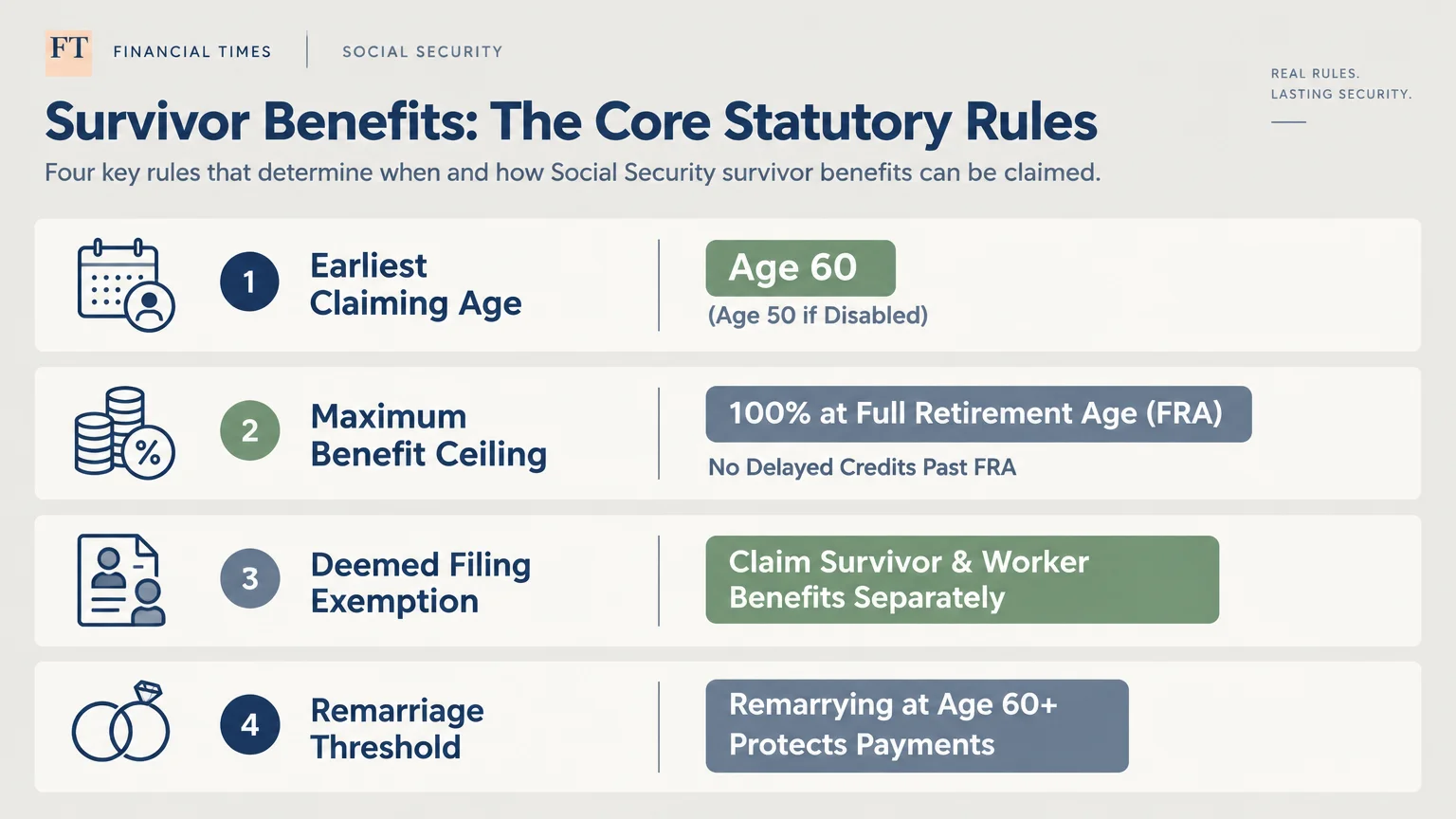
Survivor benefits follow different statutory guidelines than standard worker retirement benefits. Understanding these core distinctions prevents permanent financial reductions.
- Earliest claiming age: Surviving spouses can file at age 60, or age 50 if disabled.
- Maximum benefit ceiling: Survivor benefits cap at 100% at Full Retirement Age (FRA) and do not earn delayed credits.
- Deemed filing exemption: You can claim survivor benefits and standard retirement benefits at separate times.
- Remarriage threshold: Remarrying at age 60 or older protects your existing survivor payments.
1. Filing for Survivor Benefits at Age 60
The earliest age a non-disabled widow or widower can claim survivor benefits is age 60. However, filing at the earliest opportunity imposes the steepest permanent penalty.
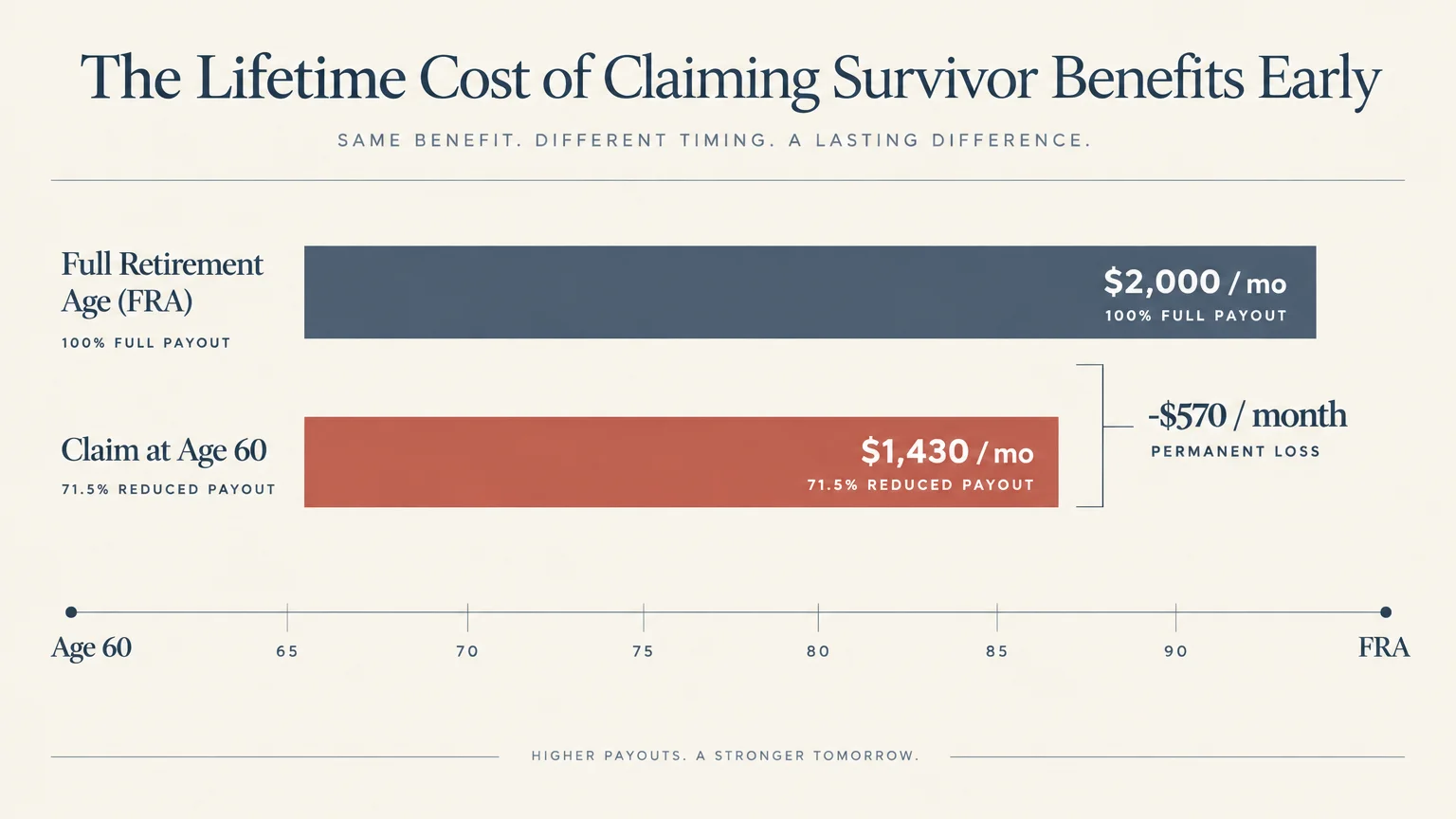
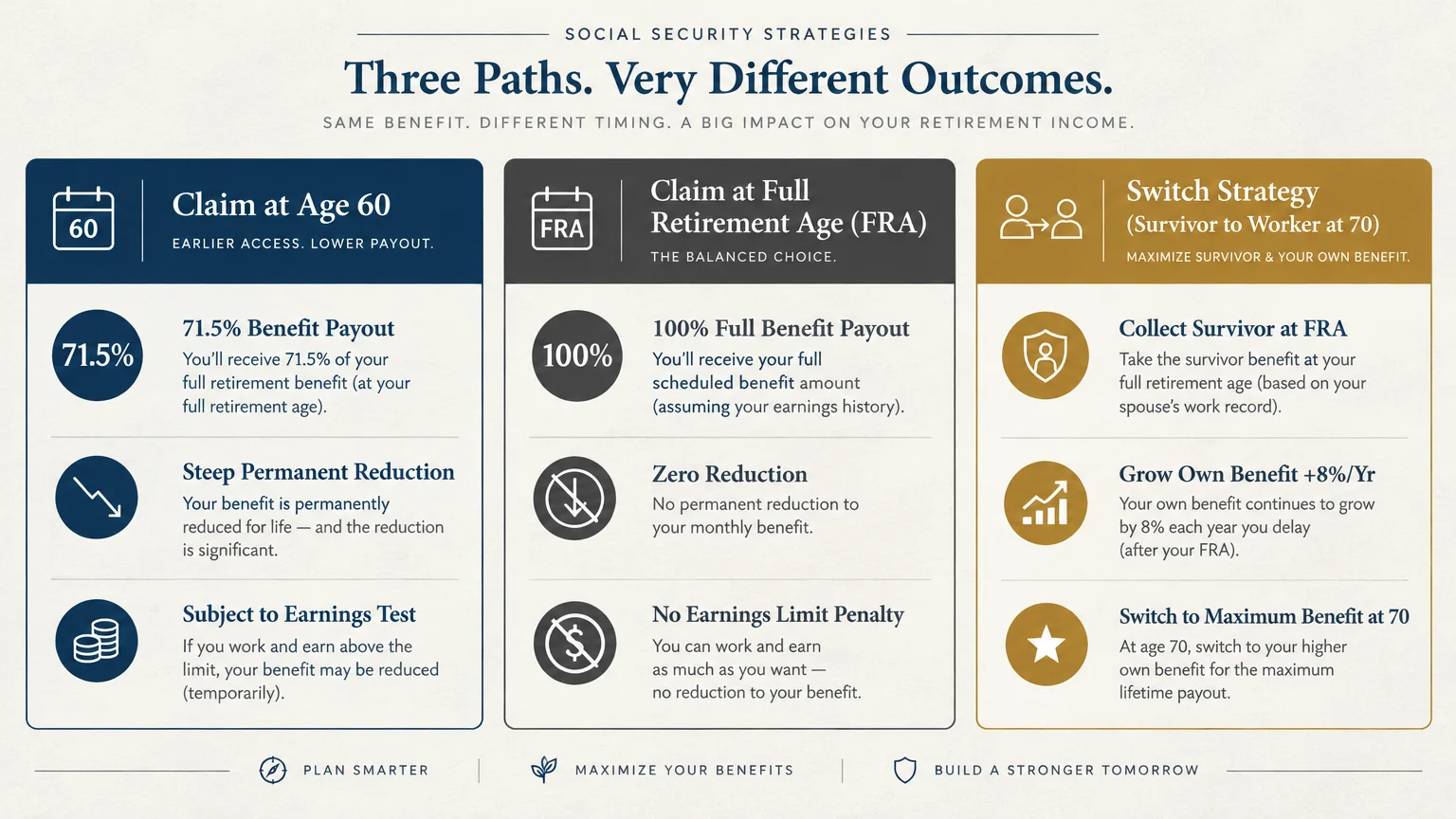
According to the Social Security Administration, claiming at age 60 reduces your survivor check to 71.5% of your deceased spouse’s basic benefit. This reduction remains locked in for the rest of your life.
For instance, if your deceased spouse had an earned benefit of $2,000 per month, claiming at age 60 cuts that payment down to $1,430. That is a permanent loss of $570 each month.
Every month you delay between age 60 and your Full Retirement Age incrementally restores that amount. Waiting until your full survivor age guarantees the complete 100% payout.
2. Confusing Your Survivor FRA with Standard Retirement FRA
Many people assume their survivor Full Retirement Age matches their regular retirement age. Conflating the two can lead you to claim too early or miscalculate your monthly income.
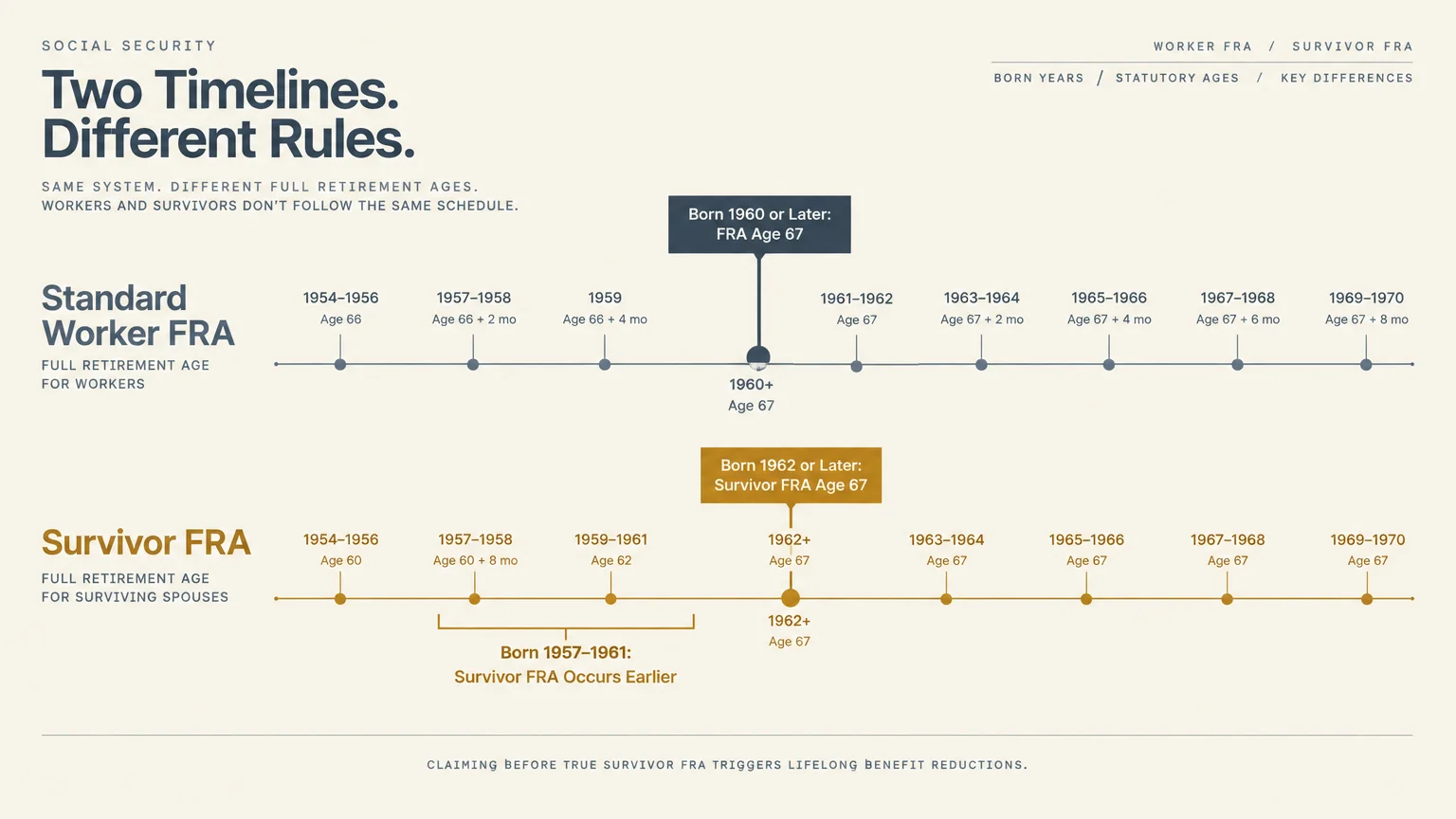
For standard worker benefits, Full Retirement Age is 67 for anyone born in 1960 or later. For survivor benefits, the age requirements follow a different historical schedule.
Survivor Full Retirement Age reaches 67 only for individuals born in 1962 or later. If you were born between 1957 and 1961, your survivor FRA occurs several months earlier than your worker FRA.
Reviewing your specific birth year on the Social Security schedule prevents accidental early filing penalties. Claiming even a few months before your true survivor FRA triggers lifelong benefit reductions.
“Social Security claiming decisions are permanent, and making the wrong move can cost you tens of thousands of dollars over a lifetime.” — Ed Slott, CPA and Retirement Specialist
3. Waiting Until Age 70 to Collect Survivor Benefits
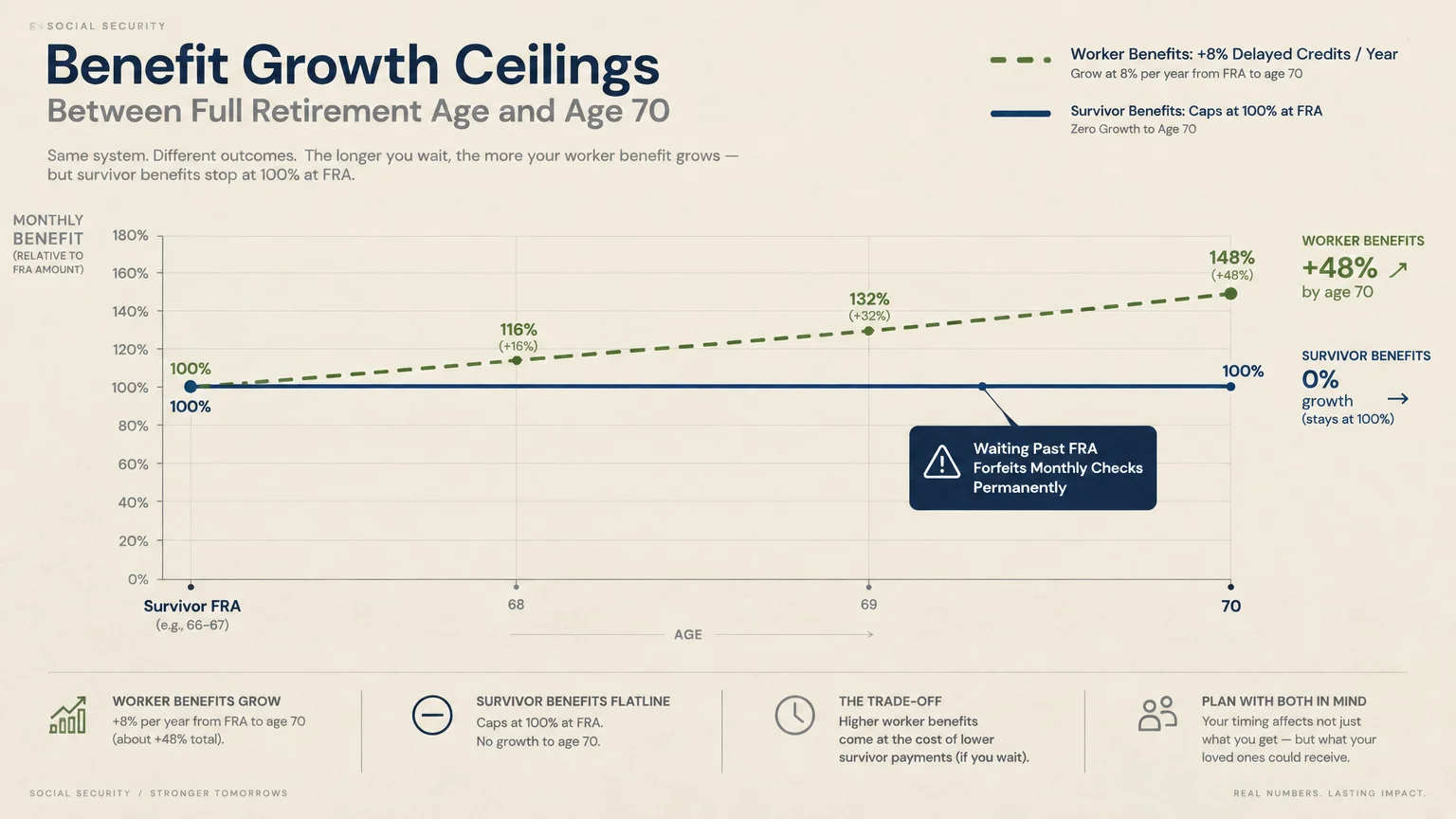
Worker retirement benefits accrue Delayed Retirement Credits of 8% per year between Full Retirement Age and age 70. However, this rule does not apply to survivor benefits.
Survivor benefits stop growing the moment you reach your survivor Full Retirement Age. Delaying your survivor claim past that milestone will not yield higher payments.
If your survivor FRA is 66 and 8 months, claiming at 67 or 70 simply forfeits months of rightful cash. That money is lost permanently without providing any increase in your monthly check.
You should always claim survivor benefits no later than your survivor Full Retirement Age. If you plan to delay a benefit until age 70, apply that strategy to your own retirement record instead.

4. Working While Collecting Benefits Before Full Retirement Age
Collecting survivor benefits early while continuing to work can trigger steep statutory deductions under the Social Security Retirement Earnings Test. The government withholds benefits once your wages pass strict annual caps.
In 2025, the earnings limit is $23,400 for those under Full Retirement Age all year. The Social Security Administration withholds $1 in benefits for every $2 earned above that limit.
In 2026, the annual threshold increases to $24,480. If you earn $34,480 in 2026, you exceed the limit by $10,000, causing $5,000 in benefits to be withheld.
In the calendar year you reach Full Retirement Age, higher limits apply. In 2025, the cap is $62,160 ($1 withheld per $3 over); in 2026, that figure rises to $65,160.
Once you reach Full Retirement Age, the earnings test disappears entirely. At that point, you can earn unlimited income from wages or self-employment without losing a single dollar.
5. Walking Down the Aisle Before Age 60
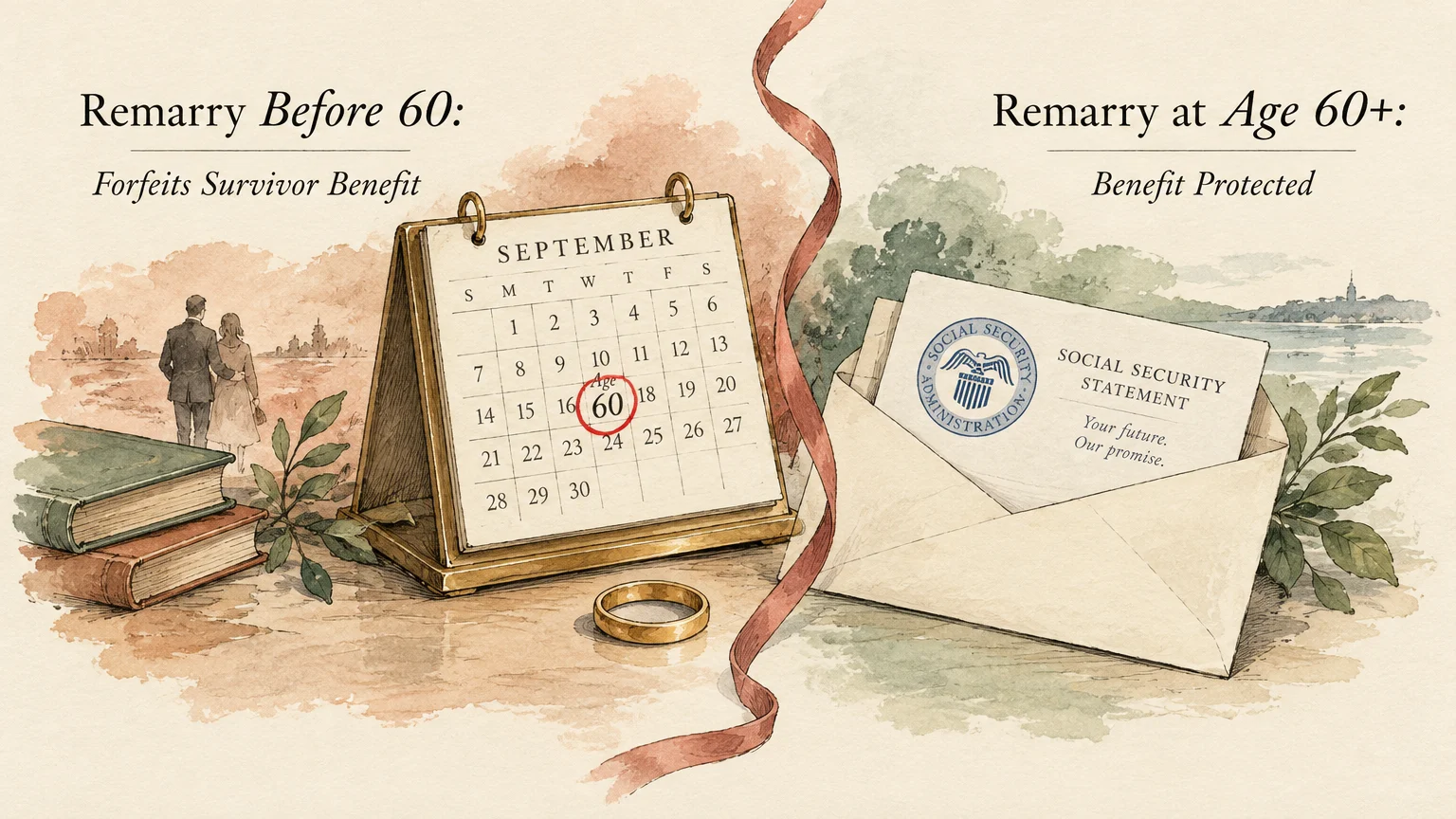
Falling in love later in life is wonderful, but legal remarriage alters your Social Security rights dramatically. Remarrying before age 60 eliminates your eligibility for survivor benefits on your deceased spouse’s record.
If you marry at age 59, your survivor benefits terminate for as long as that new marriage remains active. You forfeit your former spouse’s income until the subsequent marriage ends through death or divorce.
Waiting until age 60 or later changes the legal equation completely. Under federal guidelines, remarrying at or after age 60 does not disrupt your existing survivor benefits.
If your late spouse earned significantly more than your new partner, timing your wedding day carefully protects substantial retirement capital. Delaying the legal ceremony until your 60th birthday preserves your survivor income intact.
6. Claiming Both Benefits at the Same Time
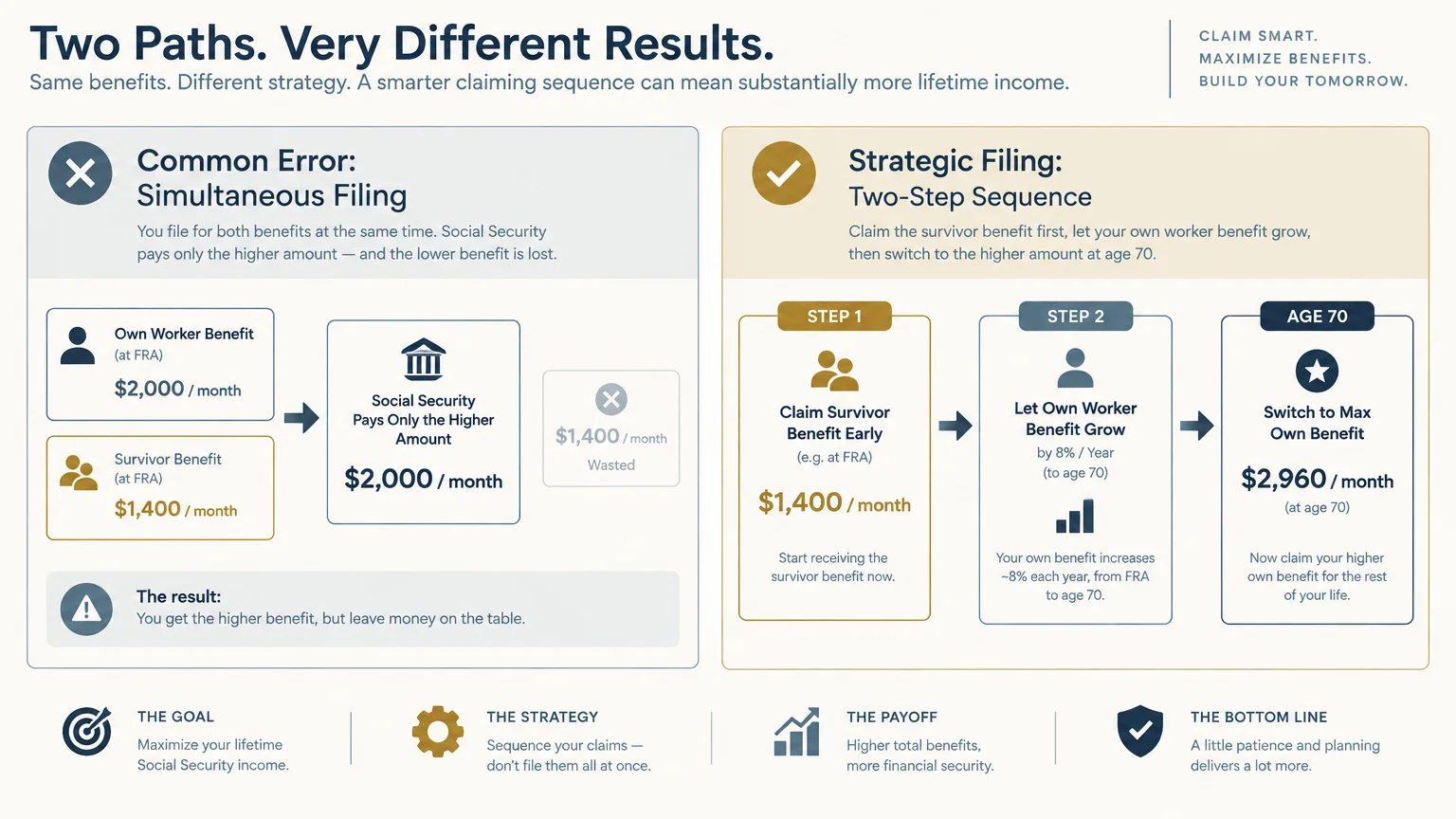
When you file for standard retirement benefits, the law treats you as having filed for spousal benefits automatically under deemed filing rules. Survivor benefits, however, are completely exempt from deemed filing.
This critical exemption gives surviving spouses powerful claiming flexibility. You can collect survivor benefits first while letting your personal worker benefit accumulate delayed credits until age 70.
Alternatively, you can claim your personal retirement benefit at age 62 and switch to your maximum survivor benefit once you reach survivor FRA. Claiming both records simultaneously wastes the chance to let one stream grow.
The Consumer Financial Protection Bureau encourages surviving spouses to analyze both earning records before filing. Comparing both paths ensures you build the highest possible lifetime cash flow.
“A financial plan is not just about numbers; it is about protecting yourself and your family against the unexpected.” — Suze Orman, Personal Finance Expert

7. Overlooking the Impact of an Early-Claiming Deceased Spouse
Your survivor benefit amount depends directly on the claiming choices your spouse made while alive. If your spouse claimed their retirement benefit early at age 62, a special rule limits your survivor payment.
This regulation is known as the Retirement Insurance Benefit Limitation, or RIB-LIM rule. Under RIB-LIM, your survivor benefit cannot exceed the higher of what your deceased spouse received or 82.5% of their full benefit.
Suppose your spouse had a Full Retirement Age benefit of $2,000 but filed early at 62, receiving $1,400 monthly. Your survivor benefit caps at $1,650, which is 82.5% of $2,000.
Even if you wait until your own Full Retirement Age, the RIB-LIM cap still applies. Knowing your spouse’s claiming history helps you set realistic expectations for your ongoing budget.

8. Missing the 10-Year Marriage Rule and Application Deadlines
Divorced individuals often assume they have no claim on a late ex-spouse’s earnings. In reality, surviving divorced spouses can collect full widow benefits if the union lasted at least 10 continuous years.
Ending a marriage after 9 years and 11 months permanently disqualifies you from claiming survivor benefits on that record. If you are negotiating a divorce later in life, staying legally married until the 10-year mark protects critical safety nets.
Another overlooked administrative deadline involves the Social Security lump-sum death payment. The federal government provides a one-time benefit of $255 to eligible surviving spouses or children.
You must formally apply for this $255 payment within two years of your spouse’s death. Missing this statutory window forfeits the funds permanently.
Comparing Your Survivor Benefit Options
Reviewing the structural trade-offs between different claiming ages helps clarify your best path forward. The following table summarizes key variables for non-disabled surviving spouses.
| Claiming Age | Percentage of Basic Benefit | Subject to Earnings Test? | Delayed Credits Earned? |
|---|---|---|---|
| Age 60 | 71.5% | Yes ($24,480 cap in 2026) | No |
| Age 62 | 81.0% to 82.5% | Yes ($24,480 cap in 2026) | No |
| Survivor FRA (66 to 67) | 100% | No (Unlimited earnings) | No |
| Age 70 | 100% (No extra credits) | No (Unlimited earnings) | No (Money forfeited if delayed past FRA) |

Recent Legal Changes: The End of the Government Pension Offset
For decades, public sector retirees suffered sharp reductions in survivor benefits due to the Government Pension Offset (GPO). The GPO previously docked survivor benefits by two-thirds of the worker’s government pension.
On January 5, 2025, the Social Security Fairness Act (Public Law 118-273) was signed into law, permanently repealing the GPO retroactive to January 2024. Public servants such as retired teachers, firefighters, and police officers no longer face this reduction.
If a public pension previously eliminated or lowered your survivor benefit, you are now entitled to the full amount. Review your account with Social Security to confirm your checks reflect current federal law.

When DIY Isn’t Enough: 4 Scenarios Requiring Expert Guidance
While basic survivor rules are straightforward, overlapping life situations create costly complexities. Seeking guidance from a certified financial planner or elder law attorney is vital in these circumstances.
- Managing dual pensions and survivor claims: Coordinating complex tax brackets with newly restored survivor benefits requires careful income distribution planning.
- Caring for a disabled adult child: Surviving parents caring for a child disabled before age 22 can collect benefits at any age, bypassing standard age reductions.
- Balancing business ownership with early claims: Navigating business income under the Retirement Earnings Test requires distinct accounting strategies.
- Contemplating remarriage in your late 50s: Evaluating whether to delay legal marriage until age 60 requires a comprehensive comparison of both partners’ lifetime benefits.
Organizations like the National Council on Aging offer localized counseling resources to guide seniors through these financial crossroads. Getting an objective review prevents irreversible mistakes.
Frequently Asked Questions About Survivor Benefits
Can I switch from my survivor benefit to my own retirement benefit later?
Yes. You can collect a reduced survivor benefit as early as age 60 while letting your own retirement benefit accrue delayed credits up to age 70.
Do survivor benefits increase with annual cost-of-living adjustments?
Yes. Survivor benefits receive the same annual Cost-of-Living Adjustment (COLA) approved by Congress, ensuring your checks rise alongside inflation over time.
Are Social Security survivor benefits taxable?
Survivor benefits are subject to federal income taxes under the same provisional income rules as regular benefits, according to the Internal Revenue Service. Up to 85% of your benefits may be taxable depending on your total income.
What happens if my deceased spouse and I were both receiving benefits?
When one spouse passes away, the smaller of the two monthly checks stops. You do not keep both payments; you simply transition to the higher monthly amount.
Securing Your Financial Path Forward
Navigating financial choices while processing loss is deeply challenging, but you do not need to make every decision all at once. Take your time to review work histories, analyze earnings records, and confirm your exact survivor Full Retirement Age.
Careful planning ensures you protect your hard-earned benefits and establish enduring financial stability for years to come. This is educational content based on general financial principles for seniors. Individual results vary based on your situation. Always verify current benefit amounts, tax rules, and program eligibility with official government sources.
Last updated: February 2026. Benefit amounts, tax rules, and program details change annually—verify current figures with official government sources.









Leave a Reply