

Relocating to a historic town lets you enjoy rich cultural heritage without sacrificing your retirement nest egg. You can stroll brick-paved streets while preserving your monthly cash flow through strategic state tax benefits.
Finding the right destination requires balancing architectural character against essential living expenses like property taxes, housing values, and healthcare access. State tax policies on Social Security and pensions can alter your annual budget by thousands of dollars.
This guide explores ten charming historic towns across the United States that deliver both timeless beauty and favorable financial conditions for retirees.

Balancing Historic Charm With Retirement Reality
Historic districts offer unmatched architecture and vibrant community life. However, maintaining an older home often brings unexpected maintenance expenses and strict preservation guidelines.
You must evaluate state taxes on your retirement income before falling in love with a community. Income tax exemptions on pensions and retirement accounts vary significantly across state lines.
Property taxes also play a crucial role in your long-term housing affordability. Some states provide generous homestead exemptions to senior residents, while others reassess older homes at aggressive market rates.
Healthcare accessibility deserves equal weight in your decision. Living in small historic towns is wonderful, but you must ensure specialized medical clinics remain within a reasonable driving distance.
For example, if your combined household pension income is $5,000 monthly, living in a state with a complete pension exemption preserves thousands in annual cash flow compared to high-tax states.
Before finalizing your move, review your anticipated monthly benefits with the Social Security Administration. Understanding your exact net income helps you budget accurately for housing costs.
“Retirement is not the end of the road. It is the beginning of the open highway.” — Jean Chatzky, Financial Editor

10 Charming Historic Towns for Your Retirement
1. St. Augustine, Florida
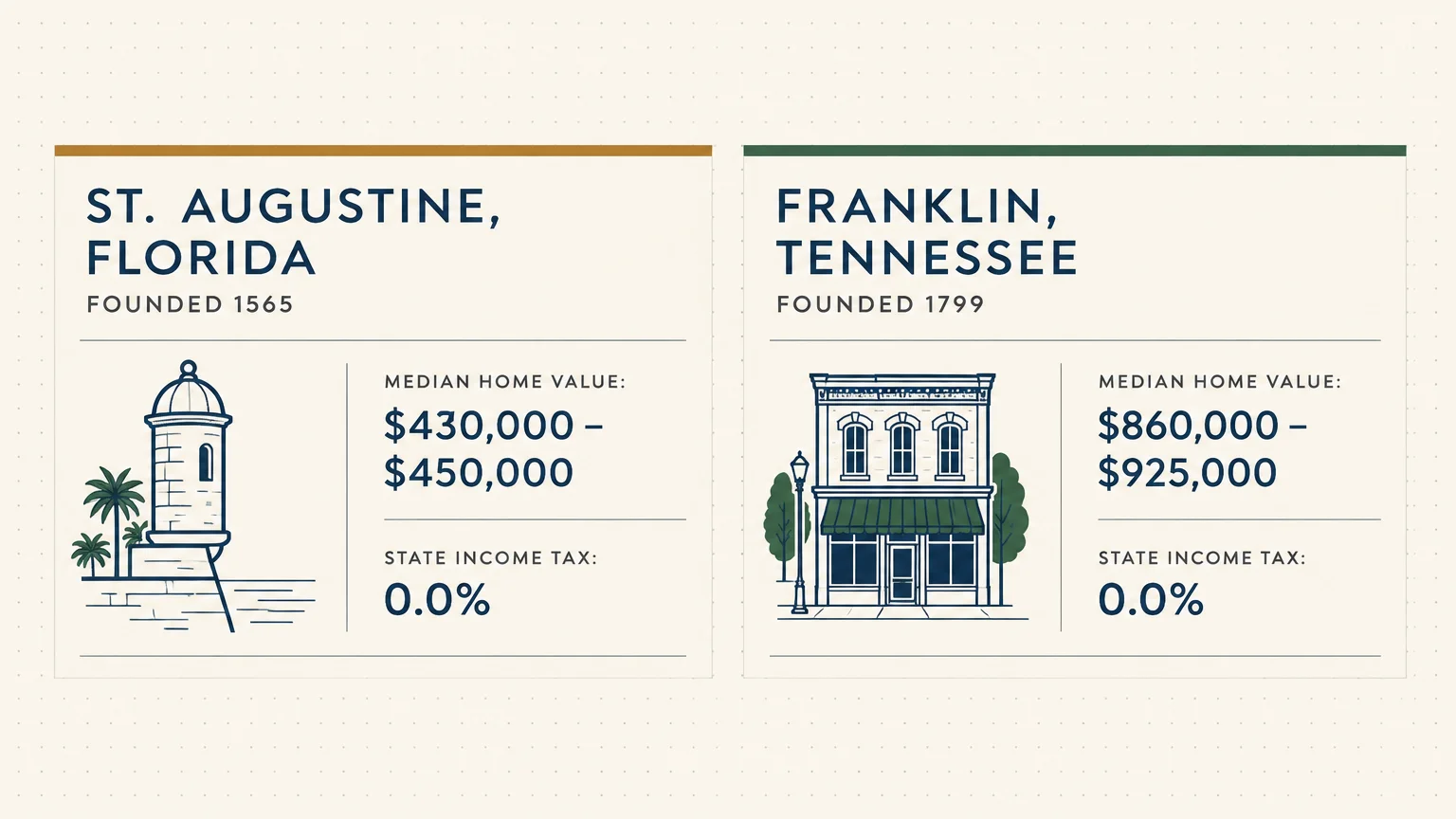
Founded in 1565 by Spanish explorer Pedro Menéndez de Avilés, St. Augustine stands as the oldest continuously inhabited European-established settlement in the contiguous United States.
The city captivates visitors with Spanish colonial architecture, cobblestone alleys, and the historic Castillo de San Marcos fortress overlooking the Matanzas River.
From a financial perspective, Florida levies a 0.0% personal state income tax. This means your Social Security payouts, corporate pensions, and IRA distributions incur zero state tax liability.
Current median home values in St. Augustine hover between $430,000 and $450,000. Retirees benefit from excellent regional medical infrastructure through nearby health networks in St. Johns County and Jacksonville.
2. Franklin, Tennessee
Founded in 1799 and named after Benjamin Franklin, this community blends antebellum heritage with a thriving, modern town center.
The 16-block National Register Historic District features restored Victorian storefronts, boutique shops, and historic sites like the Carter and Carnton plantations from the 1864 Battle of Franklin.
Tennessee enforces no state income tax on earned wages, pensions, 401(k) distributions, or Social Security benefits. That tax policy preserves substantial capital for retirees drawing from investment accounts.
Franklin carries a higher-than-average cost of living, with median home prices ranging between $860,000 and $925,000. You will enjoy world-class healthcare access and vibrant cultural festivals just 20 miles south of Nashville.
3. Savannah, Georgia
General James Oglethorpe founded Savannah in 1733 as America’s first planned city. The downtown landscape showcases 22 surviving historic squares shaded by live oaks draped in Spanish moss.
Walking through the Historic Landmark District reveals Federal, Gothic Revival, and Italianate architecture. The city’s flat topography provides an easily walkable urban environment for daily strolls.
Georgia offers generous tax exclusions for seniors, fully exempting Social Security benefits. Residents aged 65 and older can exclude up to $65,000 per person—or $130,000 for a married couple—in qualifying retirement income.
Median home prices across Savannah sit between $320,000 and $340,000, though landmark district homes command higher premiums. Two major hospital networks provide comprehensive cardiac, orthopedic, and geriatric care.
4. Beaufort, South Carolina
Chartered in 1712, Beaufort is South Carolina’s second-oldest city. Its 304-acre historic district showcases breathtaking antebellum mansions, moss-hung oaks, and waterfront vistas along the Intracoastal Waterway.
The town offers a relaxed Lowcountry pace where walking paths and waterfront parks encourage an active outdoor lifestyle.
South Carolina fully exempts Social Security benefits from state income tax. Qualified residents aged 65 and older can also deduct up to $15,000 of other taxable retirement income.
Homeowners aged 65 and older receive a $50,000 Homestead Exemption off the fair market value of their primary residence. Median home values currently range from $410,000 to $430,000.
5. Williamsburg, Virginia
Williamsburg served as the capital of the Virginia Colony from 1699 to 1780. Today, it hosts Colonial Williamsburg, a 301-acre living-history museum packed with restored eighteenth-century buildings.
Living here provides access to lifelong learning programs at the College of William & Mary and miles of paved community walking trails.
Virginia does not tax Social Security benefits. The state also provides an Age Deduction of up to $12,000 for individuals aged 65 and older, subject to statutory income limits.
Typical home values in Williamsburg range between $430,000 and $450,000. Healthcare is anchored by Riverside Doctors’ Hospital and Sentara Williamsburg Regional Medical Center.
6. Galena, Illinois
Nestled among rolling hills in northwest Illinois, Galena preserves over 85% of its buildings within a National Register Historic District.
The town is famous for nineteenth-century brick architecture, boutique shops along Main Street, and the Ulysses S. Grant Home State Historic Site.
Illinois completely exempts qualified retirement distributions—including traditional IRAs, 401(k) plans, pensions, and Social Security—from state income tax.
Median home values average between $305,000 and $310,000, making it an affordable choice among charming towns to retire. Midwest Medical Center and facilities in nearby Dubuque ensure dependable local healthcare services.
7. Cape May, New Jersey
Designated a National Historic Landmark in 1976, Cape May is widely celebrated as America’s oldest seaside resort.
The coastal town features more than 600 preserved Victorian wooden structures, complemented by pristine Atlantic beaches and gas-lit streets.
New Jersey does not tax Social Security benefits. Under state retirement tax rules, couples aged 62+ earning under $100,000 can exclude up to $100,000 of pension and IRA income.
Real estate reflects strong coastal resort demand, with median home prices sitting between $850,000 and $950,000+. Cape Regional Medical Center delivers reliable community healthcare close to residential neighborhoods.
8. Fredericksburg, Texas
German immigrants founded Fredericksburg in 1846, establishing a unique frontier heritage visible in historic limestone architecture and traditional Sunday Houses.
The town boasts the National Museum of the Pacific War, renowned Hill Country wineries, and a bustling, walkable Main Street district.
Texas levies zero personal state income tax, shielding Social Security and investment withdrawals from state-level taxes.
Median home prices hover between $540,000 and $575,000. Hill Country Memorial Hospital provides top-ranked medical care right in town, offering reassuring support for retirees.
9. Eureka Springs, Arkansas
Eureka Springs was founded in 1879 around Victorian-era natural healing springs in the Ozark Mountains.
Its entire commercial and residential historic center is listed on the National Register of Historic Places, featuring winding mountain roads and ornate gingerbread woodwork.
Arkansas completely exempts Social Security benefits from state income tax. The state also allows retirees to exempt up to $6,000 of private or employment-based pension income annually.
Home values are gentle on fixed budgets, with median prices between $315,000 and $325,000. The town fosters a vibrant arts colony that welcomes creative retirees seeking an eccentric mountain retreat.
10. Taos, New Mexico
Taos blends Spanish colonial history dating back to its 1796 plaza with the ancient culture of Taos Pueblo, an inhabited UNESCO World Heritage site.
Retirees enjoy dramatic Sangre de Cristo mountain vistas, historic adobe architecture, and a century-old creative arts community.
Social Security benefits are 100% exempt from New Mexico state income tax for single filers with an adjusted gross income up to $100,000, or $150,000 for couples.
Median home prices fall between $420,000 and $450,000. Holy Cross Hospital serves primary healthcare needs, while major regional specialists operate in Santa Fe, roughly 70 miles away.
Comparing Costs Across Historic Retirement Towns
Evaluating potential relocation spots requires comparing living expenses alongside historic charm. The following table outlines real estate benchmarks and senior tax treatments for these popular destinations.
| Town & State | Typical Home Price | Social Security Tax | Key Senior Tax Advantage | Historic Character |
|---|---|---|---|---|
| St. Augustine, FL | $430,000–$450,000 | No State Tax | 0.0% personal state income tax | Spanish Colonial, 1565 settlement |
| Franklin, TN | $860,000–$925,000 | No State Tax | No state income tax on retirement income | Victorian, Civil War heritage |
| Savannah, GA | $320,000–$340,000 | Fully Exempt | Up to $65k/person retirement income exclusion (65+) | 22 planned squares, Antebellum |
| Beaufort, SC | $410,000–$430,000 | Fully Exempt | $50k Homestead Exemption & $15k income deduction (65+) | Lowcountry, Antebellum coastal |
| Williamsburg, VA | $430,000–$450,000 | Fully Exempt | Up to $12k Age Deduction for seniors 65+ | Colonial capital, living museum |
| Galena, IL | $305,000–$310,000 | Fully Exempt | 100% exemption for qualified pensions and IRAs | 19th-century brick, 85% historic district |
| Cape May, NJ | $850,000–$950,000+ | Fully Exempt | Exclusion up to $100k joint income (62+ under income cap) | Victorian seaside resort |
| Fredericksburg, TX | $540,000–$575,000 | No State Tax | 0.0% personal state income tax | German limestone Sunday Houses |
| Eureka Springs, AR | $315,000–$325,000 | Fully Exempt | $6,000 annual retirement income exemption | Victorian mountain spa architecture |
| Taos, NM | $420,000–$450,000 | Exempt (under income limits) | 100% Social Security exemption under AGI thresholds | Pueblo revival, Spanish colonial plaza |
Hidden Costs of Historic District Living
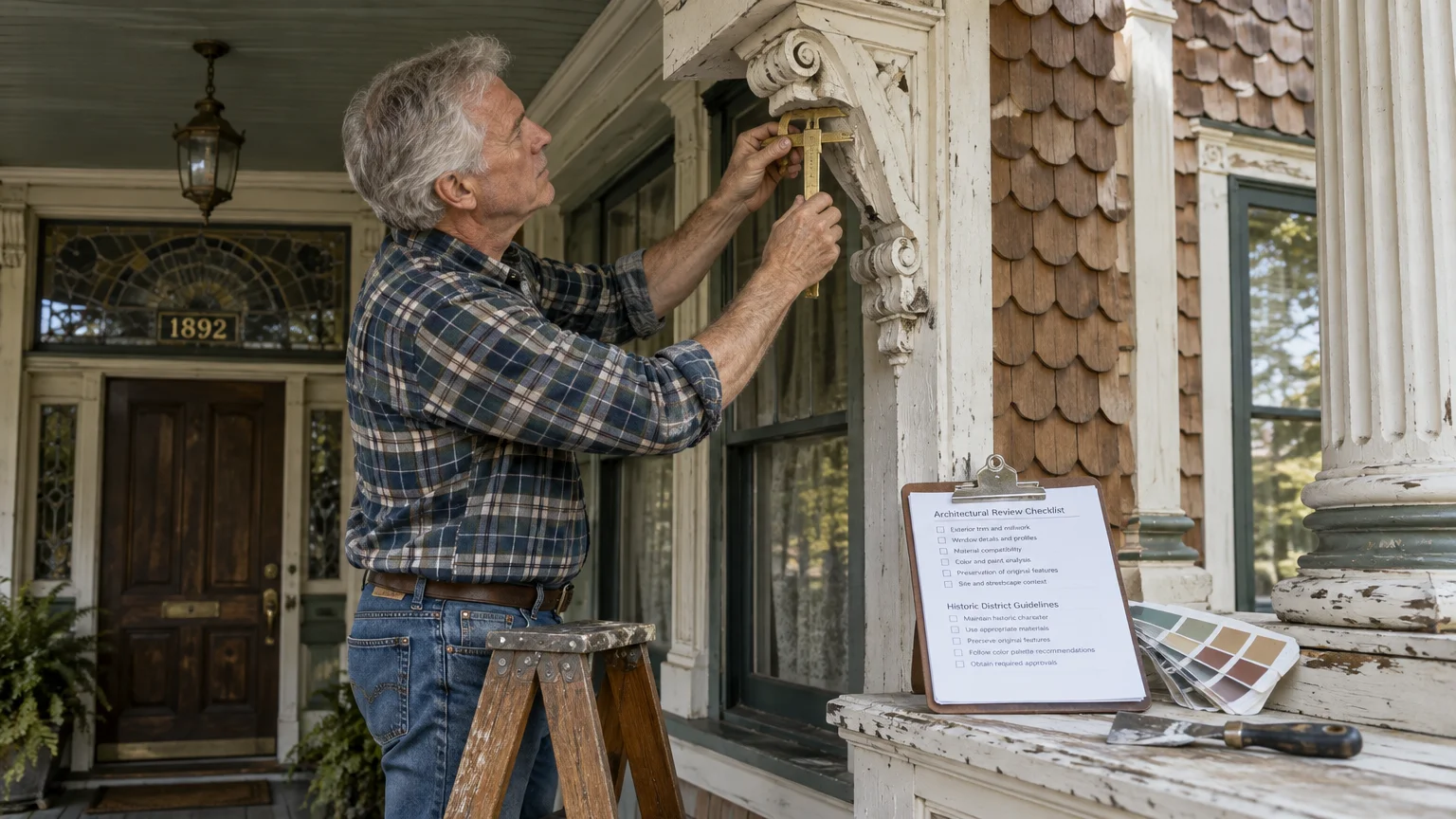
Historic homes bring undeniable visual character, but they often conceal substantial upkeep costs.
You should review local historic preservation commission rules before buying. Strict architectural guidelines can dictate exterior paint colors, window replacements, and roofing materials.
Specialty contractors often charge premium labor rates for restoring historic masonry or woodwork. According to guidance from the U.S. Department of Housing and Urban Development, structural repairs on aging foundations require specialized inspections.
Insurance premiums can also run higher on historic properties. Older electrical wiring, outdated plumbing, and unique structural components increase underwriting risks for property insurers.
You can research consumer finance protections and lending standards through the Consumer Financial Protection Bureau to understand home equity options for restoration projects.
“A big part of financial freedom is having your heart and mind free from worry about what-ifs.” — Suze Orman, Personal Finance Author

Common Mistakes to Avoid When Relocating
Relocating during retirement involves significant emotional and financial adjustments. Avoiding a few common mistakes can save your nest egg from unexpected strain.
- Skipping specialized structural inspections: Standard home inspectors frequently miss lime mortar decay, chimney settling, or obsolete knob-and-tube wiring hidden inside vintage walls.
- Miscalculating future property taxes: Tax rates often jump significantly after a sale because county assessors recalculate values based on the new purchase price.
- Underestimating peak tourist traffic: Historic resort communities experience heavy seasonal crowds that can disrupt quiet routines and clog local roadways.
- Ignoring medical travel times: Ensure that emergency departments and specialized physicians are located within a manageable 30-minute drive from your neighborhood.
Taking time to rent for a season before purchasing helps you assess whether a town’s rhythm matches your retirement goals.

Finding the Right Advisor for Relocation Planning
Relocating across state lines impacts your tax bracket, estate plan, and daily retirement budget. A qualified professional helps you navigate these cross-border complexities smoothly.
Consider working with a fee-only Certified Financial Planner if you are selling a long-time primary residence. They can calculate your capital gains exposure and help you manage moving expenses.
Engage an estate planning attorney if your healthcare directives or wills need updates under your new state’s legal codes. Powers of attorney and healthcare proxies must comply with local state laws.
Consult a tax professional if you hold multiple retirement income streams. They will identify state-specific deductions and verify current tax brackets with the Internal Revenue Service.
Frequently Asked Questions
Are historic homes more expensive to insure in retirement?
Yes, insuring older properties usually costs more due to outdated wiring, antique building materials, and higher historic replacement costs. Many insurers require specialized historic property riders.
Which historic town is the most tax-friendly for retirees?
St. Augustine, Florida and Fredericksburg, Texas offer no state income tax at all. Galena, Illinois is also exceptionally tax-friendly because Illinois fully exempts all qualified retirement distributions.
How do historic preservation commissions impact home renovations?
Preservation commissions regulate exterior changes, including window styles, paint colors, and structural additions. You must obtain formal approval before beginning exterior renovation work.
Does Social Security count as taxable income in all historic towns?
No, most states highlighted in this guide completely exempt Social Security benefits. New Mexico exempts benefits for individuals with adjusted gross income under $100,000 or married couples under $150,000.
Choosing to retire in a historic town offers a rewarding blend of timeless beauty, walkable neighborhoods, and rich cultural traditions. Taking the time to evaluate state tax structures, local healthcare services, and housing maintenance requirements ensures your retirement remains secure and fulfilling.
The information in this guide is meant for educational purposes. Your specific circumstances—including income, benefits, tax situation, and health needs—may require different approaches. When in doubt, consult a licensed financial advisor or tax professional.
Last updated: February 2026. Benefit amounts, tax rules, and program details change annually—verify current figures with official government sources.









Leave a Reply