
The Safety Net You Didn’t Know You Had: The PBGC
If you worked for a private corporation that sponsored a traditional defined benefit pension, you might assume your monthly payout is guaranteed no matter what happens to the company. While your pension is protected, that protection is not infinite. Private-sector pensions are insured by a federal agency called the Pension Benefit Guaranty Corporation (PBGC). If your former employer declares bankruptcy or cannot meet its pension obligations, the PBGC steps in to ensure you still receive a retirement check.
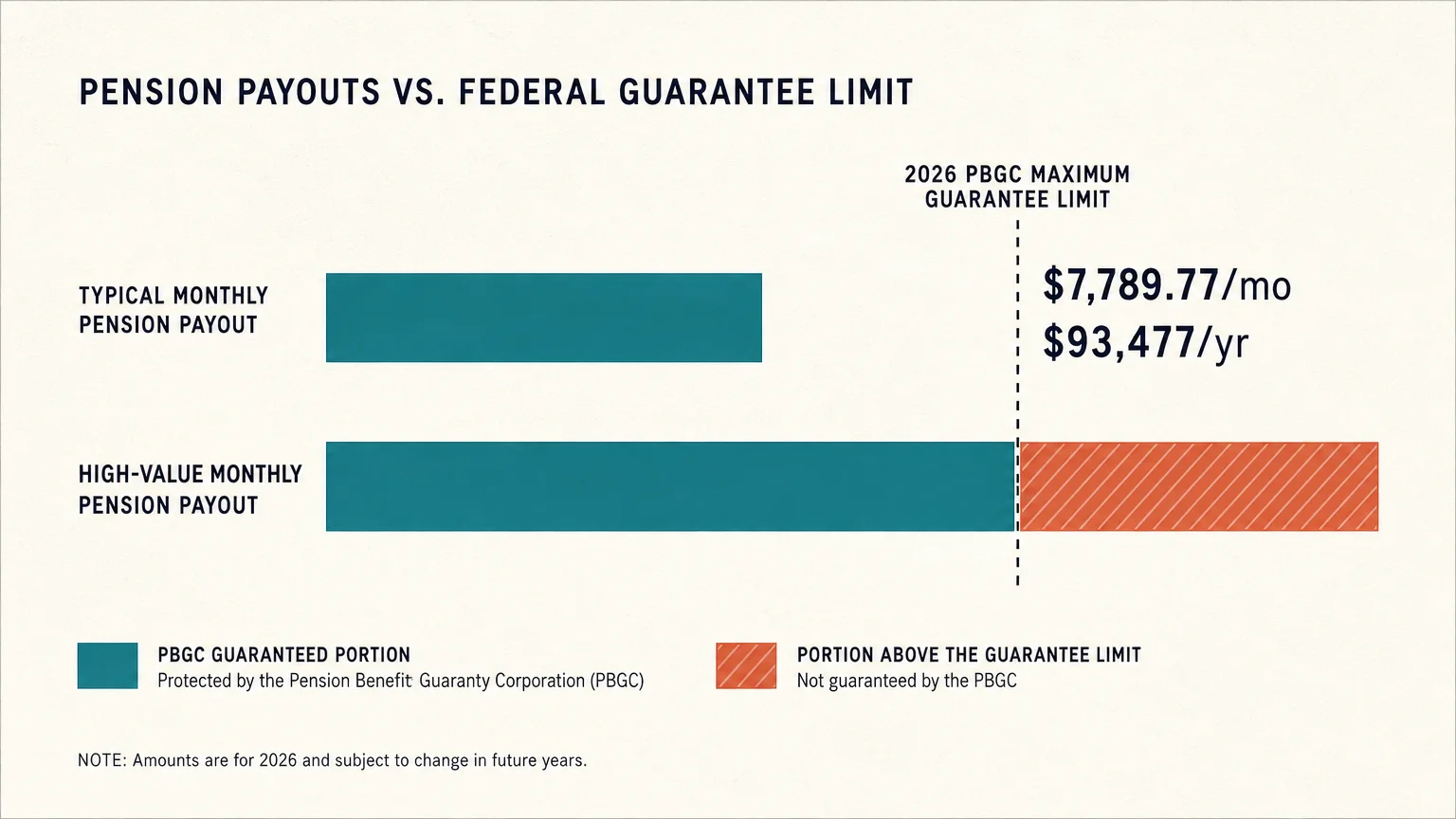
However, the PBGC strictly caps the amount they will pay. For a single-employer plan in 2026, the maximum guaranteed payout for a 65-year-old retiree electing a straight-life annuity is $7,789.77 per month, which translates to roughly $93,477 annually. While this covers the vast majority of middle-class workers, highly compensated employees anticipating six-figure annual pension payouts could see their benefits severely slashed if their employer folds.
Furthermore, this maximum limit fluctuates based on your age and the structure of your payout. If you retire early at age 55, the PBGC ceiling drops significantly because you will be collecting checks for a longer period. Similarly, if you choose a joint-and-survivor annuity to protect your spouse, the PBGC maximum limit is reduced to account for the extended timeline of two lifetimes.







Good summary, most of which I knew prior but helpful refreshment. Biggest advantage is state (in this case IA) elimination of taxes on pension and related benefits.
I think taking a lump sum is risky i took monthly payments
I would have received a $2100/monthly pension. No spouse. I took a lump sum and grew that into 7 figures. I retired at 51yo and started taking out 40,000/yr at 60yo. I now have RMDs. My RMD in 2026 is $78,900. I slowly have a large portion of my IRA to leave heirs. My lump sum buyout worked great for me.
How long did it take to ‘grow’ your lump sum like that? Just curious.
That information is very informative. Young people should pay good attention to your information. They don’t realize you have to start planning for your retirement at a young age.
I taught my sons to save from their 1st paycheck I to a ROTH-IRA. They should look at this savings as a bill that must be paid every paycheck. They should be fine when they retire.
We’ll SEE huh? Barring (avoiding), LIFE’s unforeseen events (e.g. weddings, births, funerals, car and/or home repairs. There will ALWAYS be the unforeseen. Believe me. JS (Just sayin)
Who did? Young folks don’t listen at THAT age. I didn’t, as most of us reading this article DIDN’T. (just be Honest).
have not seen yet
How do you get a tax break on your pension?
Remember that if you need to go to a ‘Nursing home’ your savings will be depleted until you are broke….after that it’s covered by Medicaid.
In other words…the person who doesn’t have a dime saved gets Nursing home care for free while the person who saved gets shafted for doing the ‘right thing’ and saving for retirement.