

You might expect your tax bill to shrink once you stop working, but the rules change dramatically your first retirement year. The tax code suddenly treats your income, savings accounts, and routine deductions through an entirely different lens.
Navigating this shift requires learning new IRS guidelines before unexpected penalties drain your savings. Understanding these adjustments helps you keep more cash in your wallet.
From vanishing payroll taxes to strict withdrawal deadlines, here are the essential tax changes you will encounter during your transition into retirement.
1. Automatic Paycheck Withholding Stops Completely
During your career, your employer handled tax withholding automatically on every paycheck. When you retire, that automatic safety net disappears instantly.
You now become personally responsible for calculating and submitting your tax payments throughout the calendar year. Failing to plan ahead can result in an unexpected tax bill next April.
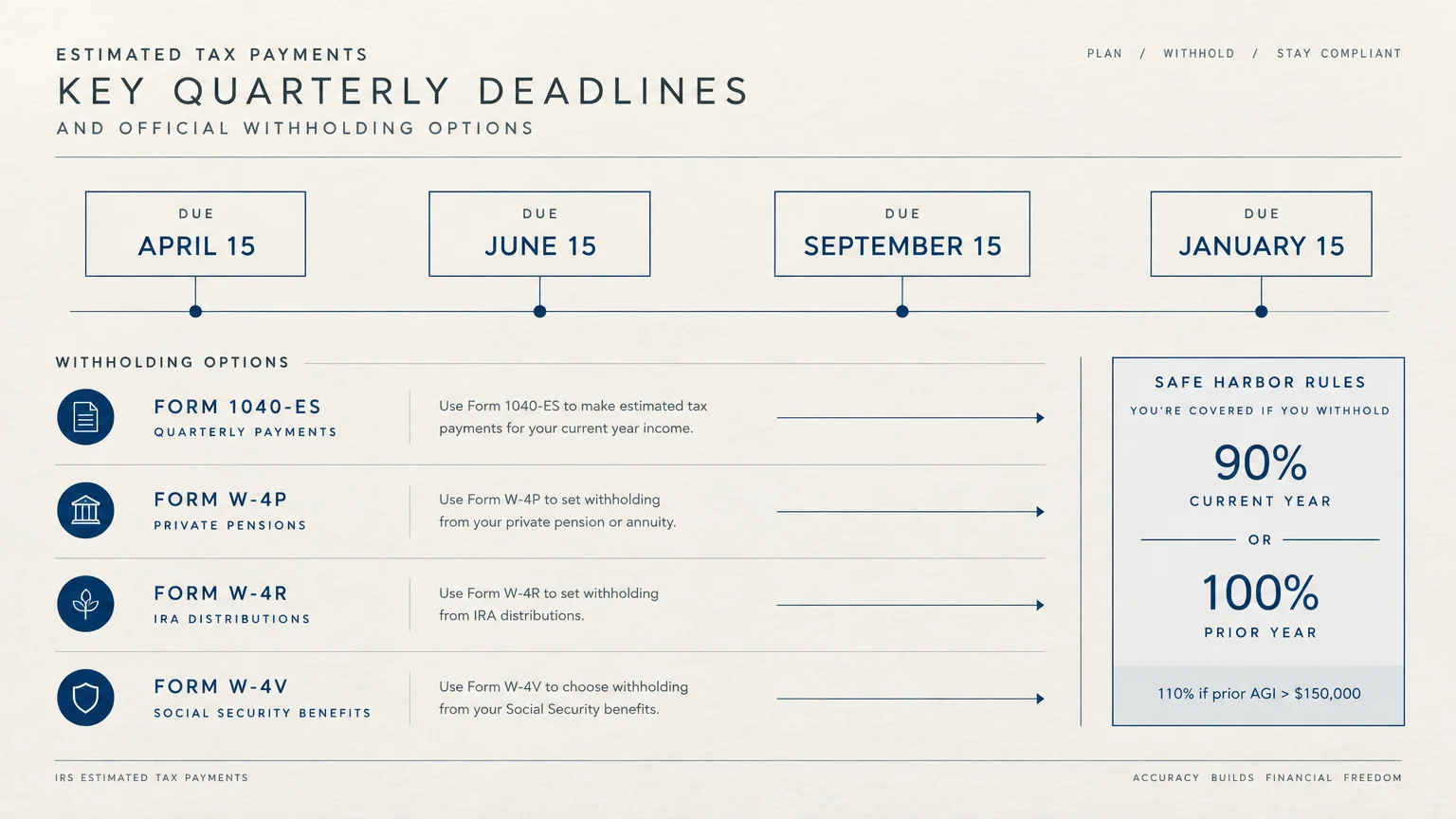
You can manage this responsibility using quarterly estimated payments via IRS Form 1040-ES. The Internal Revenue Service (IRS) schedules these due dates on April 15, June 15, September 15, and January 15.
Alternatively, you can establish voluntary withholding directly on your income distributions. Submit Form W-4P for pensions, Form W-4R for IRA withdrawals, or Form W-4V for Social Security benefits.
Remember the safe harbor requirements to avoid penalties. You must pay at least 90% of your current year tax liability or 100% of your prior year tax liability.
If your previous year adjusted gross income exceeded $150,000, your safe harbor target increases to 110%.
2. FICA Payroll Taxes Disappear on Your Withdrawals
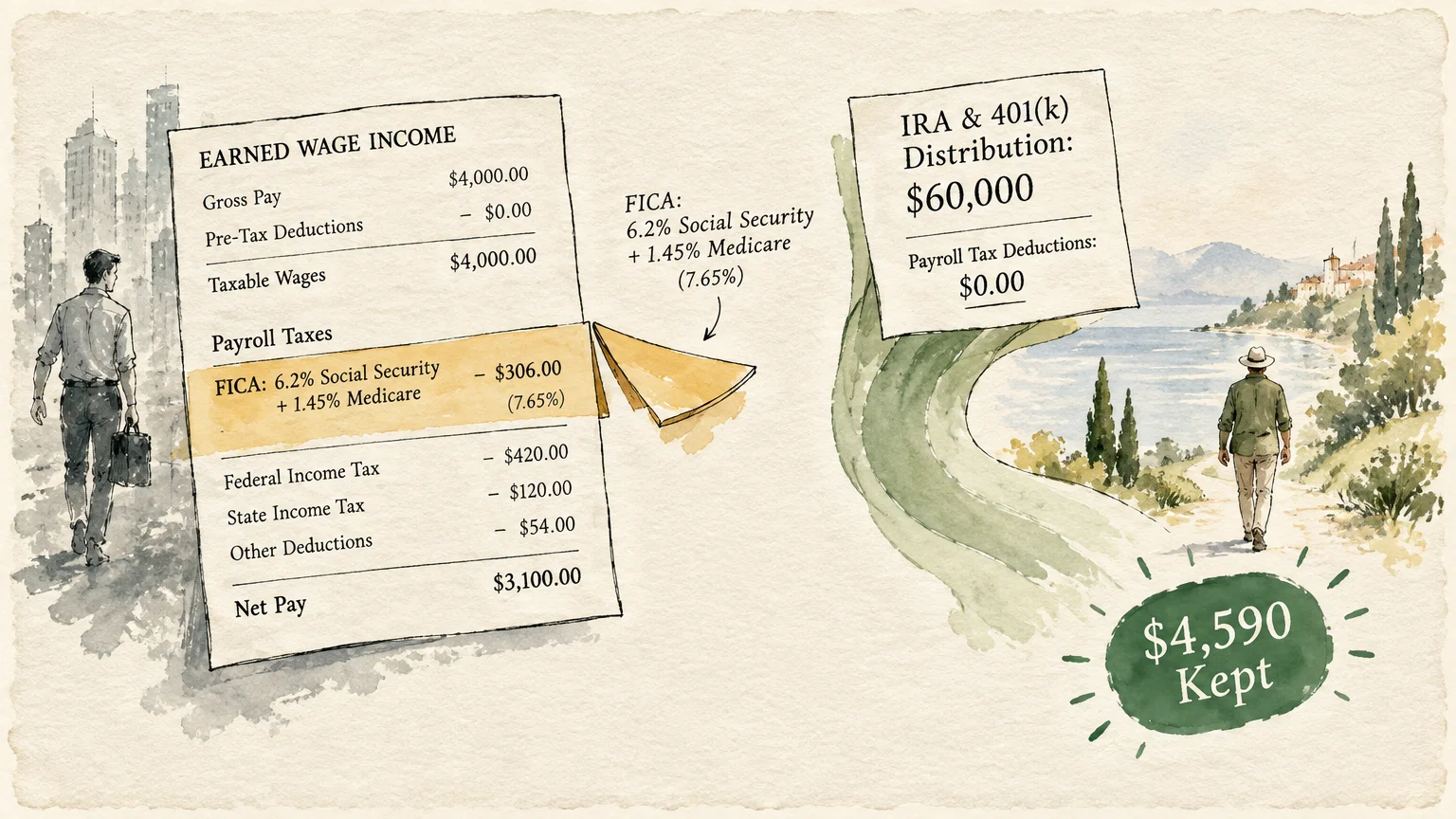
One immediate financial relief in retirement is the elimination of FICA payroll taxes on portfolio income. As an employee, you paid 7.65% on every dollar earned.
This payroll tax consists of 6.2% for Social Security and 1.45% for Medicare. Higher earners often paid an additional 0.9% Medicare surtax on wages.
Retirement income operates under different rules. Distributions from traditional IRAs, 401(k) accounts, private pensions, and fixed annuities do not trigger FICA taxes.
For example, taking a $60,000 distribution from your IRA saves you $4,590 compared to earning that same amount from a job. That extra savings stays in your account.
3. Social Security Benefits Face Provisional Income Taxes
Many new retirees believe Social Security income is completely tax-free. In reality, up to 85% of your benefits can become subject to federal income taxes.
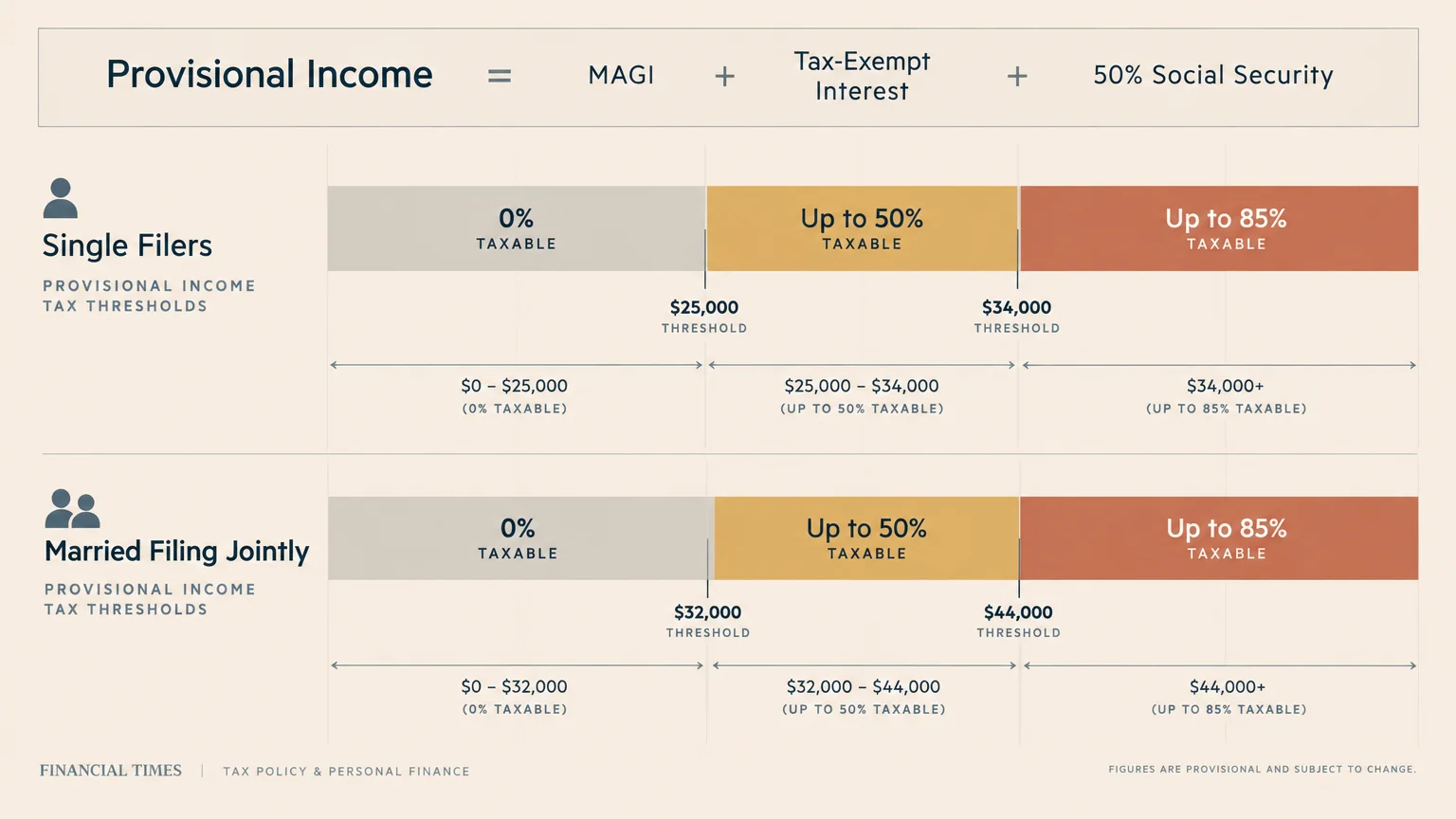
The IRS measures your liability using a metric called provisional income. You calculate this by adding your modified adjusted gross income, tax-exempt interest, and 50% of your annual Social Security benefits.
Congress established these tax brackets decades ago without linking them to inflation adjustments. As a result, modest retirement incomes frequently trigger taxation.
For single filers, provisional income between $25,000 and $34,000 triggers taxes on up to 50% of benefits. Exceeding $34,000 subjects up to 85% of benefits to taxation.
For married couples filing jointly, the 50% tax tier begins at $32,000, while the 85% tier starts at $44,000. Coordinating withdrawals from Roth accounts can help keep your provisional income below these limits.
4. Medicare IRMAA Surcharges Hit via a Two-Year Lookback
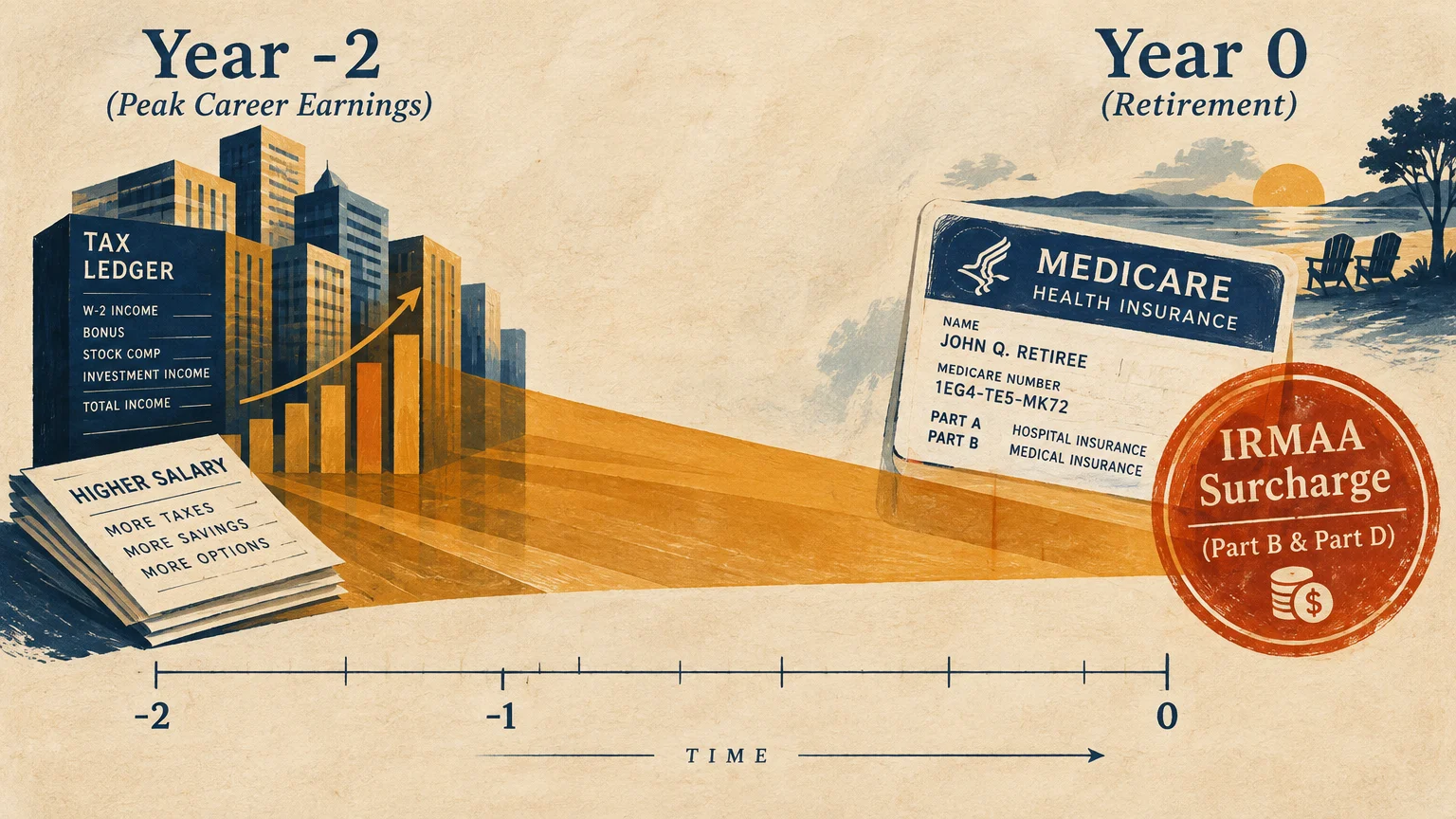
When you enroll in Medicare, your premiums depend directly on your recent tax returns. The government evaluates your Modified Adjusted Gross Income (MAGI) using a two-year lookback window.
According to Medicare.gov, higher earners must pay the Income-Related Monthly Adjustment Amount (IRMAA) surcharge for Part B and Part D coverage.
This structure creates an unfair surprise for new retirees. Your current premiums reflect your peak earning years when you were still collecting a full-time salary.
Fortunately, you can dispute this surcharge if you experienced a qualifying life-changing event. Work stoppage or work reduction qualifies you for a formal recalculation.
File Form SSA-44 with the Social Security Administration (SSA) along with proof of your retirement. This step allows officials to base your Medicare premiums on your new, lower income.

5. The 401(k) Still-Working RMD Exception Expires
If you worked past normal retirement age, you may have used the IRS still-working exception. Under IRC §401(a)(9)(C), workers who own less than 5% of their employer can delay distributions.
This exemption allows you to postpone Required Minimum Distributions (RMDs) from your current 401(k) plan while you remain employed. However, this exception vanishes the moment you retire.
Retiring means you must begin taking withdrawals from that employer plan. Your initial distribution deadline is April 1 of the calendar year following the year you retire.
Delaying that first payment until April 1 requires you to take two separate RMDs in that single tax year. That double distribution can push you into a higher tax bracket.
6. SECURE 2.0 RMD Timelines and Penalties Take Over
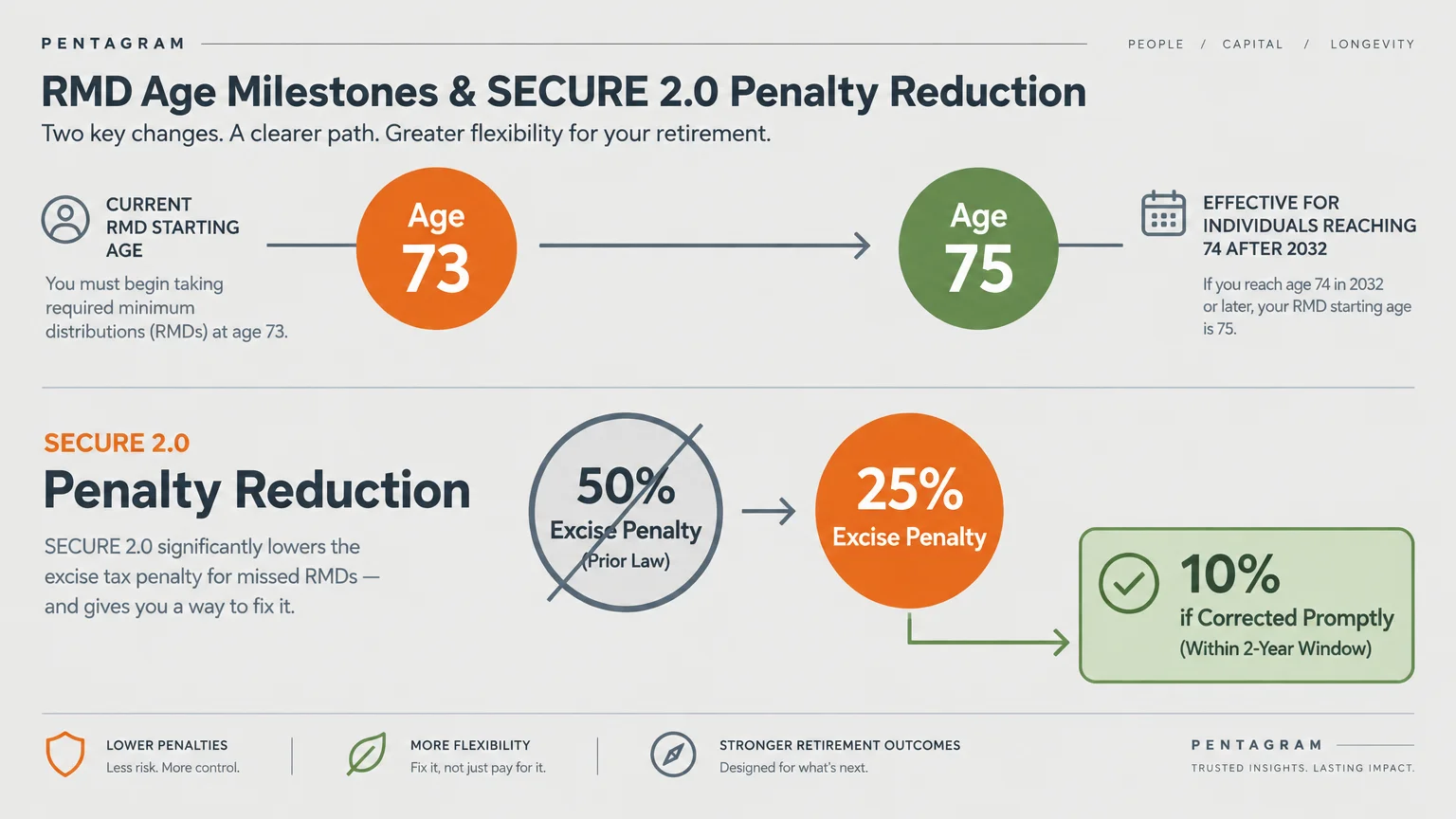
Federal retirement legislation has updated distribution requirements significantly in recent years. Under the SECURE 2.0 Act, the mandatory RMD age is 73, rising to age 75 in 2033.
Missing your required distribution deadline previously triggered an aggressive 50% excise tax penalty. SECURE 2.0 lowered this penalty to a more manageable 25% of the shortfall.
You can reduce this penalty down to 10% if you correct the missed withdrawal within a two-year correction window. You must submit IRS Form 5329 to report the correction.
“The biggest mistake retirees make is assuming they will be in a lower tax bracket in retirement.” — Ed Slott, CPA and IRA Specialist
7. Medicare Triggers the Six-Month Retroactive HSA Trap
Enrolling in Medicare fundamentally alters your eligibility for tax-advantaged health accounts. Federal law prohibits individuals enrolled in any part of Medicare from contributing to a Health Savings Account (HSA).
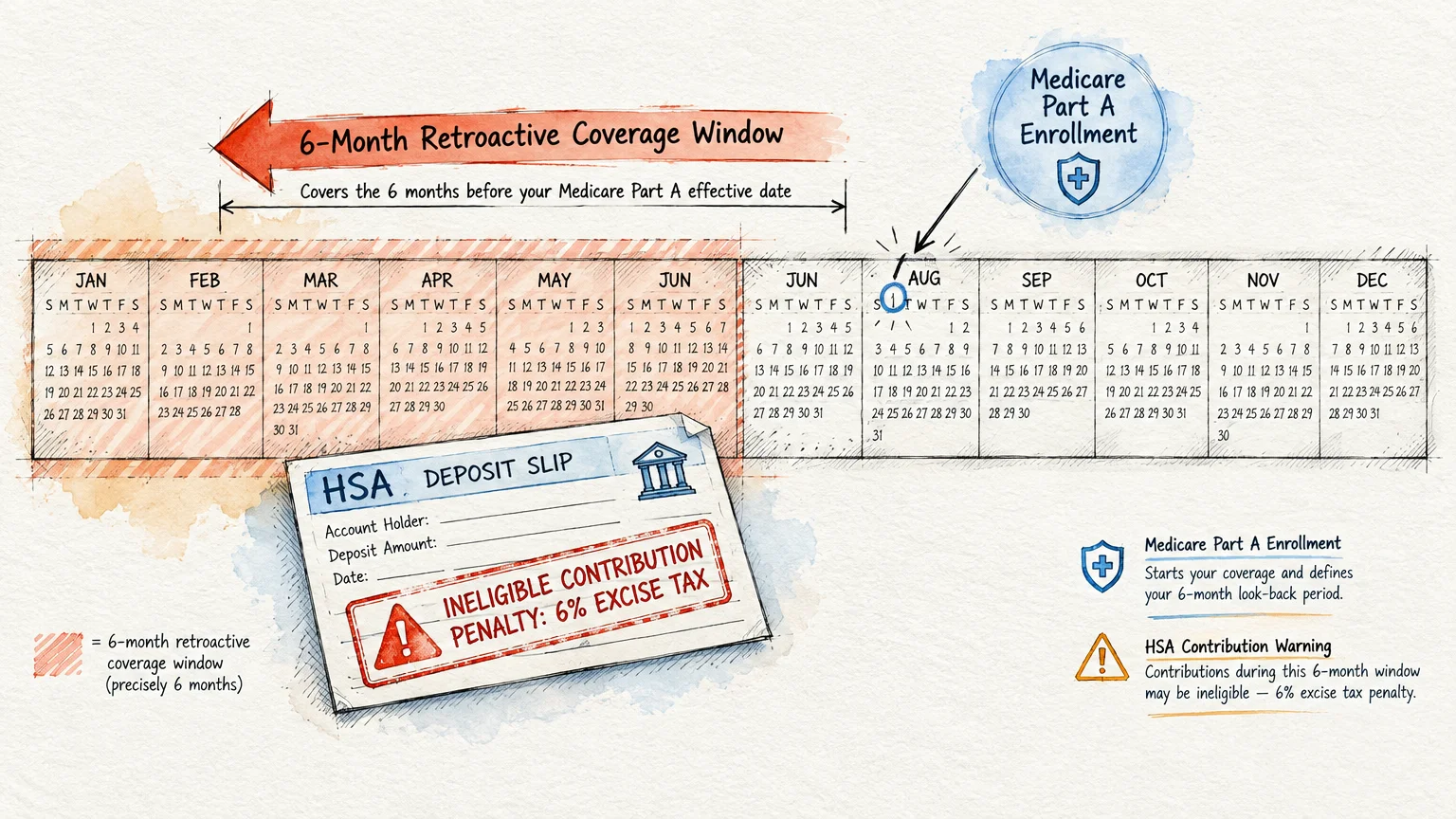
A dangerous tax trap exists if you enroll in Medicare Part A after reaching age 65. The federal government makes your Medicare Part A coverage retroactive for up to six full months.
Any HSA deposits made during those retroactive months become improper excess contributions. The IRS penalizes these uncorrected deposits with a 6% annual excise tax.
To avoid penalties, stop all HSA contributions at least six months before applying for Social Security or Medicare Part A. Withdraw any accidental excess contributions before the annual tax filing deadline.
8. The Rule of 55 Unlocks Penalty-Free 401(k) Access
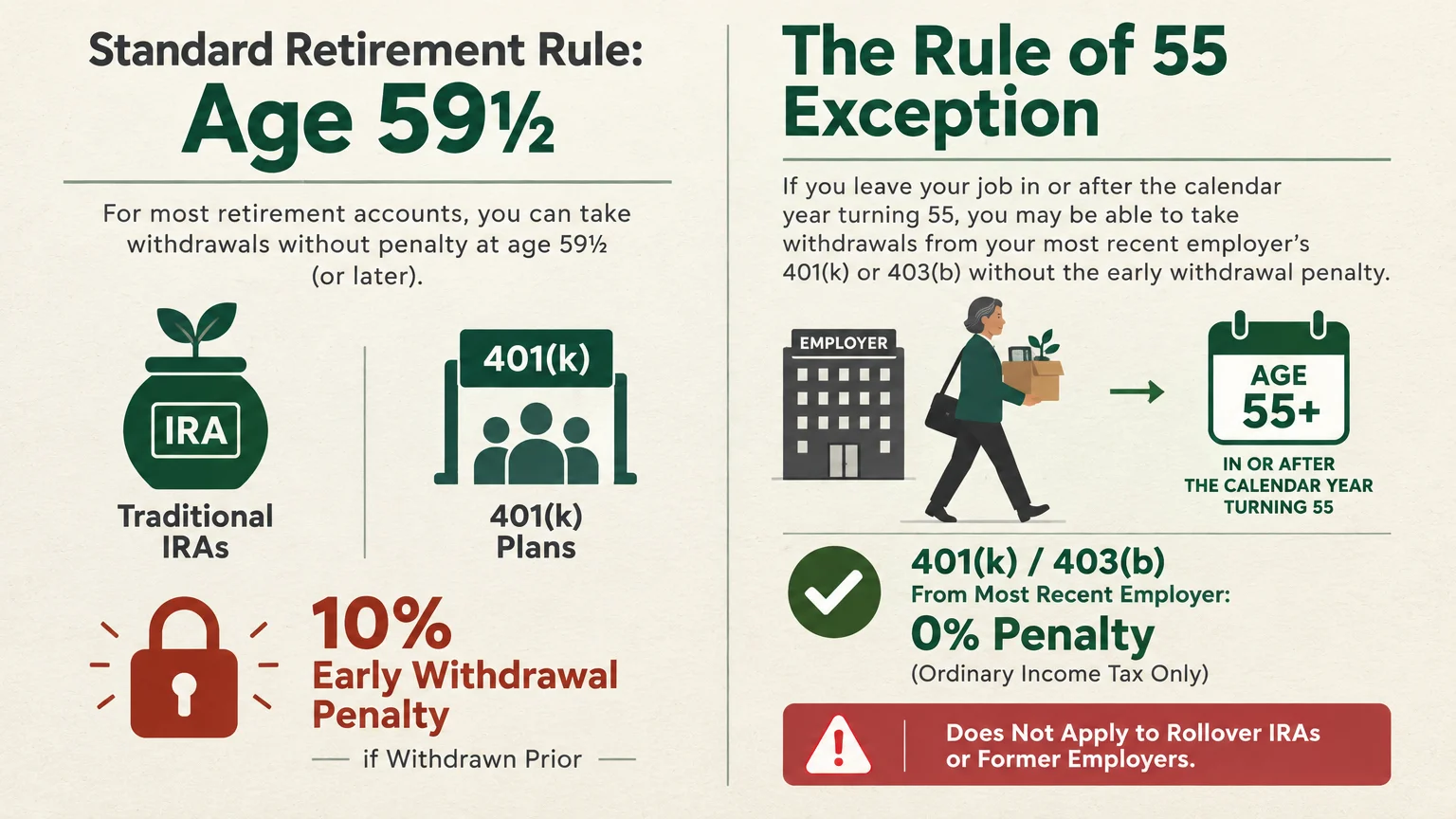
Retiring before age 59½ normally exposes your retirement distributions to a painful 10% early withdrawal penalty. However, a specific IRS rule provides early retirees with tax-favored relief.
Under Internal Revenue Code §72(t)(2)(A)(v), commonly called the Rule of 55, you can access your workplace plan without penalty. You must leave your employer during or after the year you turn 55.
Certain public safety workers, such as police officers and firefighters, can access this provision starting at age 50. You still owe regular income tax on the withdrawals.
Crucially, the Rule of 55 applies strictly to the 401(k) or 403(b) plan from the employer you just left. Rolling those funds into an IRA cancels this exception until age 59½.

9. A Larger Standard Deduction Starts at Age 65
Crossing the age 65 milestone grants you access to an expanded standard deduction on your federal tax return. This additional tax break helps reduce your taxable retirement income.
For tax year 2024, the IRS set the additional deduction at $1,950 for single filers and $1,550 per qualifying spouse for married couples. These figures adjusted upward for inflation.
For tax year 2025, single filers receive an additional $2,000 standard deduction. Married couples filing jointly claim an extra $1,600 for each spouse aged 65 or older.
If both you and your spouse are 65 or older in 2025, you receive a combined extra deduction of $3,200. This bonus deduction applies automatically when you claim the standard deduction.
10. The 0% Capital Gains Bracket Suddenly Becomes Reachable
Replacing a steady employment salary with strategic portfolio withdrawals often causes your taxable income to drop. This income reduction creates a valuable opportunity for taxable brokerage accounts.
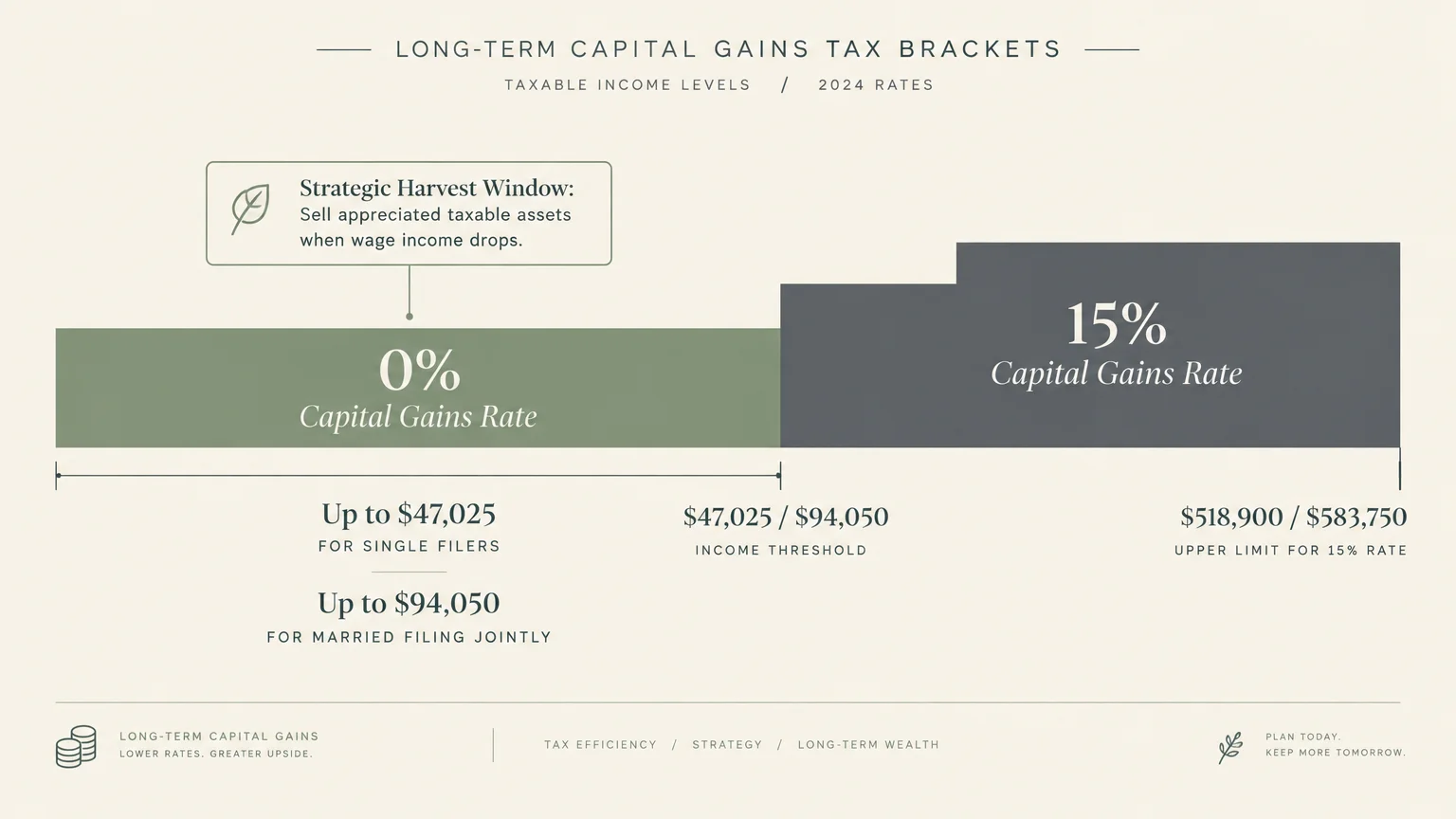
The IRS offers a 0% federal tax bracket for long-term capital gains and qualified dividends. You qualify if your taxable income stays under designated thresholds.
For tax year 2025, you pay zero capital gains tax on taxable income up to $48,350 for single filers. Married couples filing jointly qualify with taxable income up to $96,700.
In tax year 2024, those threshold ceilings were $47,025 for singles and $94,050 for joint filers. You can harvest investment gains tax-free within these annual income boundaries.
11. Qualified Charitable Distributions Bypass Income Taxes
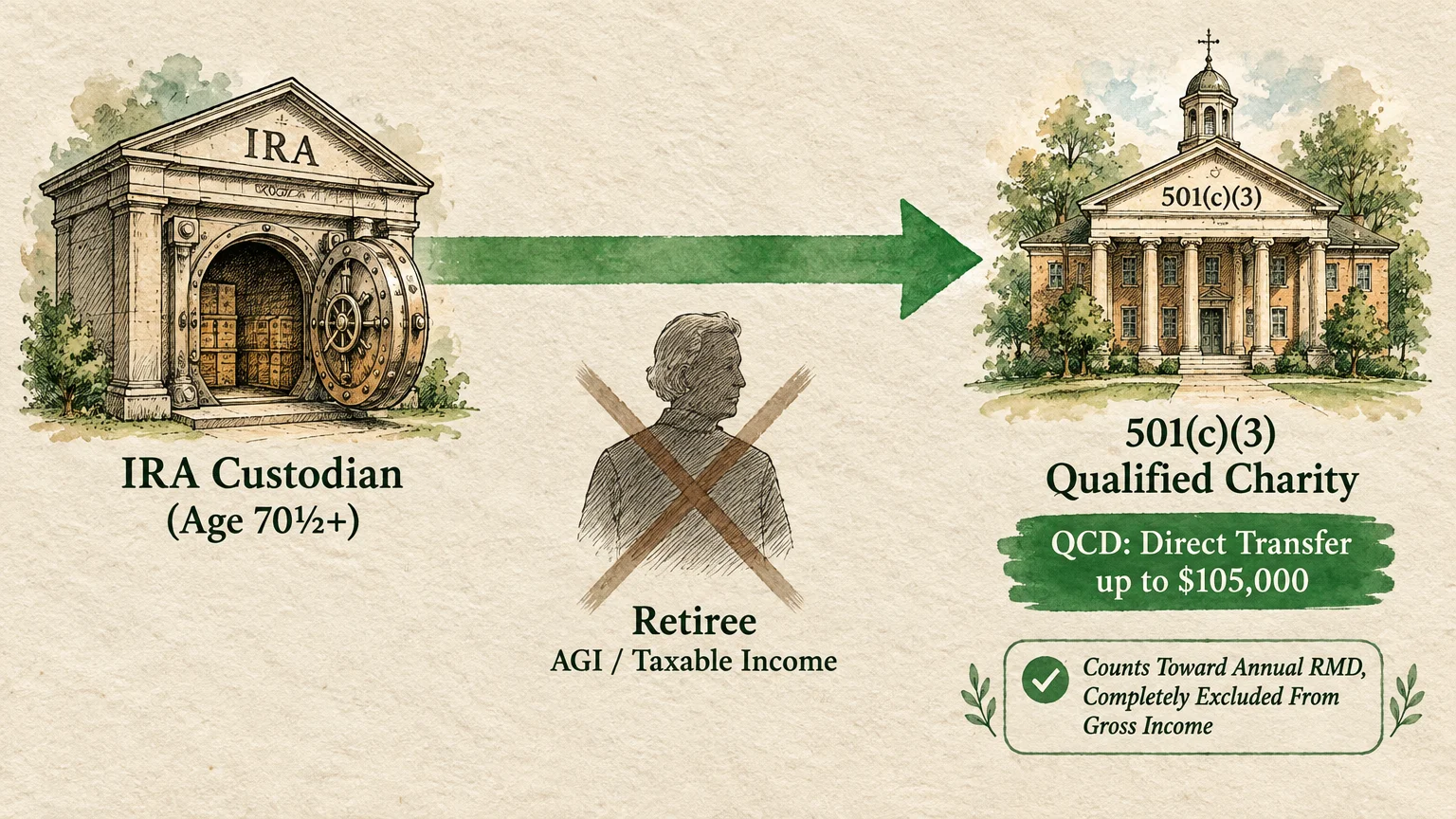
Retirees who support charitable causes can utilize a powerful tax strategy once they reach age 70½. A Qualified Charitable Distribution (QCD) lets you transfer funds directly from an IRA to charity.
This direct transfer avoids income tax completely. Unlike standard donations, a QCD does not require you to itemize deductions on your federal return.
Additionally, a QCD satisfies your annual Required Minimum Distribution once RMD age arrives. Keeping that money off your tax return helps prevent Medicare premium spikes.
Under the SECURE 2.0 Act, the maximum annual QCD allowance adjusts for inflation. The donation limit is $105,000 for 2024, $108,000 for 2025, and climbs to $111,000 in 2026.
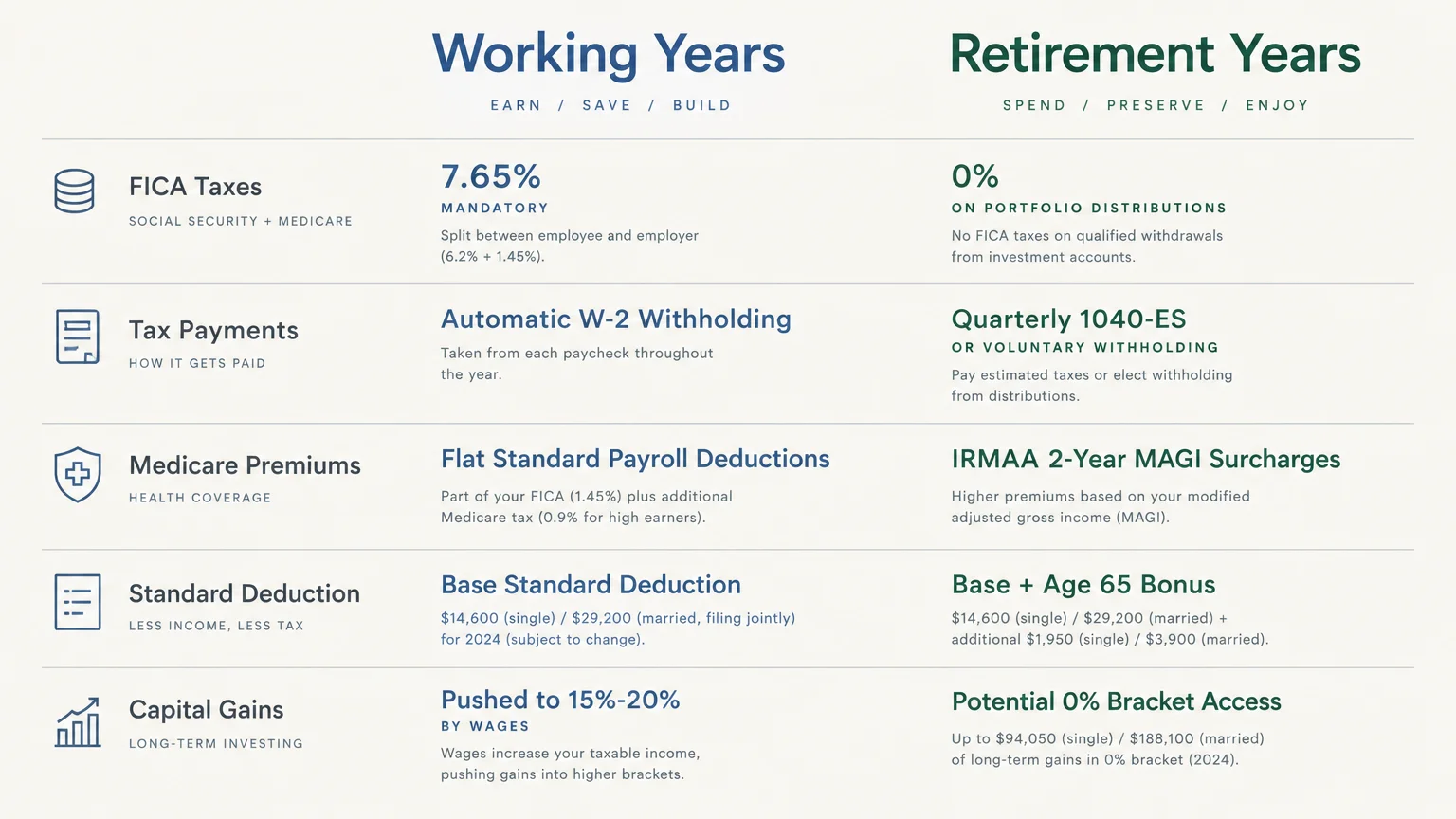
Key Tax Rules: Working Years vs. Retirement
Comparing your former tax routine to your new retirement landscape highlights how rules shift. Here is how key provisions change the year you retire.
| Tax Provision | Working Years Rule | Retirement Year Rule |
|---|---|---|
| Tax Withholding | Automatic deduction via employer W-4 form. | Voluntary withholding (W-4P, W-4R, W-4V) or Form 1040-ES quarterly estimates. |
| FICA Payroll Taxes | Mandatory 7.65% tax on wages and earnings. | 0% tax on distributions from IRAs, 401(k) plans, and pensions. |
| Standard Deduction | Base standard deduction based on filing status. | Additional bonus deduction added starting at age 65. |
| 401(k) Distributions | Delayed past RMD age via the still-working exception. | Still-working exception ends; initial RMD due by next April 1. |
| HSA Contributions | Permitted with eligible high-deductible health plans. | Strictly prohibited once enrolled in Medicare, subject to 6-month retroactivity. |

Costly Errors to Sidestep
Failing to adjust your financial routines during your first year of retirement can trigger unexpected IRS penalties. Avoid these common missteps to safeguard your nest egg.
- Ignoring Estimated Taxes: Skipping quarterly estimated payments can trigger IRS underpayment penalties. Establish voluntary withholding or schedule quarterly 1040-ES payments immediately.
- Contributing to an HSA While on Medicare: Depositing funds into an HSA after Medicare coverage begins incurs a recurring 6% excise penalty. Stop deposits six months before Medicare enrollment.
- Rolling Over a 401(k) Before Age 59½: Moving workplace savings into an IRA forfeits the Rule of 55 penalty waiver. Keep your savings in the employer plan if taking early distributions.
- Neglecting Medicare IRMAA Appeals: Overpaying Medicare premiums based on old working wages drains cash. File Form SSA-44 to reflect your reduced post-retirement income.

When DIY Isn’t Enough
While many tax adjustments are straightforward, complex financial situations require professional oversight. Consider consulting a certified tax planner or CPA in the following scenarios:
- You own non-qualified annuities or complex deferred compensation plans with deferred tax liabilities.
- You plan significant Roth conversions alongside taxable brokerage rebalancing and Social Security benefits.
- You relocate to a different state with distinct retirement income exemptions and estate taxes.
- You hold substantial employer stock inside a 401(k) eligible for Net Unrealized Appreciation (NUA) treatment.
Frequently Asked Questions
Do I still file taxes if my only income is Social Security?
If Social Security is your sole income source and provisional income stays below $25,000, you generally owe no federal income tax. You often do not need to file a federal return.
When should I submit Form SSA-44 to reduce Medicare surcharges?
Submit Form SSA-44 as soon as you receive your initial IRMAA determination notice from Medicare. Include official proof of retirement, such as an employer letter or recent tax return.
How do I withhold taxes from my private pension?
Submit IRS Form W-4P to your pension administrator to designate your preferred withholding rate. They will deduct federal income tax from each monthly disbursement automatically.
Can I still contribute to a Roth IRA after retiring?
You can only contribute to an IRA if you or your spouse have taxable earned compensation. Portfolio distributions, pensions, and Social Security do not count as earned income.
Managing your taxes during your first year of retirement requires deliberate planning and proactive execution. Take control of withholding, review account rules, and enjoy your hard-earned retirement freedom.
This educational content reflects general financial principles for seniors, and individual results vary. Always verify current benefit amounts, tax rules, and program eligibility with official government sources.
Last updated: February 2026. Benefit amounts, tax rules, and program details change annually—verify current figures with official government sources.








Leave a Reply