
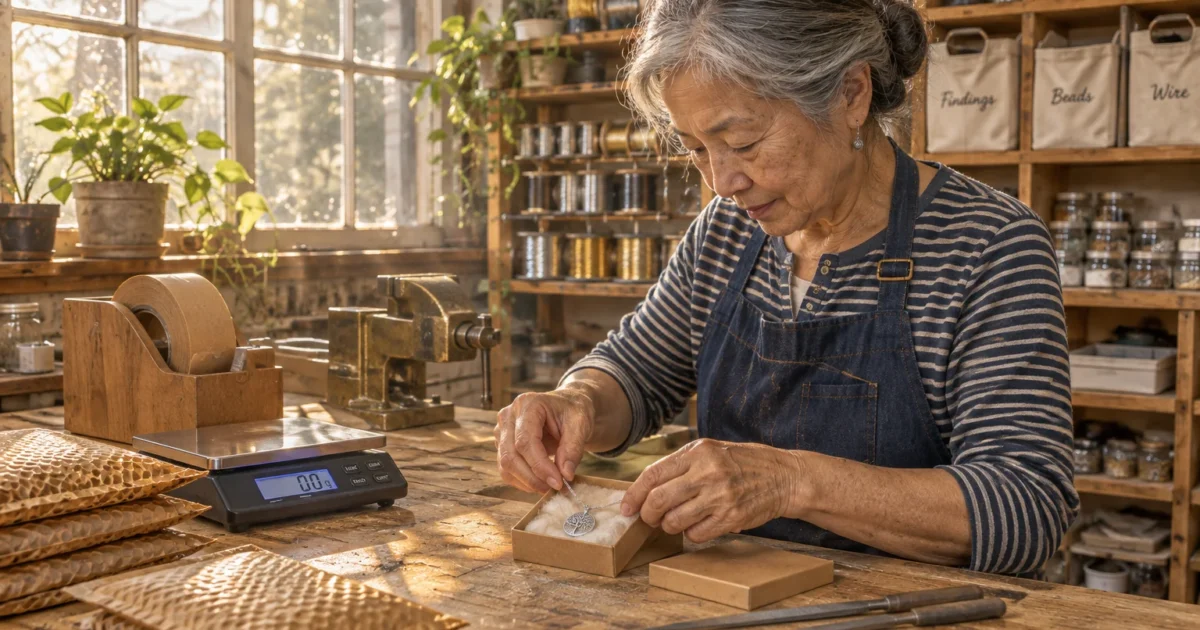
Adults age 65 and older average 7.11 hours of daily leisure time, per the U.S. Bureau of Labor Statistics (BLS) 2025 American Time Use Survey. Turning just a few weekly hours into hobbies that make money brings in extra cash without rigid schedules.
In 2025, 19.1% of Americans age 65 and older remained in the labor force, with many favoring part-time flexibility. Profitable hobbies for retirees let you earn steady cash from skills you already enjoy.
Knowing where to start is only half the equation for building retirement side income. Tracking 2026 platform fees, IRS tax updates, and Social Security rules ensures you keep more of what you make.
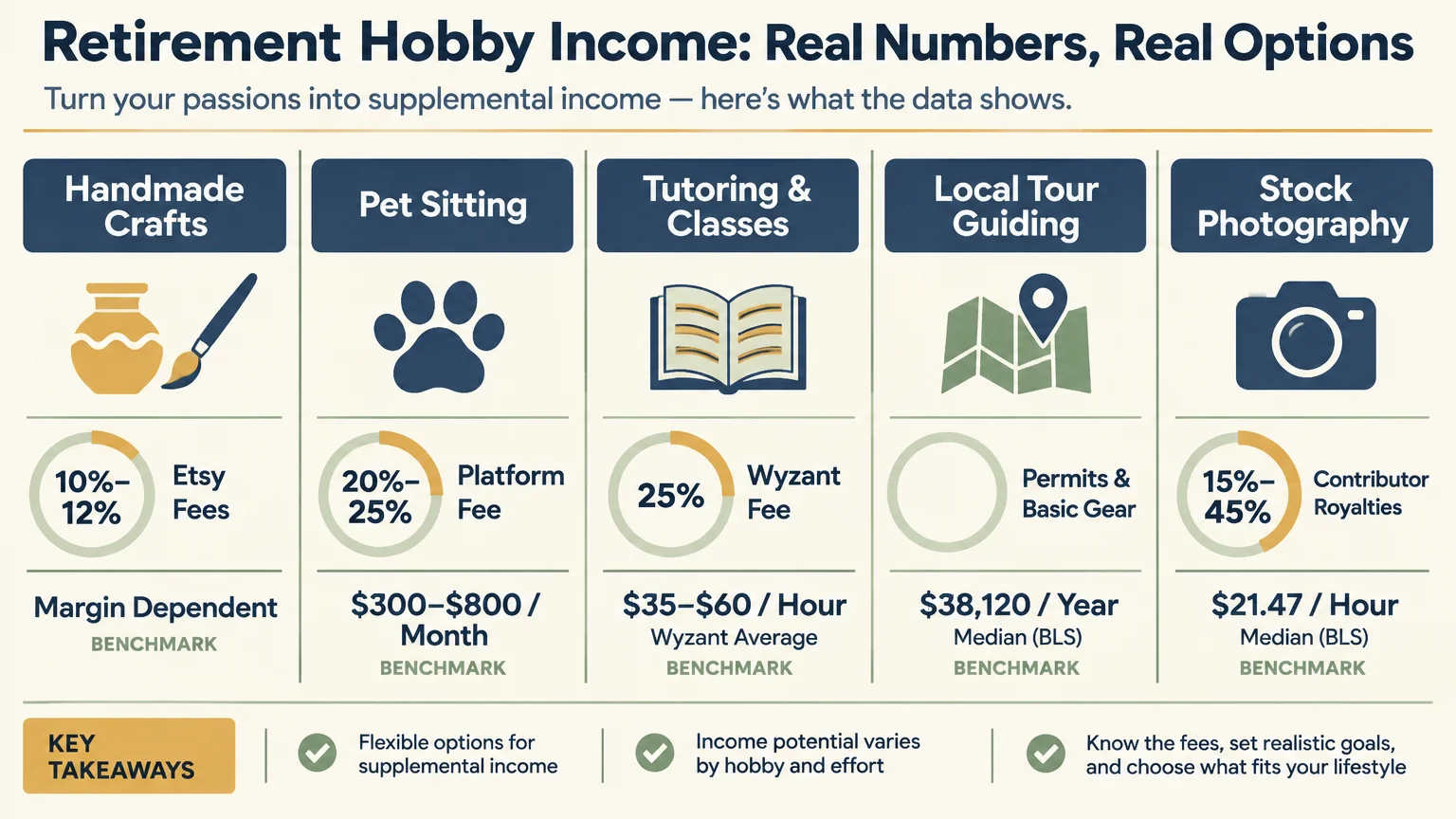
At a Glance: Comparing 9 Profitable Hobbies for Seniors
Every hobby carries different startup costs, platform commissions, and earning potential. Comparing the numbers upfront helps you pick an option that matches your energy, budget, and income goals.
| Hobby | Common Platform or Path | Typical Fee or Cost | 2026 Earnings Benchmark |
|---|---|---|---|
| Handmade Crafts | Etsy or craft fairs | 10%–12% typical Etsy fees | Varies by item profit margin |
| Vintage Reselling | Etsy or local markets | $0.20 listing plus 6.5% and 3%+$0.25 | Varies by inventory cost |
| Home Baking | Direct sales under cottage laws | Required labels and state permits | Caps from $30,000 to no limit |
| Floral Design | Independent events or shops | Flowers, vases, and supplies | $17.96/hour median (BLS) |
| Pet Sitting & Walking | Rover or Care.com | 20%–25% Rover; $18.99/yr Care.com | $300–$800/month part-time |
| Tutoring & Classes | Wyzant or Outschool | 25% Wyzant; 30% Outschool | $35–$60/hour Wyzant average |
| Local Tour Guiding | Tour firms or independent walks | Local permits and basic gear | $38,120/year median (BLS) |
| Freelance Services | Upwork or Fiverr | 0%–15% Upwork; 20% Fiverr | Set your own hourly or project rates |
| Stock Photography | Adobe Stock, Shutterstock, iStock | 15%–45% contributor royalties | $21.47/hour median (BLS) |
Hands-On Hobbies That Turn Creativity Into Cash
Working with your hands keeps your mind sharp and produces tangible goods people happily buy. These four hobbies for seniors reward patience, craftsmanship, and eye for detail.
1. Handmade Crafts on Etsy
Knitting, woodworking, quilting, and custom jewelry rank among the most reliable hobbies that make money from home. Online marketplaces connect your workshop directly with buyers across the country.
Before pricing your creations, factor in mandatory U.S. seller fees on Etsy for 2026:
- Listing fee: $0.20 per item published, sold, or auto-renewed every four months.
- Transaction fee: 6.5% applied to the total order amount, including item price, shipping, and gift wrapping.
- Payment processing fee: 3% plus $0.25 per transaction through Etsy Payments.
- Optional tools: Etsy Plus costs $10 per month, while Offsite Ads charge 12% on ad-driven sales under $10,000 annually or a mandatory 15% at $10,000 or more (capped at $100 per order).
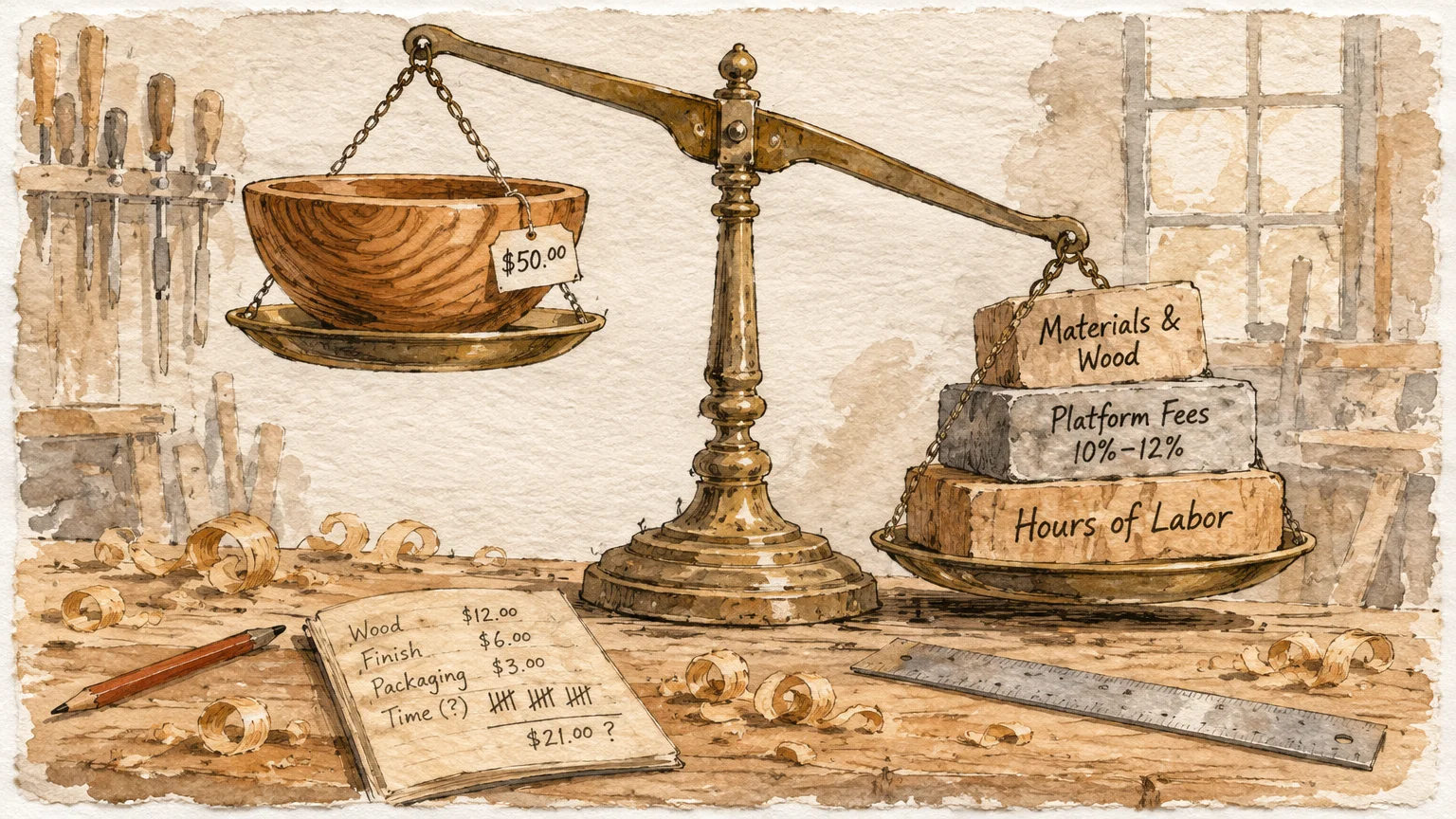
Standard organic sales typically cost 10% to 12% in combined platform fees. On a $50 handmade cutting board with $10 shipping, expect roughly $6.15 in basic fees before subtracting wood and oil costs.
2. Vintage and Collectible Reselling
Clearing out decades of collectibles or browsing weekend estate sales can fund substantial retirement side income. Buyers actively search online for mid-century glassware, vintage linens, rare books, and classic tools.
Selling vintage pieces on Etsy triggers the same 10% to 12% typical fee structure as handmade crafts. Save every receipt from thrift stores, estate auctions, and packing supply runs from day one.
Recording what you paid for each collectible lowers your taxable profit at year-end. Even if you treat reselling as a casual hobby, you can subtract the cost of goods sold from your gross sales.
3. Home Baking and Specialty Cottage Foods
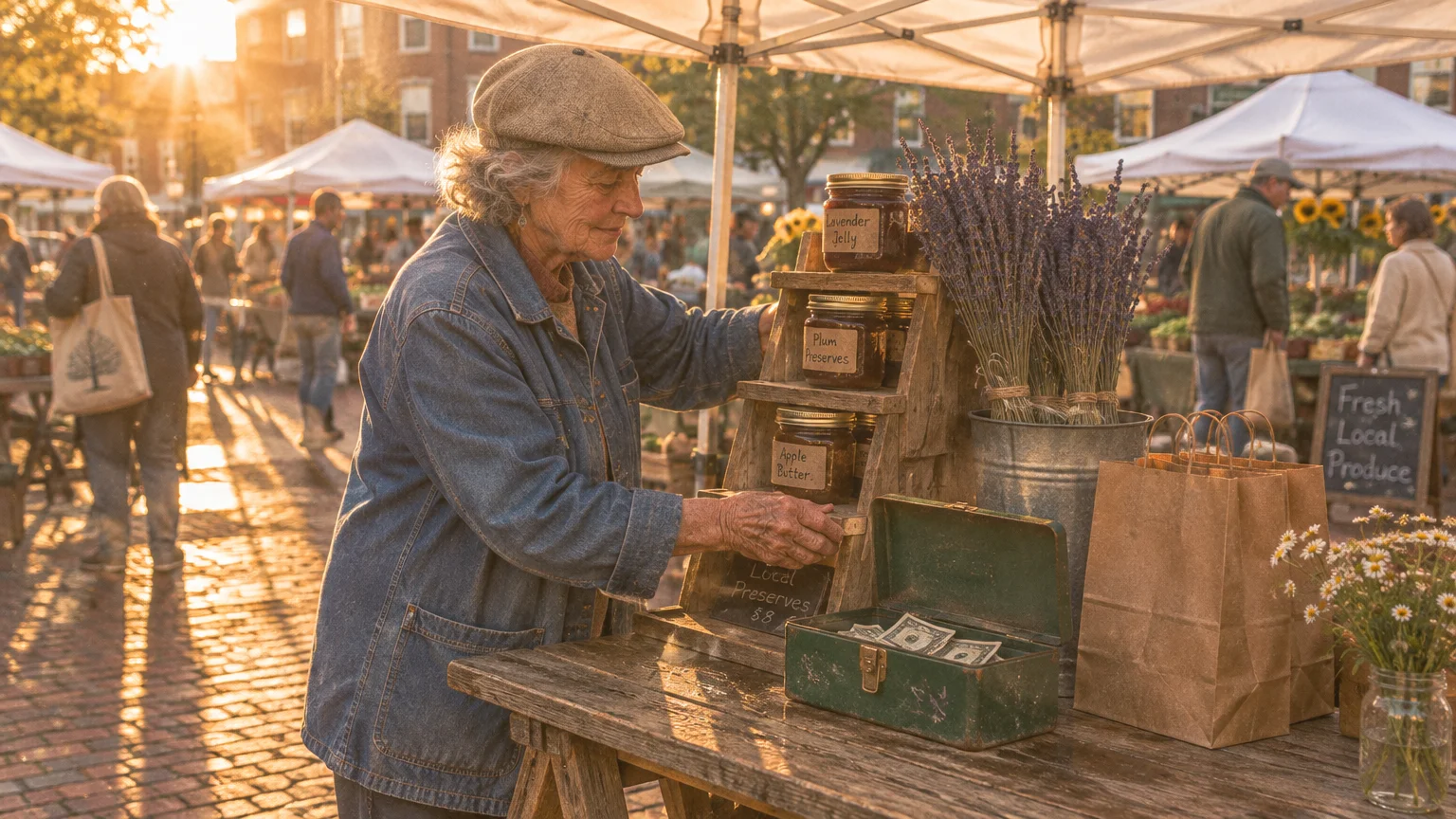
If friends rave about your sourdough, jams, or holiday cookies, state cottage food laws let you sell directly from your home kitchen. Today, 49 states maintain a cottage food law, exemption, or permit for shelf-stable foods.
Delaware is the lone exception, offering only an on-farm home processing permit. Traditional rules bar meat, seafood, low-acid canned items, and refrigerated foods, though Texas, Arizona, Nebraska, and Colorado (starting January 1, 2027) allow limited refrigerated goods with registration.
Every state requires clear product labels listing your ingredients, major allergens, and a home-kitchen disclosure. Check your state rules carefully before baking, because limits and online rules vary widely:
- Revenue caps: Nineteen states cap annual cottage food sales—from $30,000 in Vermont up to $250,000 in Florida, Wyoming, and Oklahoma (effective November 1, 2026)—while 22 states set no overall cap on baked goods.
- Recent 2025–2026 expansions: Texas raised its cap to $150,000 (ending mail-order in favor of in-person delivery), Michigan doubled to $50,000 ($75,000 for items priced $250 or more) with in-state shipping, and Louisiana and Maryland jumped to $100,000.
- State adjustments: California sets 2026 inflation-adjusted caps at $88,878 for Class A direct sales and $177,756 for Class B retail sales, while Colorado moves to a $150,000 cap on January 1, 2027.
- Online ordering: Online sales are permitted in some form across 33 states but prohibited under basic cottage rules in Delaware, Mississippi, South Dakota, Washington, and Nevada (until July 1, 2027).
Start with high-margin, shelf-stable specialties like spiced nuts, biscotti, or small-batch fruit preserves. Farmers markets and neighborhood pre-orders help you test local demand without overbaking.
4. Floral Design and Event Arrangements
Arranging fresh blooms for birthdays, neighborhood dinners, and small weddings blends creative satisfaction with healthy local demand. You can work seasonally from a garage workbench or partner with a neighborhood florist during peak holidays.
According to May 2025 BLS Occupational Employment and Wage Statistics released in 2026, floral designers earned a median wage of $17.96 per hour, or $37,360 annually ($39,520 mean). Roughly 5,200 job openings are projected each year through 2035.
To keep waste low, offer weekly porch-drop bouquets on a pre-paid subscription to neighbors. Buying wholesale stems only for confirmed orders protects your cash flow.

People-Focused Hobbies With Flexible Schedules
Retirement can feel quiet once daily workplace chatter ends. These three hobbies for seniors get you out of the house, build community ties, and pay you for your warmth and knowledge.
5. Pet Sitting and Dog Walking
Spending mornings with neighborhood dogs turns daily exercise into steady extra income. Many pet owners prefer mature, dependable sitters who stay calm and follow feeding or medication routines carefully.
On Rover in 2026, sitters typically charge $15 to $25 per 30-minute walk (up to $40), $10 to $20 per drop-in visit, $25 to $40 per day for doggy daycare, and $35 to $75 or more per night for boarding.
Rover deducts a 20% sitter service fee in most states—or 25% in California and on RoverGO—while letting you keep 100% of tips. Pet owners also pay an 11% booking fee capped at $50 per booking.
If you want to avoid ongoing commissions, Care.com charges sitters an $18.99 annual fee for background checks and takes 0% of your pay. Part-time sitters commonly net $300 to $800 per month, while full-time Rover dog sitters average $45,364 per year ($21.81 per hour) according to November 2026 ZipRecruiter data.
6. Private Tutoring and Teaching Classes
Decades of career experience, musical skill, or fluency in a second language carry real market value. Parents and adult learners gladly pay for patient, one-on-one instruction over Zoom or at a local library.
BLS wage data for self-enrichment teachers shows a median employee rate of $21.79 per hour, while independent private tutors routinely charge $25 to $80 per hour ($30 to $50 for general K–12 subjects). Two major platforms make finding students straightforward:
- Wyzant: Tutors set hourly rates between $10 and $1,000, averaging $35 to $60 per hour. Wyzant takes a flat 25% platform fee (0% for students you personally refer) and charges students a 9% service fee.
- Outschool: Teachers design live group classes for students ages 3 to 18—covering everything from chess to watercolor—and pay a flat 30% fee on every enrollment under Outschool’s March 2026 payment policy.
Ask former colleagues or neighbors to spread the word locally so you keep 100% of your hourly rate on direct referrals. Even two tutoring hours a day at $40 per hour adds $80 a day to your budget.
7. Local Tour Guiding
If you know every historic landmark, botanical garden, or hidden diner in your town, tour guiding pays you to share your enthusiasm. Visitors love learning local stories from residents who remember how neighborhoods evolved.
BLS data from May 2025 shows tour and travel guides earned a median annual wage of $38,120 including tips, with the lowest 10% under $28,520 and the highest 10% over $60,930. Part-time schedules are standard across museums, historic districts, and food tours.
Employment for tour guides is projected to grow 6% between 2025 and 2035, creating roughly 11,900 openings per year. Contact local historical societies, visitor bureaus, or walking-tour companies before the spring travel season starts.

Digital and Skill-Based Ways to Earn Money From Hobbies
Remote digital work lets you earn money from hobbies without commuting or lifting heavy boxes. All you need is a reliable computer, solid internet, and an organized routine.
8. Freelance Writing, Consulting, and Micro-Services
Strong communicators and retired specialists—from bookkeepers to former project managers—can package lifelong expertise into bite-sized online gigs. Small businesses often prefer hiring seasoned freelancers for short projects rather than full-time staff.
According to the Upwork Future Workforce Index 2026, 39% of all U.S. workers now freelance, up 4% from 2025. You can join that market through two established marketplaces with distinct fee structures:
- Upwork: Charges a variable Freelancer Service Fee between 0% and 15% per contract (locked for the life of that contract since May 2025), plus Connects at $0.15 each to submit proposals; Freelancer Plus costs $19.99 monthly.
- Fiverr: Charges sellers a flat 20% commission on every order—including tips and extras—while buyers pay a 5.5% service fee plus small-order fees under $200.
Focus your profile on one specific solution, such as editing newsletters, organizing spreadsheets, or coaching job seekers on resumes. Clear, narrow offerings attract higher-paying clients faster than broad descriptions.
9. Photography and Stock Image Licensing
Taking your camera on morning walks or road trips can build a library of images that license repeatedly. Businesses, bloggers, and publishers constantly buy authentic photos of everyday life, seasonal food, and regional travel.
In May 2025, BLS recorded a median wage of $21.47 per hour for photographers ($26.64 hourly mean, or $55,410 per year), with roughly 10,700 annual job openings projected through 2035. The top 10% earn over $44.14 per hour, while the bottom 10% earn under $14.82.
If you prefer passive licensing over event shoots, compare 2026 stock agency royalties before uploading your portfolio:
- Adobe Stock: Pays a flat 33% royalty on photos, vectors, and illustrations and 35% on video with no annual reset, plus $0.33 to $0.38 minimum floors on large subscription plans.
- Shutterstock: Pays 15% to 40% across six annual volume tiers (separate for images and video), resetting every contributor back to Level 1 (15%) each January 1, with a $0.10 floor on select subscription downloads.
- iStock: Pays non-exclusive contributors 15% on photos and 20% on illustrations or video, while exclusive contributors earn 25% to 45%.
Uploading clear, unbranded lifestyle photos and regional landmarks gives your portfolio steady visibility across multiple sites. Pairing stock licensing with occasional family portrait sessions multiplies your annual return.
How Retirement Side Income Affects Your Social Security Benefits
Earning extra cash feels great until an unexpected letter arrives about benefit withholding. Before scaling your retirement side income, check how your age interacts with 2026 limits set by the Social Security Administration (SSA).
If you collect Social Security before reaching your full retirement age (FRA) for all of 2026, the annual exempt earnings limit is $24,480 (up from $23,400 in 2025). SSA withholds $1 in benefits for every $2 earned above $24,480, or uses a $2,040 monthly test in your first retirement year.
Suppose you are 64 and earn $30,480 in net tutoring income during 2026. Because that sits $6,000 above the $24,480 cap, SSA withholds $3,000 of your benefits for the year.
In the calendar year you reach FRA in 2026, the annual limit jumps to $65,160 (up from $62,160 in 2025). Only earnings from months prior to your FRA month count, and SSA withholds $1 for every $3 earned above that higher threshold.
Once you reach full retirement age—66 and 10 months if born in 1959, or 67 if born in 1960 or later—the earnings limit drops to $0. Any benefits withheld earlier are recalculated to boost your monthly check upward from that point forward.
Only earned income—wages and net self-employment profit—counts toward the Social Security earnings test. Pensions, investment dividends, and rental income never trigger withholding.
Watch out for tax thresholds even after passing FRA, because extra earned cash raises your provisional income. Up to 85% of your Social Security benefits can become taxable once provisional income passes fixed IRS thresholds of $25,000 to $34,000 for single filers or $32,000 to $44,000 for married couples filing jointly.
IRS Rules Every Hobby Earner Needs to Know in 2026
Tax rules for hobbies changed significantly under the One Big Beautiful Bill Act (OBBBA), enacted in July 2025. Reviewing current guidelines on the Internal Revenue Service (IRS) website protects you from surprise tax bills.
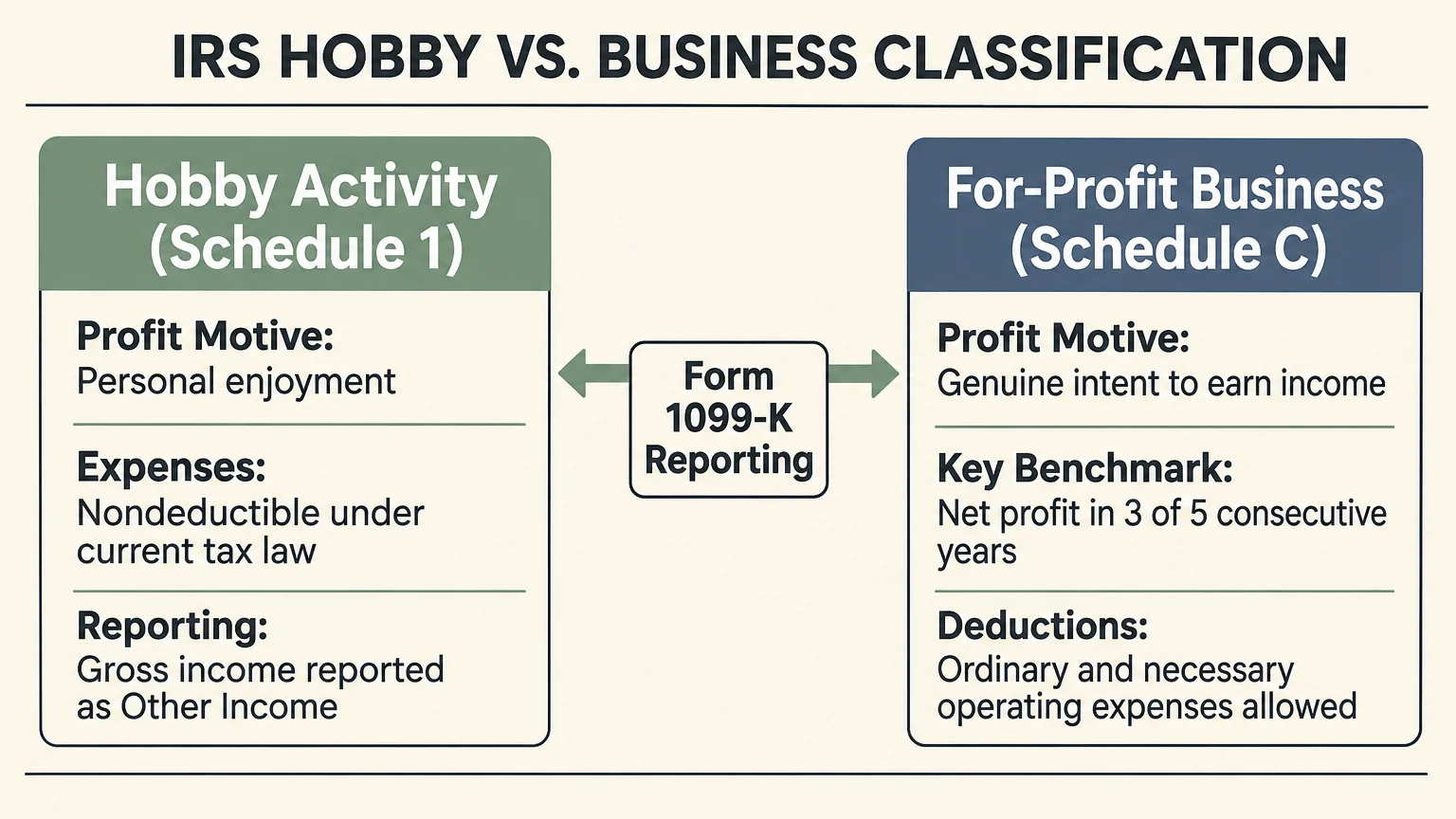
First, the IRS separates hobbies from businesses under Internal Revenue Code Section 183 using a nine-factor test in Treasury Regulation 1.183-2(b). Factors include whether you keep businesslike records, invest serious time and effort, carry expertise, and rely on the income.
An activity is presumed for-profit under Section 183(d) if gross income exceeds deductions in three or more of five consecutive tax years (two of seven years for horse activities). That presumption shifts the burden of proof to the IRS, though it is not an automatic guarantee.
How the IRS classifies your activity creates a dramatic difference on your 2026 tax return:
- Hobby classification (Schedule 1): Miscellaneous itemized deductions for hobby expenses—suspended in 2018—are permanently eliminated starting in 2026 under OBBBA. You report all hobby income on Schedule 1 (Form 1040), line 8j with no dollar minimum and can subtract only cost of goods sold (not software, tools, or craft booth fees), though hobby income is exempt from the 15.3% self-employment tax.
- Business classification (Schedule C): You can deduct ordinary and necessary business expenses, which lowers taxable profit. However, once net earnings hit $400 or more, you owe self-employment tax even while collecting Social Security.
For 2026, the self-employment tax rate is 15.3%—consisting of 12.4% for Social Security up to the $184,500 combined wage base and 2.9% for Medicare on all net earnings. It is calculated on 92.35% of net profit, with half deductible above the line per IRS Schedule SE (an extra 0.9% Medicare tax applies above $200,000 single or $250,000 joint).
OBBBA also reshaped payment reporting forms for 2026. The federal Form 1099-K threshold for payment apps and marketplaces like PayPal, Venmo, and Etsy was permanently restored to more than $20,000 in gross payments AND more than 200 transactions (though some states keep lower thresholds and direct card processors have no minimum).
For payments made after December 31, 2025, OBBBA also raised the Form 1099-NEC and general Form 1099-MISC reporting threshold from $600 to $2,000. Remember that all taxable income must still be reported even when you do not receive a 1099 form.
Costly Errors to Sidestep When Monetizing Your Passions
Enthusiasm makes it easy to overlook small administrative details early on. Avoiding these four common missteps keeps your profitable hobbies for retirees stress-free and financially sound.
- Underpricing after platform fees: Forgetting that Outschool takes 30%, Wyzant takes 25%, and Rover or Fiverr take 20% can leave you working for far less than planned. Always build commissions and payment processing fees directly into your rates.
- Treating missing 1099s as tax-free cash: Earning $1,500 tutoring or $4,000 on Etsy means you likely will not receive a 1099-NEC or federal 1099-K in 2026. You still owe income tax—and possibly self-employment tax—on every dollar of profit.
- Counting on hobby overhead write-offs: Some retirees still expect to deduct yarn, camera lenses, or booth rentals against hobby earnings. Because OBBBA permanently eliminated miscellaneous hobby deductions in 2026, only cost of goods sold reduces hobby income unless you operate as a legitimate Schedule C business.
- Skipping state food or local rules: Selling frosted cakes or pickled vegetables across state lines can violate cottage food bans. Verify your state cap, allergen label requirements, and online sales rules before launching a kitchen business.
When DIY Isn’t Enough
Most low-key hobbies are simple to manage with a notebook and spreadsheet. Still, four situations call for personalized guidance from a Certified Public Accountant (CPA) or Certified Financial Planner (CFP):
- Approaching Social Security earnings limits before FRA: If net side income nears $24,480 (or $65,160 in your FRA year), a planner can help time invoices or expenses cleanly.
- Hitting Social Security tax cliffs: When extra earnings risk pushing provisional income over $25,000 (single) or $32,000 (joint), tax modeling prevents up to 85% of your benefits from suddenly becoming taxable.
- Deciding between Schedule 1 and Schedule C: A CPA can evaluate the nine IRS Section 183 factors, track cost of goods sold properly, and confirm whether $400+ in net profit triggers Schedule C self-employment taxes.
- Scaling local operations: Expanding cottage food sales toward state caps or boarding multiple pets in your home may require separate liability coverage or local permits.
For broader work, training, and benefit planning tools tailored to older adults, explore free guides from AARP, the National Council on Aging (NCOA), and Benefits.gov. Combining community resources with sound tax advice keeps your retirement finances steady.
Frequently Asked Questions About Profitable Hobbies
Do I pay self-employment tax on hobby income in 2026?
No, genuine hobby income reported on Schedule 1 (Form 1040), line 8j is exempt from the 15.3% self-employment tax. However, if your activity qualifies as a side business on Schedule C, you owe self-employment tax once net profit reaches $400 or more.
Can I still deduct hobby supplies on my 2026 tax return?
You cannot deduct general hobby overhead like tools, software, or mileage because OBBBA permanently eliminated miscellaneous itemized deductions starting in 2026. If you make or resell physical goods, you can still subtract the direct cost of goods sold from gross hobby sales.
How much can I earn from a hobby while collecting Social Security?
If you are under full retirement age all of 2026, you can earn up to $24,480 without benefit withholding ($65,160 in the year you reach FRA, counting earlier months). Once you reach FRA, there is no earnings limit at all.
Will Etsy or Rover send me a 1099-K if I earn less than $20,000?
Under OBBBA, the federal Form 1099-K threshold for 2026 requires more than $20,000 in gross payments and more than 200 transactions. Some states enforce lower reporting limits, and you must report all taxable profit regardless of whether a form arrives.
Start Small and Keep More of What You Earn
Pick just one hobby from this list that fits your energy and daily routine, then price your time or goods with platform fees included. Open a dedicated folder for receipts and mileage today so tax season stays effortless.
This article provides general financial education and information only. Everyone’s financial situation is unique—what works for others may not work for you. For personalized advice tailored to your retirement needs, consider consulting a qualified financial professional such as a CFP or CPA.
Last updated: November 2026. Benefit amounts, tax rules, and program details change annually—verify current figures with official government sources.





Leave a Reply