

At age 67, women receive an average Social Security check of $1,801.82 per month, while men receive $2,234.41, according to Social Security Administration (SSA) data for December 2025. That $433 monthly difference adds up to nearly $5,200 less every year.
Because women live longer on average than men, a smaller monthly check stretches your retirement budget thin for decades. Fortunately, specific SSA claiming rules let you close much of that gap.
You can boost your retirement income through strategic timing, spousal or survivor rules, and recent law changes for public employees. Here is how the numbers compare and what steps raise your payout.
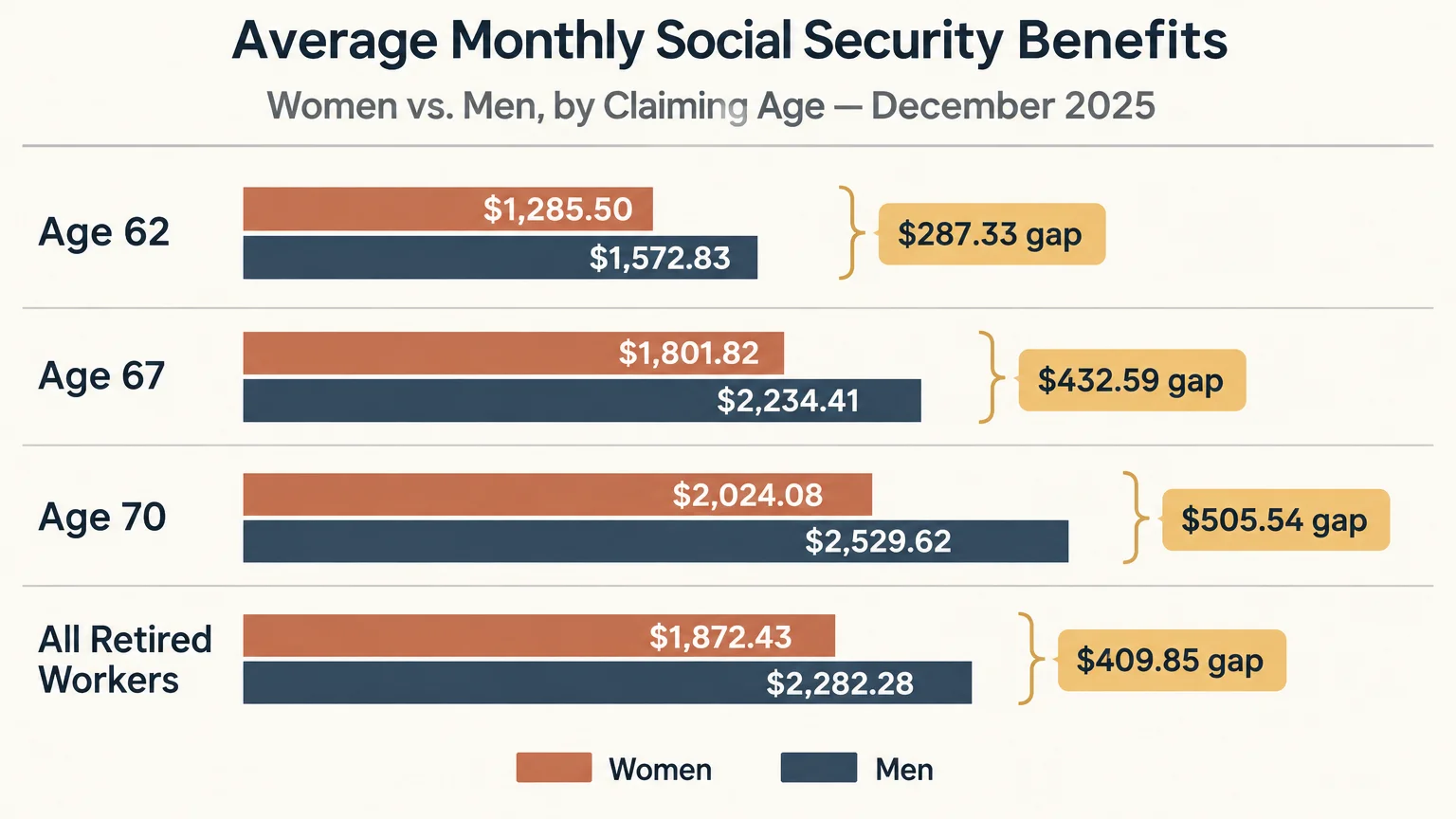
Average Social Security Benefit at 67 and Across Ages: Men vs. Women
When comparing Social Security for men vs. women, the gap appears at every claiming age. According to the SSA Annual Statistical Supplement, 2026, retired women aged 67 averaged $1,801.82 monthly in December 2025 across 1,510,437 beneficiaries.
Men of the same age averaged $2,234.41 monthly across 1,487,707 beneficiaries, putting the combined average benefit at 67 at $2,016.48. FinanceBuzz analysis of those SSA records highlights that the gap equals roughly $433 every month.
The disparity holds steady across the entire retirement spectrum, not just at age 67. Overall in December 2025, retired women averaged $1,872.43 per month compared with $2,282.28 for retired men—a gap of $409.85 monthly.
| Claiming Group (December 2025) | Women Average Monthly Benefit | Men Average Monthly Benefit | Monthly Gender Gap |
|---|---|---|---|
| Retired workers aged 62 | $1,285.50 | $1,572.83 | $287.33 |
| Retired workers aged 67 | $1,801.82 | $2,234.41 | $432.59 |
| Retired workers aged 70 | $2,024.08 | $2,529.62 | $505.54 |
| All retired workers (all ages) | $1,872.43 | $2,282.28 | $409.85 |
Cost-of-living adjustments (COLAs) lift these figures each January, though they do not shrink the percentage gap between men and women. Following a 2.8% COLA for 2026, the average check for all retired workers reached $2,092.17 in June 2026, per The Senior Citizens League.
Across all beneficiary types—including spouses, widows, and disabled workers—the June 2026 average stood at $1,946.23. On October 14, 2026, the SSA announced a 3.6% COLA for 2027, effective in January 2027 for Social Security and December 31, 2026 for SSI.
That 2027 increase adds roughly $75 per month to a typical retirement check. As a result, the estimated retired-worker average rises to $2,170 per month in January 2027.
Understanding women retirement income matters because women make up the majority of older beneficiaries. SSA records show women represented 55% of adult beneficiaries in 2025 and 55.2% of recipients aged 62 and older by June 2026.
Out of 62.79 million beneficiaries aged 62 and older in June 2026, 34.65 million were women. Among Americans aged 85 and older, women accounted for 62.0% of all Social Security recipients.
Why the Social Security Gender Gap Happens
The Social Security formula itself is completely gender-neutral. Yet the way the Social Security Administration calculates benefits reflects lifetime earnings patterns that often penalize women.
To qualify for retirement benefits on your own record, you need 40 work credits, which equals 10 years of covered employment. You can earn up to four credits per year; one credit requires $1,890 in earnings in 2026 and $1,970 in 2027.
Once you qualify, the SSA averages your highest 35 years of wage-indexed earnings to find your Average Indexed Monthly Earnings (AIME). If you worked fewer than 35 years due to raising children or caring for aging parents, each missing year counts as $0.
Even a few zero-earning years pull down your lifetime average significantly. For example, replacing five $0 years with modest late-career wages can raise your monthly check for the rest of your life.
The benefit formula is progressive, replacing a higher share of income for lower earners. In 2026, your Primary Insurance Amount (PIA) replaces 90% of your AIME up to $1,286, 32% up to $7,749, and 15% above that amount.
For 2027, those bend points adjust to $1,340 and $8,077. Maximum earnings subject to Social Security payroll taxes also climb from $184,500 in 2026 to $192,300 in 2027.
Despite that built-in cushion for modest earners, three real-world factors drive the Social Security gender gap:
- Lower lifetime wages: Pew Research Center data show women earned 85 cents per dollar earned by men in 2023, totaling roughly $400,000 less over a 40-year career.
- Caregiving breaks and part-time schedules: Federal data cited by AARP indicate that women participate in the labor force at rates nearly 11 percentage points lower than men.
- Smaller personal nest eggs: Using U.S. Census Bureau SIPP data, the Institute for Women’s Policy Research reported in May 2024 that median retirement account balances for women aged 55 to 64 were 38.7% lower than men’s.
Because Social Security replaces roughly 40% of a typical worker’s pre-retirement earnings, lower savings make every dollar of your monthly check vital. Longevity widens that financial pressure even further.
According to the SSA 2023 Period Life Table published in the 2026 Trustees Report, a 65-year-old woman is projected to live an average of 20.66 more years. By comparison, a 65-year-old man is projected to live 18.12 additional years.
Women also face a 34.9% chance of reaching age 90, versus 24.1% for men. When factoring in future mortality improvements on a cohort basis, SSA Trustees project 21.7 remaining years at 65 for women compared with 19.1 years for men.

Timing Your Claim: How Age 62, 67, and 70 Shape Your Check
Your claiming age is one of the biggest levers you control to increase your monthly payout. Your Full Retirement Age (FRA) depends on the year you were born.
For anyone born in 1959—meaning you turn 67 in 2026—FRA is 66 and 10 months. For anyone born in 1960 or later, FRA is 67.
In November 2026, Congress passed the Claiming Age Clarity Act, as reported by the Bipartisan Policy Center. Without changing benefit rules or dollar amounts, the law directs the SSA to rename claiming ages for clearer understanding:
- Age 62 becomes the minimum monthly benefit age.
- Age 67 becomes the standard monthly benefit age.
- Age 70 becomes the maximum monthly benefit age.
If your FRA is 67 and you claim at age 62, your own retirement benefit drops permanently by 30%, leaving you with 70% of your PIA. Claiming a spousal benefit at 62 triggers a permanent 35% cut, paying 32.5% of the worker’s PIA instead of 50%.
Waiting past your FRA earns delayed retirement credits worth 8% per year—or two-thirds of 1% per month—up to age 70. For someone with an FRA of 67, delaying until 70 delivers a 24% boost, bringing your check to 124% of your PIA.
Look at how that works on a real-world scale using the average benefit at 67 for women. If your standard monthly check at 67 is $1,801.82, waiting until age 70 increases it by 24% to roughly $2,234 per month—nearly matching the average man’s check at 67.
Delaying Social Security past age 67 adds 8% a year to your guaranteed inflation-adjusted income—a hard-to-beat return when you have a roughly one-in-three chance of living past 90.
For high earners who paid the maximum Social Security tax from age 22, the SSA maximum monthly benefit in 2026 is $2,969 at age 62, $4,152 at FRA, and $5,181 at age 70. In 2027, maximum benefits increase to $3,094 at 62, $4,188 at FRA, and $5,358 at age 70.
Even though patience pays off, Bipartisan Policy Center data show nearly 60% of new claimants file before FRA and over 25% claim at age 62. Fewer than 10% wait until age 70 to claim their maximum check.

Practical Ways Women Can Boost Their Social Security Benefits
Beyond choosing your claiming age, federal rules offer several targeted strategies to boost social security benefits. Reviewing each option before you file can add thousands of dollars over your retirement.
1. Replace Zero-Earning Years and Track Earnings Limits
Working into your early or mid-60s delivers a double advantage. You add fresh wages to your 35-year calculation while allowing your claiming age to move closer to 67 or 70.
Even part-time work helps if it replaces a $0 caregiving year in your top-35 earnings history. Just watch the Retirement Earnings Test if you collect benefits before reaching your FRA.
In 2026, the SSA withholds $1 in benefits for every $2 you earn above $24,480 per year before your FRA year; that threshold rises to $25,560 in 2027. During the calendar year you reach FRA, the SSA withholds $1 for every $3 earned above $65,160 in 2026 ($67,920 in 2027) in the months before your birthday month.
Starting the exact month you reach FRA, the earnings limit disappears completely. Any benefits withheld earlier are not lost forever—the SSA recalculates your check upward once you reach FRA.
2. Use Voluntary Suspension If You Claimed Early
If you already started collecting benefits and regret taking a smaller check, you still have an option once you reach FRA. You can ask the SSA to voluntarily suspend your payments between your FRA and age 70.
During the suspension, your benefit earns the same 8% annual delayed retirement credits up to age 70. Keep in mind that any spousal or family benefits paid on your work record also pause while your check is suspended.
3. Coordinate Spousal Benefits
If you are married and your spouse earned substantially more than you, a spousal benefit may exceed your own retirement check. At your FRA, a spousal benefit equals up to 50% of your higher-earning spouse’s PIA.
Unlike your own retirement benefit, spousal benefits do not earn delayed credits past your FRA. Under SSA deemed filing rules for anyone turning 62 on or after January 2, 2016, applying for either retirement or spousal benefits automatically files you for both and pays the higher amount.
Because you cannot collect a spousal benefit until your spouse claims their own benefit, coordinate your timelines together. Often, having the higher earner wait until 70 maximizes both your household income today and future survivor protection.
4. Check Divorced Spouse Eligibility
Marriage history still counts even after a divorce. Under SSA rules, you can claim up to 50% of an ex-spouse’s PIA at your FRA if your marriage lasted at least 10 consecutive years.
To qualify, you must be at least 62, currently unmarried, and your ex-spouse must be at least 62. If your divorce has been final for at least two years, you can file independently even if your ex-spouse has not yet claimed benefits.
Many women hesitate to apply out of concern for their former spouse’s finances or privacy. Rest assured that claiming on an ex-spouse’s record never reduces their benefit.
5. Maximize Widow and Survivor Benefits
Survivor benefits are one of the most powerful tools for protecting women retirement income. Widows qualify for 71.5% to 100% of a late spouse’s benefit, including any delayed retirement credits the spouse earned by waiting past FRA.
You can generally claim survivor benefits starting at age 60—or age 50 if you have a qualifying disability—provided your marriage lasted at least nine months. Widows caring for a child under 16 or a child disabled before age 22 can claim at any age.
Divorced widows also qualify for survivor benefits if the prior marriage lasted at least 10 years. In October 2026, over 3.8 million widows and widowers received survivor checks, and nearly 500,000 divorced spouses collected survivor benefits in December 2025.
Crucially, deemed filing does not apply to survivor benefits. That means you can claim survivor benefits as early as age 60 while letting your own retirement benefit grow by 8% a year until age 70, then switch to whichever check is higher.
Remarriage timing matters here too. If you remarry at age 60 or older—or age 50 or older if disabled—you preserve full eligibility for survivor benefits from a late spouse or ex-spouse.
6. Claim Back Your Public-Pension Reductions Under the Social Security Fairness Act
For decades, two federal rules—the Windfall Elimination Provision (WEP) and the Government Pension Offset (GPO)—slashed Social Security checks for retirees who earned non-covered government pensions. Those rules hit many female teachers, municipal employees, police officers, firefighters, and pre-1984 federal Civil Service Retirement System workers.
Signed into law on January 5, 2025 and effective for benefits payable January 2024 and later, the Social Security Fairness Act repealed both WEP and GPO. The law restores full earned benefits as well as full spousal and survivor benefits previously cut by two-thirds of a public pension.
By July 2025, the SSA had issued more than 3.1 million retroactive payments totaling roughly $17 billion. Affected retirees saw an estimated average monthly boost of $360, so verify your record if you never applied previously because of GPO or WEP.
What the 2026 Trustees Report Means for Your Retirement Plan
Headlines about Social Security funding often make seniors worry about whether checks will arrive on time. Knowing the official numbers helps you plan calmly rather than claiming early out of fear.
According to the June 2026 Social Security Trustees Report, the Old-Age and Survivors Insurance (OASI) trust fund reserves are projected to be depleted in the fourth quarter of 2032. Even if Congress took zero action before then, ongoing payroll taxes would still cover 78% of scheduled benefits.
On a combined basis with Disability Insurance, the OASDI trust funds are projected to deplete reserves in the third quarter of 2034, with continuing taxes covering 83% of benefits. Historically, lawmakers have stepped in before trust funds ran dry, though building extra savings remains smart.
To keep your plan grounded in verified numbers, open a free account on the SSA website and review your earnings history every year. You can also compare benefit guides through the National Council on Aging to see if other senior programs can stretch your monthly budget.
Common Mistakes to Avoid
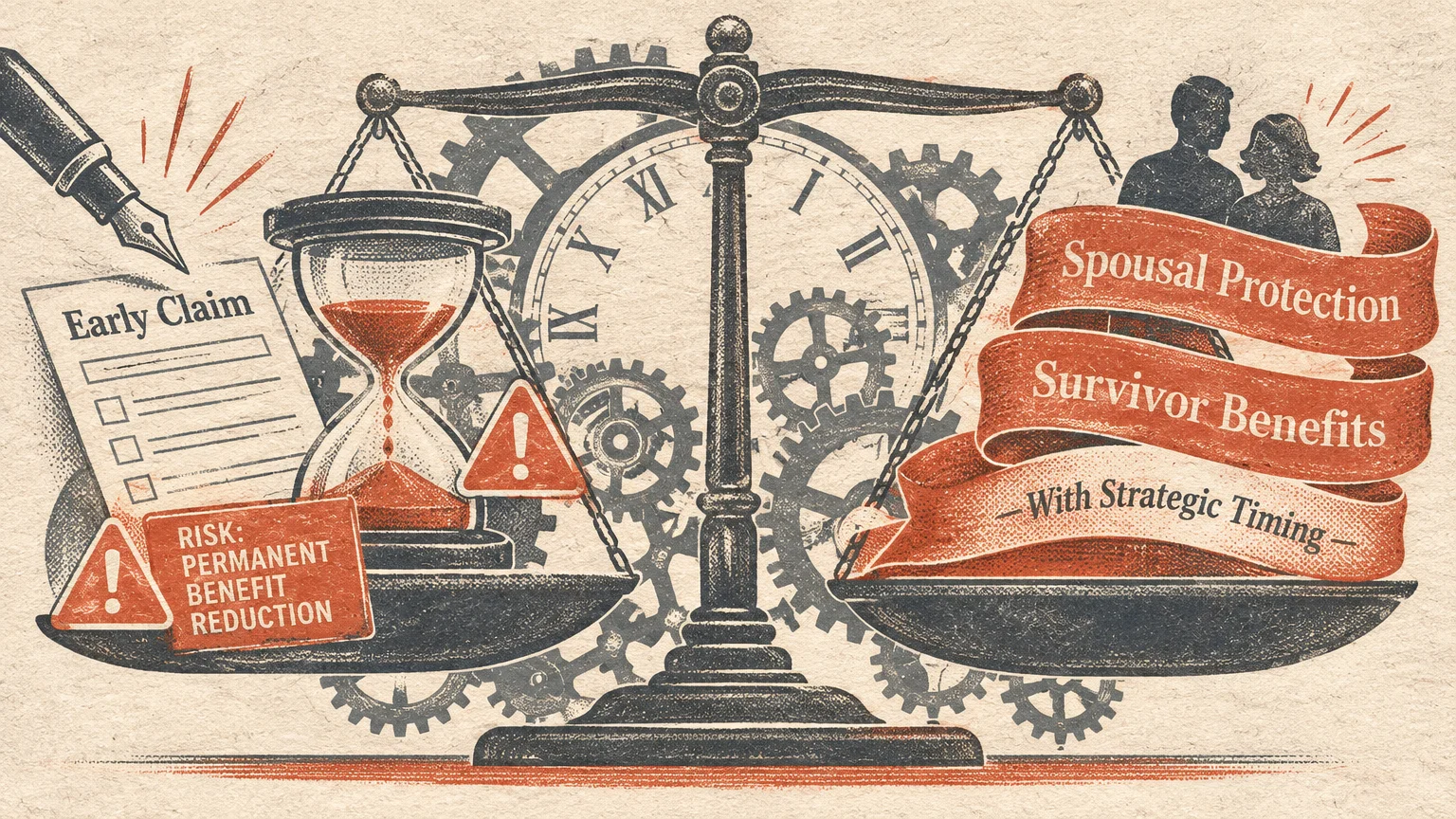
Small misunderstandings about SSA paperwork can lock in lower payments for life. Watch out for these four frequent mistakes before submitting your application:
- Filing at 62 out of panic: Taking benefits at 62 cuts your check by 30% permanently, which hurts most if you reach your late 80s or 90s.
- Assuming deemed filing blocks widow switching: Unlike spousal benefits, survivor benefits let you take one check early and switch to a larger own-record check at age 70.
- Forgetting ex-spouse or divorced survivor rights: If you were married at least 10 consecutive years, you may qualify for up to 50% while your ex is living or up to 100% as a survivor.
- Skipping a claim because of an old pension rule: Because the Social Security Fairness Act repealed WEP and GPO, retired teachers and public workers who previously received nothing may now qualify for full checks.
Double-checking your marriage certificates, divorce decrees, and annual wage statements prevents costly errors. For interactive tools on comparing claiming ages, visit the Consumer Financial Protection Bureau planning portal.
Finding the Right Advisor
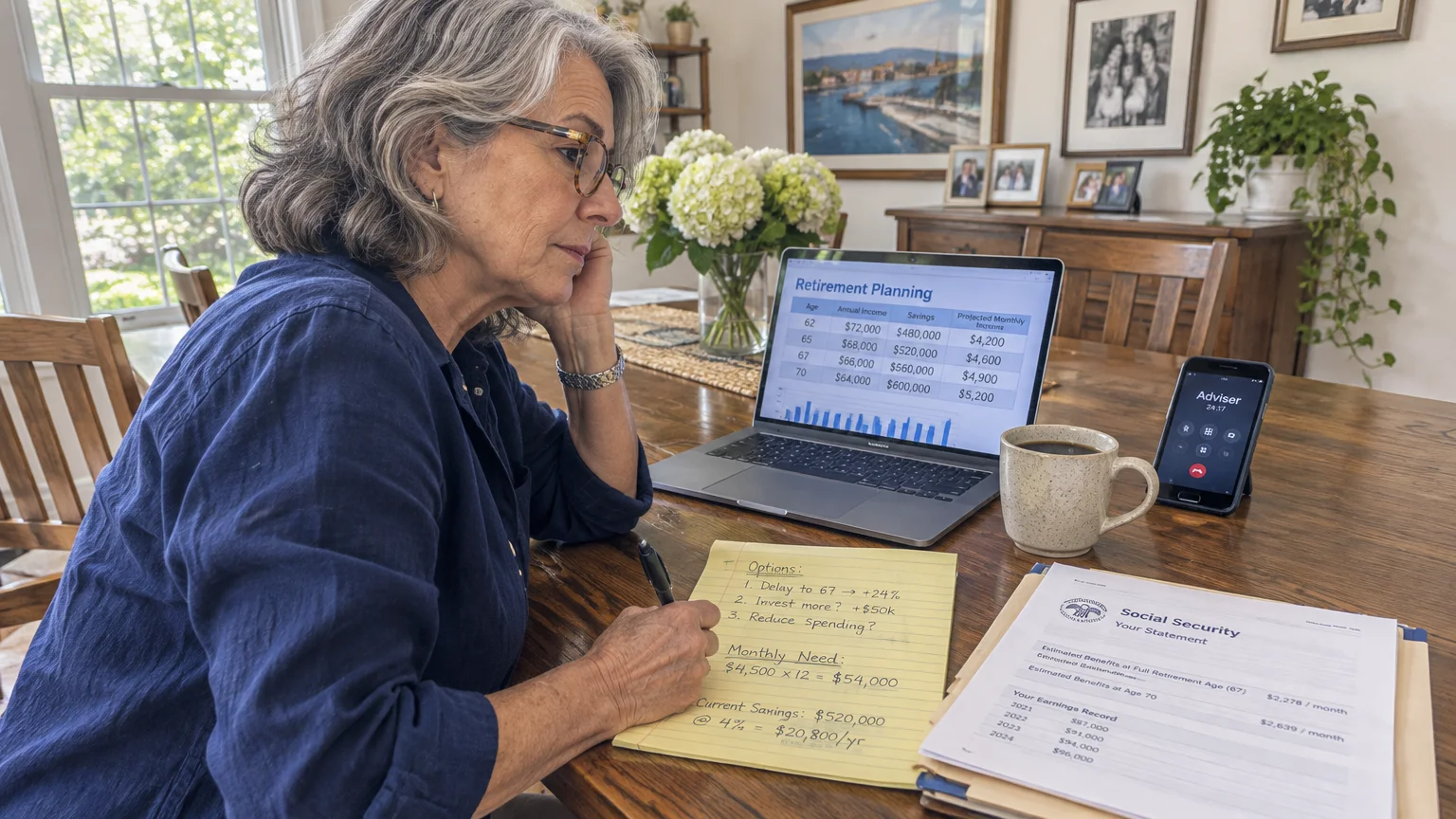
Many women handle straightforward retirement claims on their own using official SSA calculators. However, complex family histories or multiple income streams often justify sitting down with a fee-only financial planner or tax specialist.
Consider seeking professional guidance in these four situations:
- Coordinating with a higher-earning spouse: An advisor can model break-even ages so the higher earner delays to 70 while the lower earner brings in cash flow earlier.
- Managing a widow switching strategy: Comparing a reduced survivor check at 60 against your own delayed retirement benefit at 70 requires careful math across tax years.
- Balancing work, taxes, and Medicare: A tax professional can help you check Internal Revenue Service rules on how provisional income taxes your benefits alongside retirement withdrawals.
- Reviewing public-pension adjustments: If you receive a non-covered state or local pension, a specialist can confirm your retroactive and ongoing amounts following the WEP and GPO repeal.
Frequently Asked Questions
Why is the average Social Security benefit at 67 lower for women than for men?
Women averaged $1,801.82 per month at age 67 compared with $2,234.41 for men in December 2025 largely because benefits reflect your top 35 years of earnings. Lower average wages, caregiving breaks that leave $0 years in your record, and part-time schedules all reduce a worker’s lifetime average.
Can I collect Social Security on my ex-husband’s record without reducing his check?
Yes. If your marriage lasted at least 10 consecutive years, you are currently unmarried, and you are both at least 62, claiming divorced spousal benefits never lowers your ex-spouse’s monthly payment or affects his current family’s benefits.
If I am a widow, can I take survivor benefits early and switch to my own benefit at 70?
Yes. Because deemed filing rules do not apply to survivor benefits, you can claim survivor benefits as early as age 60—or age 50 if disabled—while allowing your own retirement benefit to earn 8% annual delayed credits up to age 70.
Did the Social Security Fairness Act eliminate reductions for retired teachers and public workers?
Yes. Signed in January 2025 and retroactive to January 2024, the law repealed both the Windfall Elimination Provision and the Government Pension Offset, restoring full earned, spousal, and survivor benefits for workers with non-covered government pensions.
Take ten minutes this week to sign into your online SSA account, confirm every year of your earnings record, and run estimates for ages 62, 67, and 70. Knowing your exact numbers gives you control over your retirement timeline and peace of mind for the decades ahead.
The information in this guide is meant for educational purposes. Your specific circumstances—including income, benefits, tax situation, and health needs—may require different approaches. When in doubt, consult a licensed financial advisor or tax professional.
Last updated: November 2026. Benefit amounts, tax rules, and program details change annually—verify current figures with official government sources.





Leave a Reply