


Getting a letter from the Social Security Administration that denies benefits or cuts your check feels stressful. The moment that letter arrives, a strict legal clock starts ticking on your rights.
Under the Social Security 60-day rule, you get two months to challenge most agency decisions. Missing that Social Security appeal deadline can force you to start over and lose past-due benefits.
Some overpayment and disability notices even use shorter 10-day or 30-day windows. Learning how these deadlines work helps you protect your monthly income and appeal rights.

How the 60-Day Clock Actually Works
Federal Social Security rules give you 60 days to appeal a written decision after you receive it. This rule covers retirement, survivor, disability, and Supplemental Security Income (SSI) claims.
The Social Security Administration (SSA) assumes you get a notice five days after the date printed on the letter. That gives you about 65 days from the letter date to file.
You can get more time if the mail takes longer than five days. Keep the postmarked envelope or save a screenshot from your online account to prove late delivery.
Weekends and federal holidays also help your timeline. If day 60 falls on a Saturday, Sunday, or federal holiday, your deadline moves to the next business day.
Never wait until the last week to act. Gathering medical records or tax papers takes time, and online forms can slow down near a cutoff date.
You can read letters and check your claim status on the Social Security Administration website. Setting up an online account lets you see notices days before paper mail arrives.
The Four Stages of a Benefit Denial Appeal
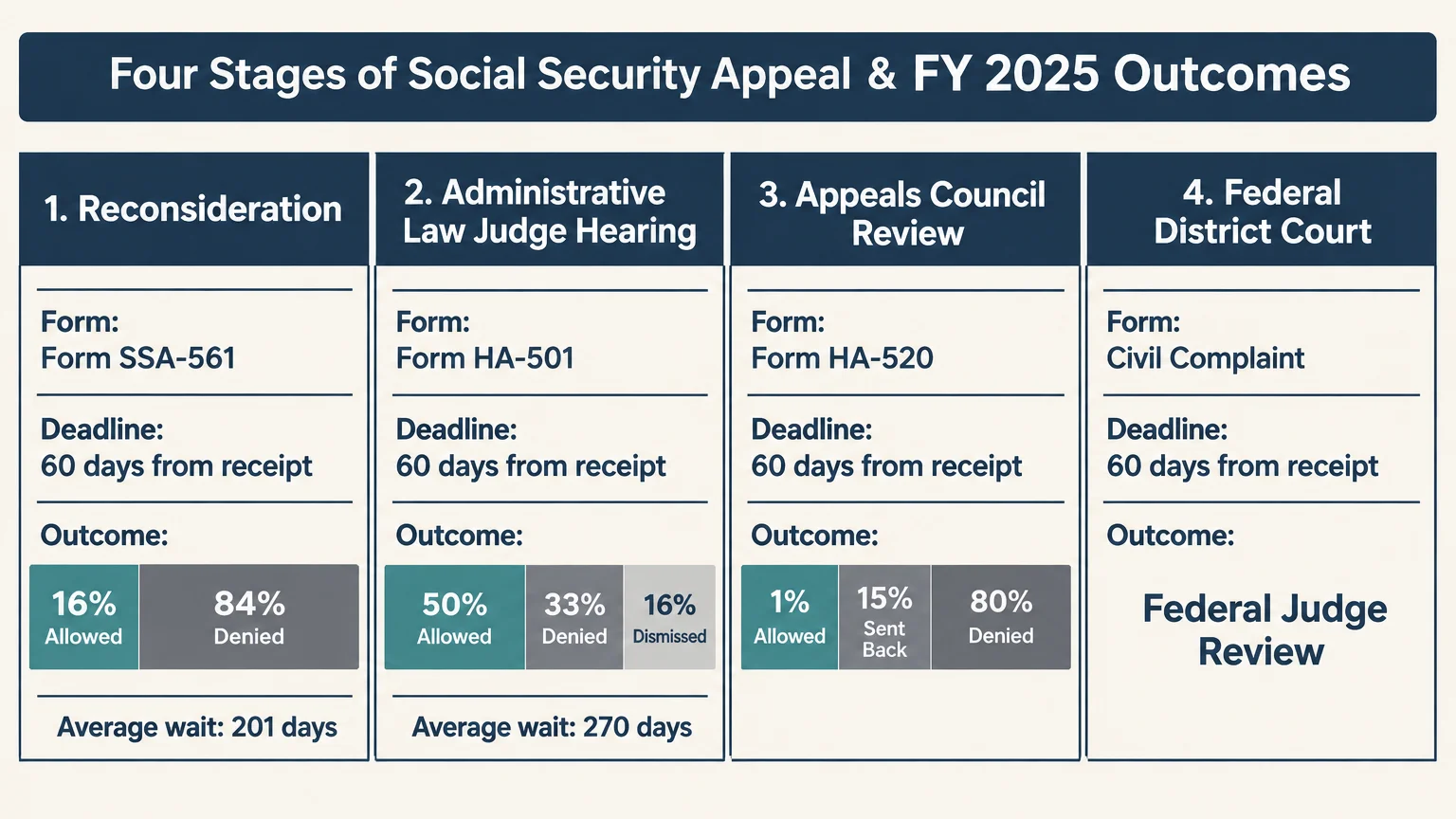
A benefit denial appeal follows four set steps, and the 60-day clock resets at each stage. Most people who win their case succeed by sticking with the process.
Your first step is a reconsideration request, where a new reviewer checks your file. You can file online or submit Form SSA-561 by mail or in person.
Medical disability appeals also need Form SSA-3441 for new health updates and Form SSA-827 to release records. If SSA stopped an existing disability check, download Form SSA-789 instead.
Reconsideration applies in every state, though approval odds stay low at this stage. In fiscal year 2025, SSA approved only 16% of reconsideration claims and denied 84%.
Wait times are also long, averaging 201 days in September 2026. If SSA denies your reconsideration request, you get another 60 days to ask for a hearing.
Your second step is a hearing before an Administrative Law Judge using Form HA-501. SSA must mail your hearing date notice at least 75 days ahead of time.
You must turn in or list any new written evidence at least five business days before your hearing. Judges approved 50% of all hearing cases in fiscal year 2025.
Excluding dismissed claims, the national judge approval rate reached 57.5% in fiscal year 2026. Average waits for a hearing decision ran 270 days across fiscal year 2026.
If a judge says no, your third step is asking the Appeals Council to review the ruling using Form HA-520. The fourth step is filing a civil lawsuit in federal court.
| Appeal Stage | Form Needed | Deadline | FY 2025 Outcome |
|---|---|---|---|
| 1. Reconsideration | SSA-561 (plus SSA-3441 and SSA-827 for disability) | 60 days from receipt | 16% allowed, 84% denied |
| 2. Administrative Law Judge Hearing | HA-501 | 60 days from receipt | 50% allowed, 33% denied, 16% dismissed |
| 3. Appeals Council Review | HA-520 | 60 days from receipt | 1% allowed, 15% sent back, 80% denied |
| 4. Federal District Court | Civil complaint | 60 days from receipt | 1% allowed, 65% sent back, 30% denied |
The Appeals Council and federal judges rarely grant benefits outright, but they often send flawed cases back for a new hearing. That second look gives many claimants a fresh chance to win.
Shorter Deadlines That Catch Seniors Off Guard
Relying only on the 60-day rule can hurt you when SSA says it paid you too much. Overpayment letters carry a hidden timer that starts much sooner.
You still get 60 days to appeal an overpayment decision or ask for a lower balance with Form SSA-561. You can also ask SSA to waive the debt using Form SSA-632 at any time.
However, you must file that appeal or waiver within 30 days to pause collection. If you miss day 30, SSA can start taking money out of your checks right away.
For retirement, survivor, and disability notices sent on or after April 25, 2025, SSA defaults to taking 50% of your monthly benefit. SSI overpayment withholding stays capped at 10%.
Disability and SSI checks also have a fast 10-day rule if SSA tries to stop payments. Filing within 10 days keeps your monthly check coming while you wait for a review.
If you file an SSI non-medical appeal between days 11 and 60, payments stop temporarily. They restart once SSA enters your appeal into its system.
Medicare Part B and Part D income surcharges work differently from regular appeals. In 2026, the standard Medicare Part B premium is $202.90 per month.
Extra surcharges, called IRMAA, start when your 2024 income topped $109,000 as a single filer or $218,000 for married couples filing jointly. You can check your past tax return figures on the IRS website.
If your income dropped because you retired, lost a spouse, or lost a pension, file Form SSA-44 instead of a standard appeal. Form SSA-44 covers eight major life events and has no 60-day cutoff.
Only use the 60-day Form SSA-561 if SSA turns down your Form SSA-44 request. Mixing up those two forms is a common mistake that delays premium relief.

What Can Go Wrong If You Miss the Deadline
Missing the 60-day Social Security appeal deadline turns a bad decision into a final one. Once it becomes final, you lose your right to fight that ruling at the next level.
Many people try to fix a missed deadline by filing a brand-new application. That mistake resets your claim date and can wipe out huge sums of back pay.
For disability claims, back pay can go back at most 12 months before your new filing month. For SSI, SSA pays zero benefits for any month before you reapply.
- Waiting past day 30 on an overpayment notice, which triggers automatic monthly check reductions before SSA reviews your waiver request.
- Sending Form SSA-561 instead of Form SSA-44 after retiring, which slows down Medicare Part B premium relief.
- Missing the five-business-day deadline to submit new doctor records before an Administrative Law Judge hearing.
- Throwing away the mailing envelope, leaving you with no proof if a notice arrived weeks late.
Avoiding these four traps keeps your appeal moving and protects your household budget. You can also check local support programs through the National Council on Aging if a delay hurts your budget.

Good Cause Extensions and Reopening Old Decisions
If you already missed the 60-day mark, do not give up right away. Social Security rules let you ask for extra time in writing if you show good cause.
SSA looks at your physical, mental, reading, or language limits when judging good cause. Valid reasons also include a serious illness, a death in your immediate family, or records destroyed in a fire.
You also qualify if SSA gave you wrong advice or mailed the letter to a wrong address. People with severe mental limits and no legal help can get more time even years later.
Even without an appeal, SSA can reopen closed retirement, survivor, or disability decisions. The agency can reopen a case within 12 months for any reason, or within four years for good cause.
Write a short, signed letter explaining the exact reason you filed late and attach proof like hospital bills. File that letter together with your completed appeal form right away.
When to Consult a Professional
You can handle a simple clerical error or a routine Form SSA-44 filing on your own. Still, some situations put too much monthly income at risk to go it alone.
Consider calling a disability lawyer, accredited representative, or financial advisor in these cases:
- You receive an overpayment bill that threatens to take half your monthly Social Security check.
- Your reconsideration request fails and you need to prepare for a judge hearing.
- You missed the 60-day cutoff and must write a formal good cause request.
- Your Medicare surcharge involves business sales, pensions, or complex retirement tax rules.
You can search for trusted legal help and state benefit counselors through USA.gov Benefits. Getting guidance early often saves months of wasted paperwork.

Common Questions About the 60-Day Rule
Does the 60-day rule apply to Medicare surcharge appeals?
Yes, if you file a formal appeal using Form SSA-561-U2 after SSA denies a Medicare surcharge request. However, filing Form SSA-44 for one of eight major life events has no 60-day limit.
What happens if I appeal an overpayment after 30 days?
You can still file an appeal up to day 60, or request a waiver anytime. Because you passed day 30, SSA can start taking 50% of a retirement or disability check while reviewing your case.
How do I prove my Social Security letter arrived late?
Save the envelope showing a late postmark date, or print your online notice history. Attach a copy to your appeal form and write a brief note asking SSA to honor the true delivery date.

Protect Your Deadline Starting Today
Check the date on any Social Security letter the same day you open it, and mark day 30 and day 60 on your calendar. Keeping your paperwork dated and organized gives you the best shot at keeping every dollar you earned.
The information in this guide is meant for educational purposes. Your specific circumstances—including income, benefits, tax situation, and health needs—may require different approaches.
When in doubt, consult a licensed financial advisor or tax professional.
Last updated: November 2026. Benefit amounts, tax rules, and program details change annually—verify current figures with official government sources.





Leave a Reply