

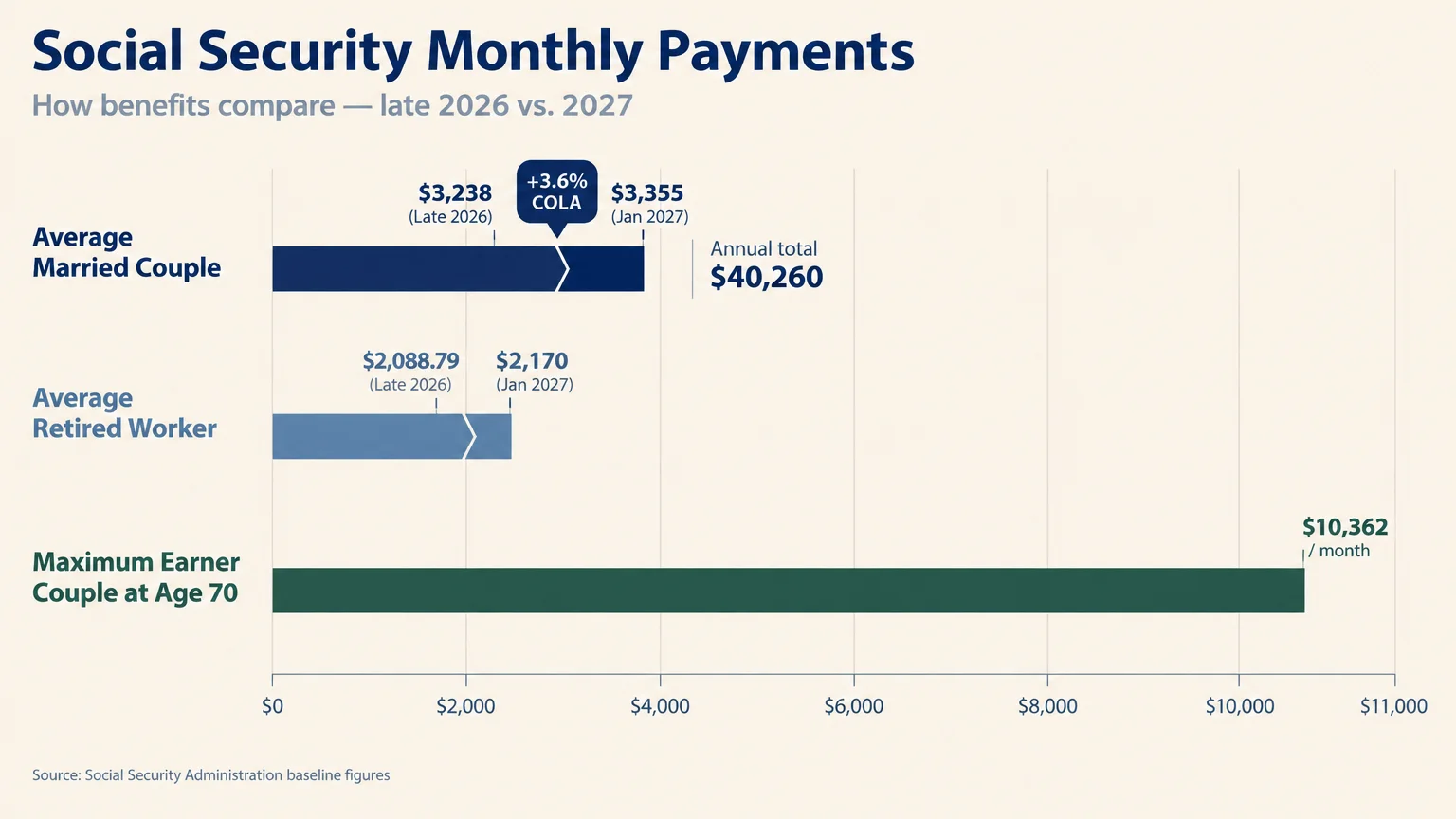
The average married couple collects $3,238 per month from Social Security in late 2026, rising to $3,355 in January 2027. Yet many couples leave tens of thousands of dollars on the table simply by claiming too early.
Coordinating your filing strategy with your spouse can substantially boost your lifetime household income. Understanding how spousal rules, cost-of-living adjustments, and delayed credits interact gives you complete control over your retirement checks.
With the right planning, you can transform an average joint benefit into a durable, inflation-protected financial foundation.
The Baseline: What the Average Married Couple Collects Today
According to the Social Security Administration, the average benefit for an aged couple where both spouses receive benefits started at $3,208 per month in January 2026. That equaled an annual household baseline of $38,496.
By late 2026, natural wage adjustments brought that joint average to $3,238 per month. On October 14, 2026, the agency announced a 3.6% Cost-of-Living Adjustment (COLA) taking effect in January 2027.
This 3.6% boost will lift the average married couple’s payment to $3,355 per month in 2027. That adjustment provides typical retired couples with $40,260 per year in guaranteed federal income.
For individual retired workers, the monthly check averaged $2,071 in January 2026 and reached $2,088.79 by September 2026. Following the upcoming COLA, the typical individual benefit rises to $2,170 per month in January 2027.
However, wide disparities exist between the average payout and the maximum legal thresholds. In 2026, a worker retiring at Full Retirement Age (FRA) can collect up to $4,152 monthly, increasing to $4,188 in 2027.
If you delay claiming until age 70, the individual maximum benefit jumps to $5,181 per month in 2026. A married couple who both earned at the maximum wage cap for 35 years can collect a staggering joint total of $10,362 per month.
The maximum taxable earnings cap sits at $184,500 in 2026 and expands to $192,300 in 2027. Understanding where your earnings fall against these metrics helps you benchmark your financial progress.
Understanding How Spousal Benefits Really Work
Spousal benefits allow one partner to receive retirement income based on the other spouse’s work record. This provision provides essential security when one spouse earned significantly more during their working career.
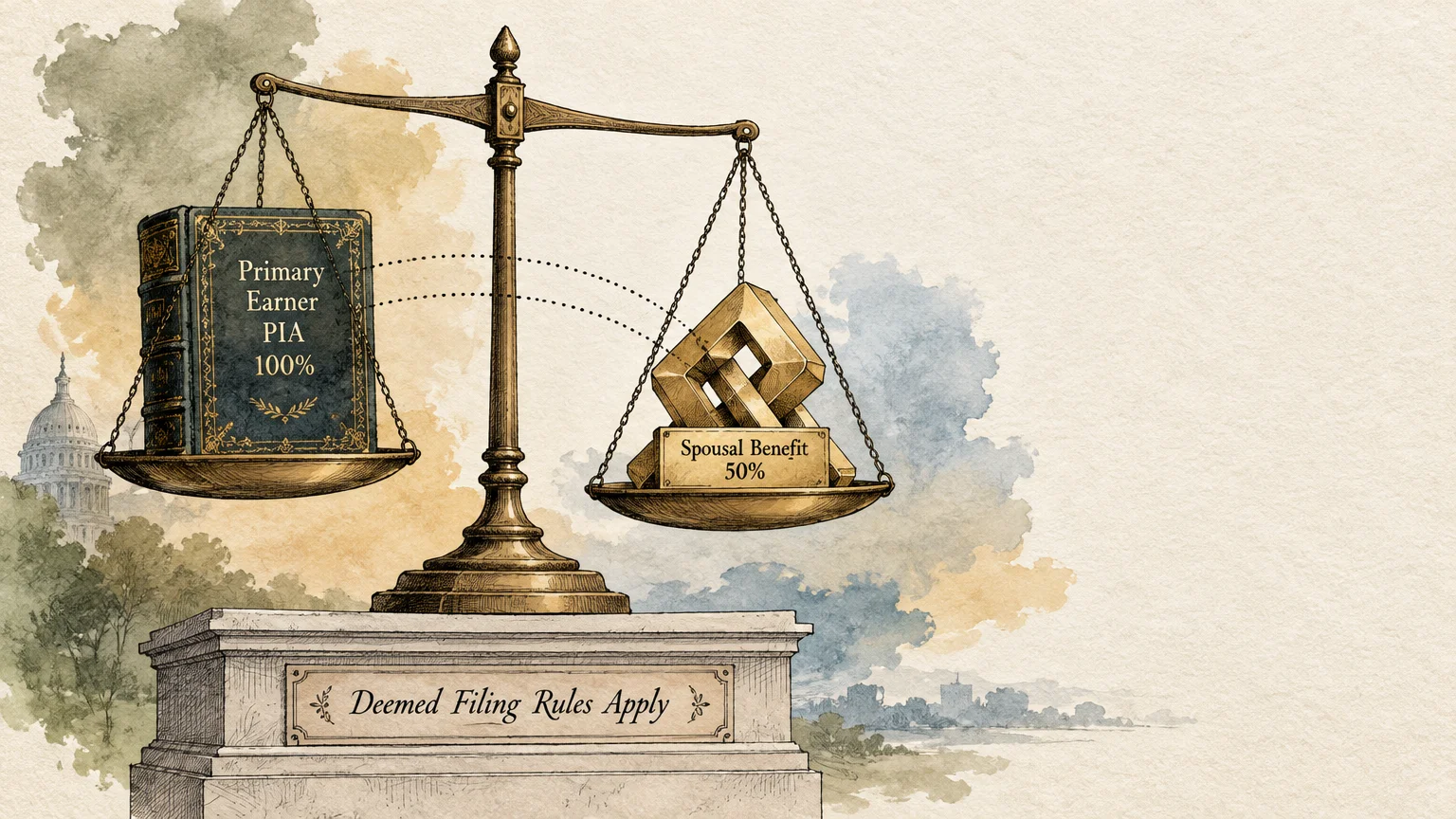
Under federal guidelines, a spousal benefit can equal up to 50% of the primary earner’s Primary Insurance Amount. That calculation relies on the primary earner’s benefit at Full Retirement Age, not an early reduced rate.
As of September 2026, spouses claiming on a partner’s record received an average monthly payment of $986.68. With the 3.6% COLA taking effect in January 2027, the average spousal check crosses $1,022 per month.
To qualify for spousal benefits, you must be married for at least one continuous year. Divorced spouses can also claim on an ex-partner’s record if the marriage lasted at least 10 years and the claimant remains unmarried.
Timing your spousal claim makes an immense difference to your monthly payout. If you file for spousal benefits at age 62, your payment drops permanently to 32.5% of your partner’s baseline amount.
Critically, spousal benefits do not earn delayed retirement credits. While your own worker benefit grows by 8% per year past Full Retirement Age, a spousal benefit stops growing once you reach age 67.
The Bipartisan Budget Act eliminated the older “restricted application” claiming loophole for anyone born after January 1, 1954. Today, filing triggers “deemed filing,” meaning you automatically apply for both your own benefit and spousal benefits simultaneously.
The system will evaluate both earnings histories and automatically award you the higher amount. You cannot collect your spousal benefit while letting your own record accumulate credits in the background.
The Staggered Claiming Strategy for Couples
Filing for benefits at the exact same moment rarely produces the highest lifetime income for a married couple. Instead, using a staggered claiming strategy often generates hundreds of thousands of dollars in additional wealth.
Full Retirement Age stands at 66 years and 10 months for individuals born in 1959. For everyone born in 1960 or later, Full Retirement Age is exactly 67.
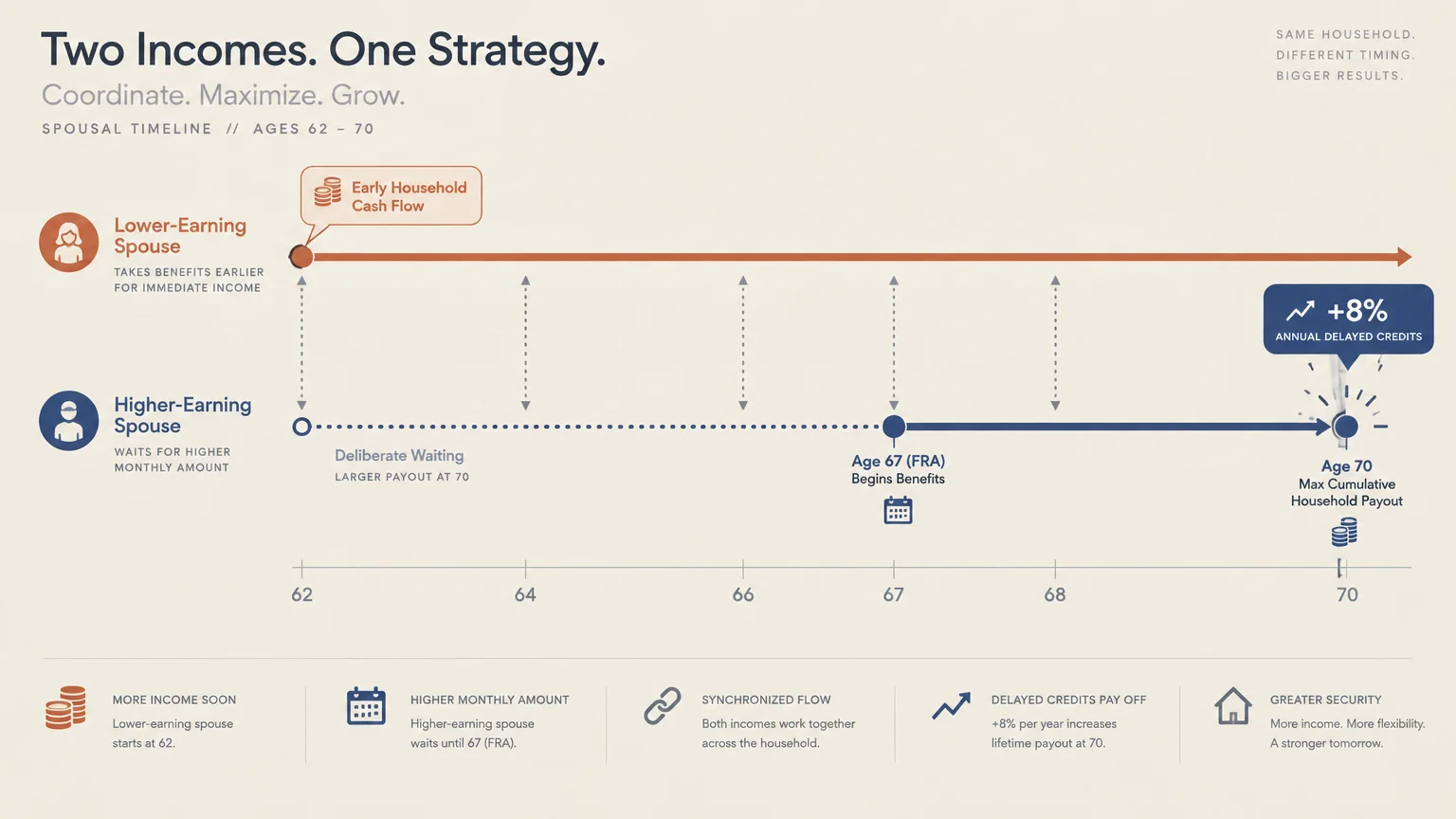
Claiming your worker benefit at age 62 triggers a permanent 30% reduction if your Full Retirement Age is 67. Conversely, delaying beyond age 67 adds 8% per year in delayed retirement credits up to age 70.
In a staggered approach, the lower-earning spouse files earlier—either at age 62 or at Full Retirement Age. This initial claim establishes immediate household cash flow to cover daily living expenses.
Meanwhile, the higher-earning spouse delays filing until age 70. This delay maximizes the primary check by an extra 24% over the baseline amount, locking in the largest possible cost-of-living increases.
Every future annual COLA adjustment gets calculated as a percentage of your total benefit. By building the largest possible baseline on your primary check, you compound the dollar value of every cost-of-living bump.
Before implementing this strategy, review your liquid savings and personal health indicators. A staggered strategy requires sufficient interim assets to bridge the gap while the higher earner delays claiming.
Timing Comparison: Claiming at 62, 67, and 70
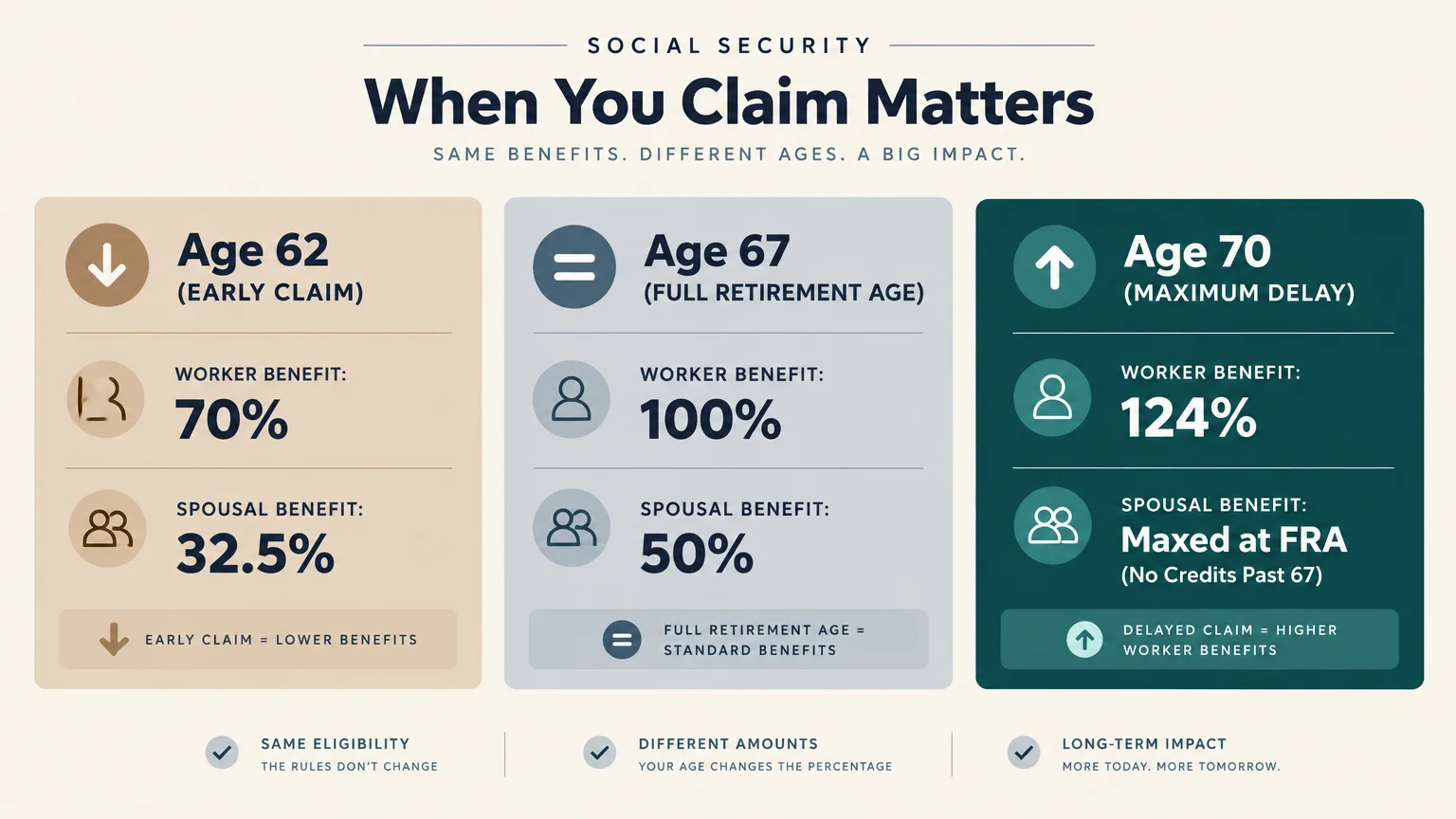
To visualize how claiming ages shape your household cash flow, examine the exact reduction and credit percentages set by federal law.
| Claiming Age | Worker Benefit (% of PIA) | Spousal Benefit (% of PIA) | Key Strategic Outcome |
|---|---|---|---|
| Age 62 | 70.0% | 32.5% | Immediate cash flow; permanent 30% reduction on worker benefit. |
| Age 67 (FRA) | 100.0% | 50.0% | Full baseline benefit; maximum available spousal payout achieved. |
| Age 70 | 124.0% | 50.0% (No extra credits) | Maximum worker check; builds largest long-term survivor protection. |
Consider a practical example using John and Mary, both born in 1960 with a Full Retirement Age of 67. John’s benefit at Full Retirement Age is $3,000 per month, while Mary’s baseline benefit is $1,200.
If John and Mary both claim early at age 62, severe permanent cuts apply to their checks. John receives $2,100 per month, while Mary receives $840, providing a combined monthly household income of $2,940.
If they both wait until Full Retirement Age at 67, John collects his full $3,000 monthly check. Mary collects her $1,200, bringing their combined household baseline to $4,200 every month.
Now consider the staggered approach where Mary claims her $1,200 at age 67, but John delays until age 70. John’s benefit surges by 24% to $3,720 per month.
When combined with Mary’s $1,200 check, their joint monthly income expands to $4,920. That staggered choice generates an extra $1,980 each month compared to claiming at age 62.

Protecting the Surviving Spouse Through Strategic Delay
Planning for Social Security is not just about joint income while both partners are alive. It is equally about protecting the spouse who outlives the other.
When one spouse dies, household income inevitably contracts because one of the two checks stops immediately. The surviving partner only keeps the higher of the two monthly payments.
According to federal records, the average survivor benefit for an aged widow or widower living alone was $1,936 in late 2026. The 2027 COLA will increase that typical survivor benefit to $2,005 per month.
A surviving spouse steps up to 100% of the deceased spouse’s actual payment. This rule includes all the 8% annual delayed retirement credits the primary earner earned before passing away.
If the higher-earning partner claims at age 62, they permanently reduce the survivor benefit for their partner. Delaying until age 70 builds the largest possible financial shield for the surviving spouse.
“Delaying Social Security is the single best longevity insurance you can buy, especially for a surviving spouse.” — Suze Orman, Personal Finance Expert
Because women statistically outlive men on average, a husband’s decision to delay claiming often protects his wife deep into her retirement years. This guaranteed, inflation-adjusted survivor check prevents late-life financial distress.
You can research survivor eligibility guidelines directly through the Consumer Financial Protection Bureau to understand how household budgeting changes after a loss.
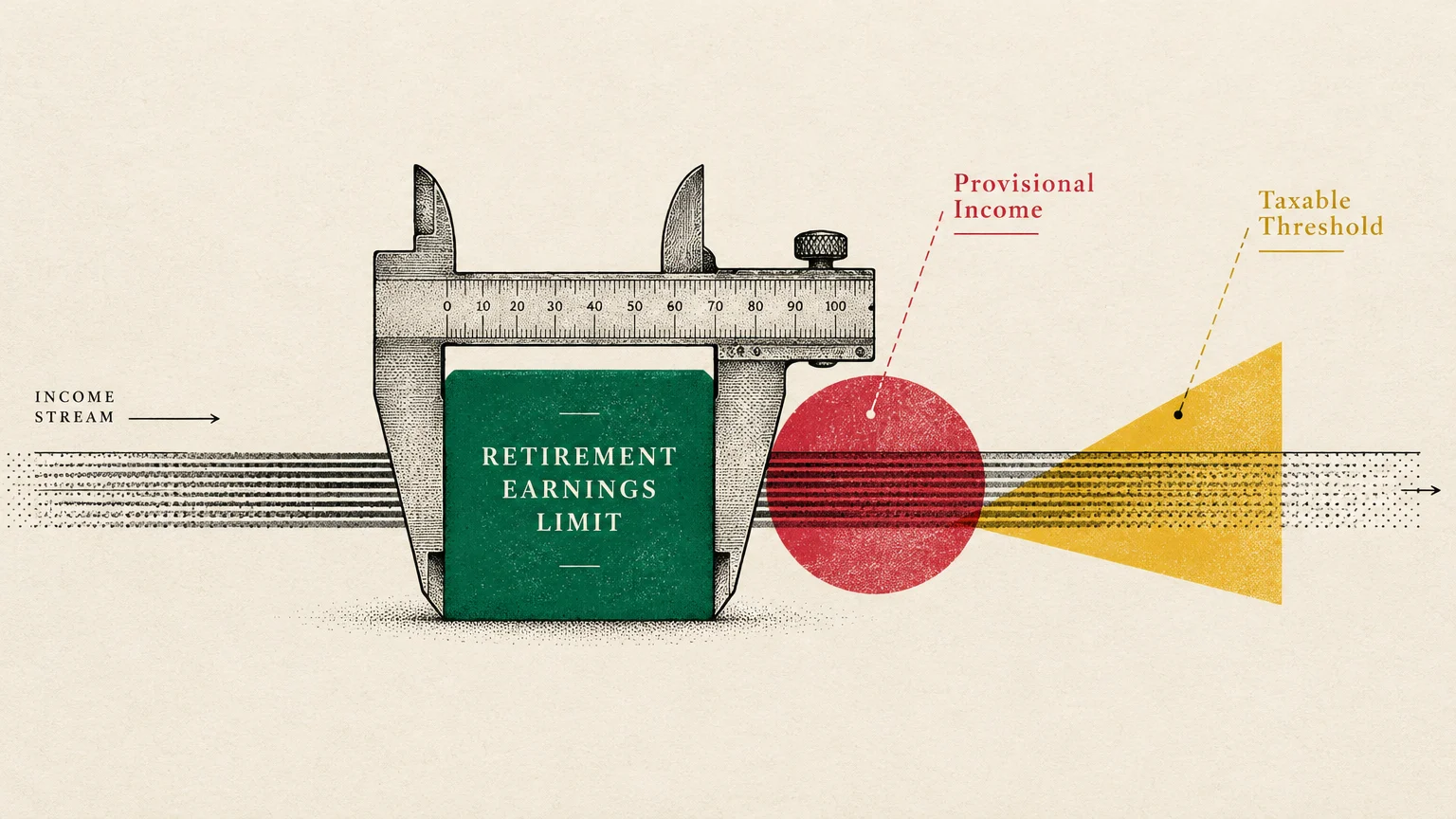
The Retirement Earnings Test and Tax Traps
Continuing to work while collecting Social Security requires careful monitoring if you have not reached Full Retirement Age. The Retirement Earnings Test temporarily withholds benefits when your wages exceed statutory limits.
In 2026, the earnings limit is $24,480 for workers who remain under Full Retirement Age for the entire year. The agency withholds $1 of benefits for every $2 you earn above that threshold.
During the year you reach Full Retirement Age, a more generous threshold applies. In 2026, the limit rises to $65,160, and the agency withholds $1 for every $3 earned above that number.
Only income earned prior to the exact month you reach Full Retirement Age counts toward the penalty. Once you hit your Full Retirement Age, the earnings limit disappears entirely, allowing unlimited wages.
Taxes represent another major hurdle for married couples, governed by rules enforced by the Internal Revenue Service. The federal government taxes your benefits based on your combined provisional income.
Your provisional income equals your Adjusted Gross Income, plus any nontaxable interest, plus 50% of your total household Social Security benefits. These thresholds are not indexed for inflation and have remained fixed for decades.
For married couples filing jointly with provisional income between $32,000 and $44,000, up to 50% of benefits face federal income tax. When your joint provisional income exceeds $44,000, up to 85% of your benefits become taxable.
Distributions from traditional IRAs, 401(k) plans, and part-time jobs push many unsuspecting couples past that $44,000 threshold. Strategic withdrawals from Roth accounts can keep your provisional income below these tax cliffs.

Common Mistakes to Avoid
Navigating Social Security involves intricate regulations where simple oversights can cost your household thousands of dollars. Avoid these critical errors when structuring your joint retirement plan.
- Filing Early Without Joint Coordination: Many couples rush to claim at 62 simply because the money becomes available. Doing so locks in a permanent 30% reduction and damages the future survivor benefit.
- Waiting Past Age 67 for Spousal Benefits: Unlike personal retirement benefits, spousal benefits do not accumulate delayed retirement credits. Delaying a spousal claim past Full Retirement Age permanently wastes monthly income.
- Ignoring the Survivor Benefit Transition: Couples often evaluate two checks while ignoring the financial shock when one partner dies. Maximizing the higher earner’s benefit guarantees the survivor maintains adequate income.
- Triggering the Tax Torpedo Unprepared: Taking large traditional retirement account withdrawals alongside Social Security can push 85% of your benefits into taxable territory. Coordinate your distributions carefully.
Take the time to model out both of your earnings histories together rather than treating your benefits as independent accounts. A unified household approach consistently yields superior results.

Finding the Right Advisor
While many couples manage their Social Security decisions independently, certain complex situations benefit from professional guidance. A qualified fiduciary advisor can evaluate how your claiming timeline interacts with your broader portfolio.
Consider seeking advice if you and your spouse have a significant age difference of five or more years. Large age gaps require specialized timing to avoid leaving younger spouses without adequate income.
Professional advice also helps when balancing pension plans affected by the Windfall Elimination Provision or Government Pension Offset. These rules reduce Social Security payouts for those who worked in non-covered public sector jobs.
You should also consult an advisor if you hold substantial assets in tax-deferred retirement accounts. Coordinating required minimum distributions with your benefit start dates avoids catastrophic tax brackets.
When searching for professional help, look for fee-only Certified Financial Planners (CFPs) or CPAs who act as strict fiduciaries. Avoid salespeople who push proprietary annuity products disguised as Social Security optimization tools.
Frequently Asked Questions
Can my spouse get half my Social Security if they never worked?
Yes, your spouse can collect up to 50% of your Full Retirement Age benefit even with no personal earnings history. They must be at least 62 years old, and you must have already filed for your own retirement benefit.
What happens to our benefits if both spouses delay until age 70?
Both partners earn the maximum 8% annual delayed credits on their individual work records up to age 70. This creates the highest guaranteed household cash flow, provided both spouses have strong individual earnings histories.
Can a divorced spouse claim benefits without their former partner knowing?
Yes, a divorced spouse can file directly through the Social Security Administration without notifying their ex-partner. The claim has zero impact on the former spouse’s benefit amount or their current spouse’s payments.
How does the 2027 COLA affect our joint benefits?
The 3.6% adjustment announced for January 2027 applies automatically to all existing benefits. The average married couple will see their monthly payments rise from $3,238 to approximately $3,355 starting in January 2027.
Next Steps for Your Retirement
Start by creating personal accounts on the official Social Security portal to inspect your detailed earnings records. Verify that the government has accurately logged every year of your historical earnings history.
Next, calculate your household budget and model different claiming scenarios using your actual Full Retirement Age numbers. Discuss your health history, expected longevity, and post-retirement income goals with your partner.
This article provides general financial education and information only. Everyone’s financial situation is unique—what works for others may not work for you. For personalized advice tailored to your retirement needs, consider consulting a qualified financial professional such as a CFP or CPA.
Last updated: October 2026. Benefit amounts, tax rules, and program details change annually—verify current figures with official government sources.









Leave a Reply