

With nursing home costs averaging over $9,500 per month, long-term care can rapidly drain your life savings. Medicaid covers comprehensive nursing home care, but securing eligibility requires meeting strict income, asset, and medical requirements.
Qualifying for coverage does not mean you must surrender your home or leave your spouse impoverished. Federal and state laws offer legal pathways to protect essential assets while obtaining necessary care.
This guide explains the eligibility rules, spend-down strategies, and critical timing considerations you need to successfully navigate the Medicaid application process.
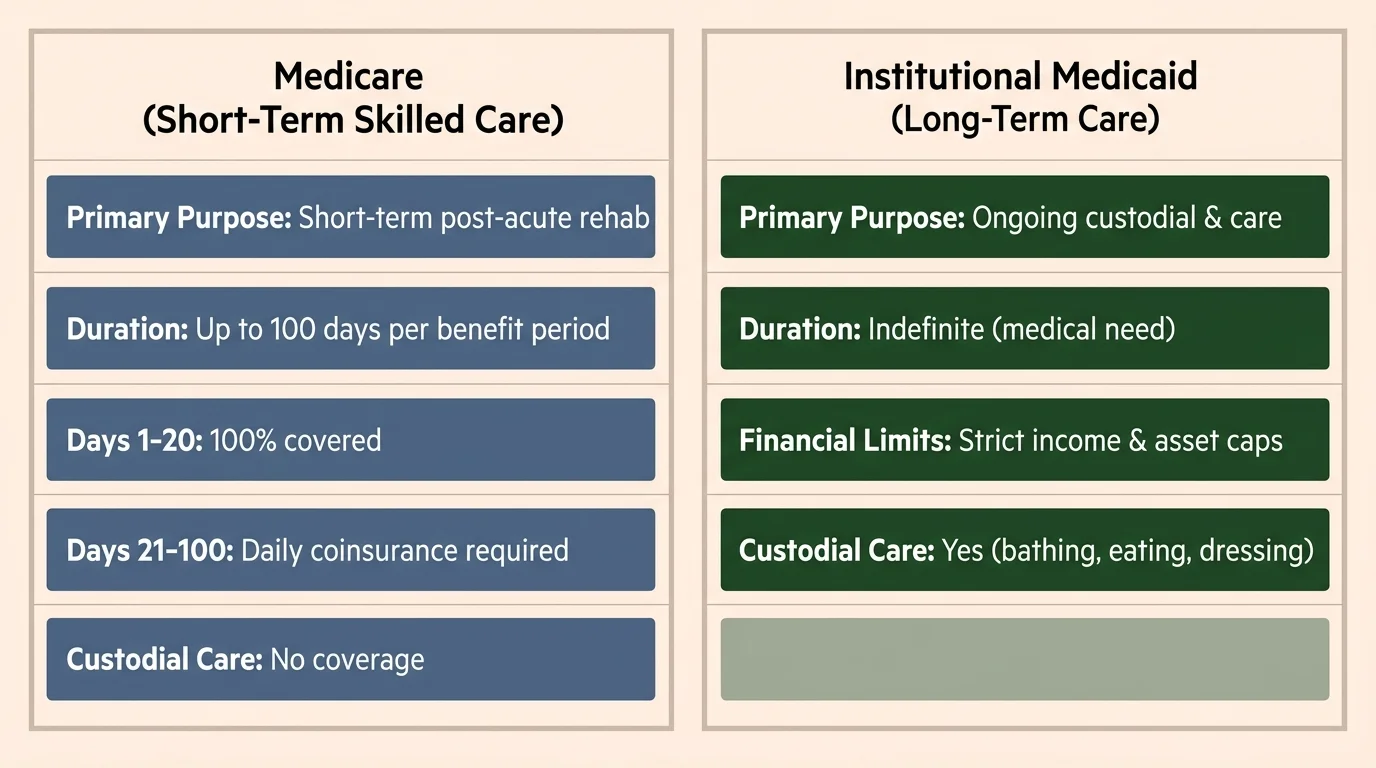
Understanding Institutional Medicaid vs. Medicare Coverage
Many seniors assume Medicare will pay for their extended nursing home stay. In reality, Medicare offers very limited long-term care benefits; it pays only for short-term rehabilitation following a qualifying inpatient hospital stay of at least three consecutive days.
According to Medicare.gov, Medicare covers up to 100 days of skilled nursing care per benefit period. Days 1 through 20 are covered at 100%, but days 21 through 100 require a substantial daily coinsurance payment. After day 100, Medicare pays nothing for custodial care—the assistance with daily living activities that most nursing home residents require.
Institutional Medicaid, by contrast, serves as the primary government payer for indefinite, long-term nursing home care. When you qualify for Medicaid long-term care coverage, the program pays the nursing facility directly for your room, board, and medical care, minus a small personal needs allowance that you retain each month.
| Feature | Medicare | Medicaid (Institutional) |
|---|---|---|
| Primary Purpose | Short-term post-acute rehabilitation | Ongoing, long-term custodial and medical care |
| Maximum Duration | Up to 100 days per benefit period | Indefinite (as long as medical need persists) |
| Financial Qualification | None (based on work history/age) | Strict income and asset limits |
| Custodial Care Coverage | No (only skilled medical services) | Yes (bathing, dressing, eating, mobility) |
| Cost Sharing | Daily coinsurance after day 20 | Income paid to facility; resident keeps small allowance |

Medicaid Long-Term Care Eligibility Requirements
To have Medicaid pay for a nursing facility, you must satisfy three distinct criteria: functional need, income limitations, and asset thresholds.
- Medical and Functional Necessity: You must require a “nursing facility level of care” (NFLOC). State evaluators determine this by assessing your ability to complete Activities of Daily Living (ADLs), such as bathing, dressing, eating, transferring from bed to chair, toileting, and managing cognitive impairments like dementia.
- Income Limits: Your gross monthly income from all sources—including Social Security, pensions, and annuities—must fall below your state’s established ceiling.
- Asset Limits: You must possess very limited countable financial resources, typically capped at $2,000 for an individual applicant in most states.
- Residency and Status: You must be a U.S. citizen or qualified legal immigrant and reside in the state where you submit your application. You can review broader assistance guidelines at Benefits.gov.
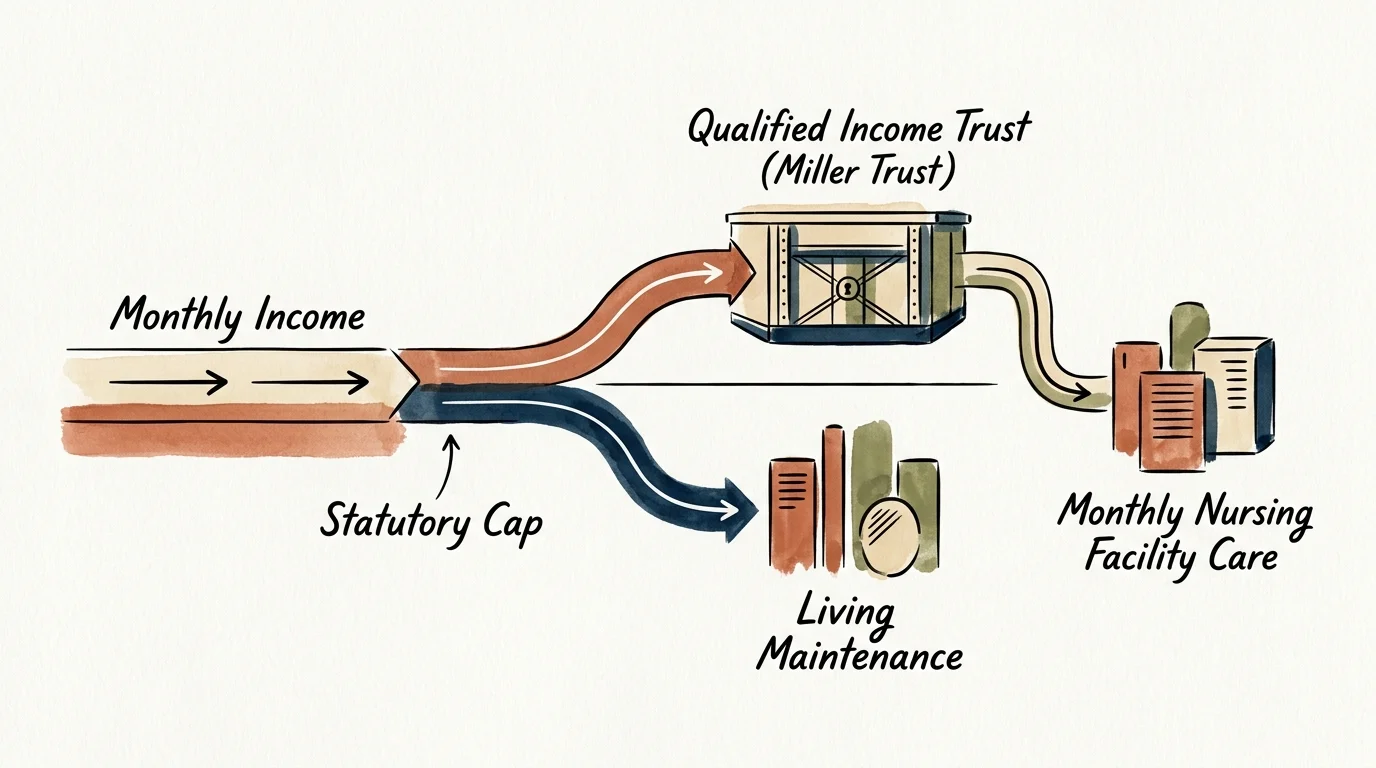
Income Limits and Qualified Income Trusts (Miller Trusts)
In most states categorized as “income cap” states, an individual applicant’s gross monthly income cannot exceed 300% of the federal Supplemental Security Income (SSI) standard. For 2025 and 2026, this threshold is set at $2,982 per month. If your monthly income is below this limit, you meet the financial income test.
If your monthly income exceeds $2,982, you do not automatically lose eligibility. The solution depends on how your state manages excess income:
- Qualified Income Trusts (QITs / Miller Trusts): In income-cap states, you can establish an irrevocable Qualified Income Trust. You deposit your excess monthly income into the trust bank account each month. Medicaid excludes this routed income from eligibility calculations, and the funds are paid directly to the nursing home toward your patient liability share.
- Medically Needy / Spend-Down Programs: In non-income-cap states, you qualify through a spend-down program. You use your excess monthly income to pay for your recurring medical bills and nursing home costs; once your remaining income drops below the state standard, Medicaid covers the balance.
“Long-term care is one of the greatest financial threats facing retirees today. Planning ahead gives you options that vanish when a medical crisis strikes.” — Suze Orman, Personal Finance Author & Host
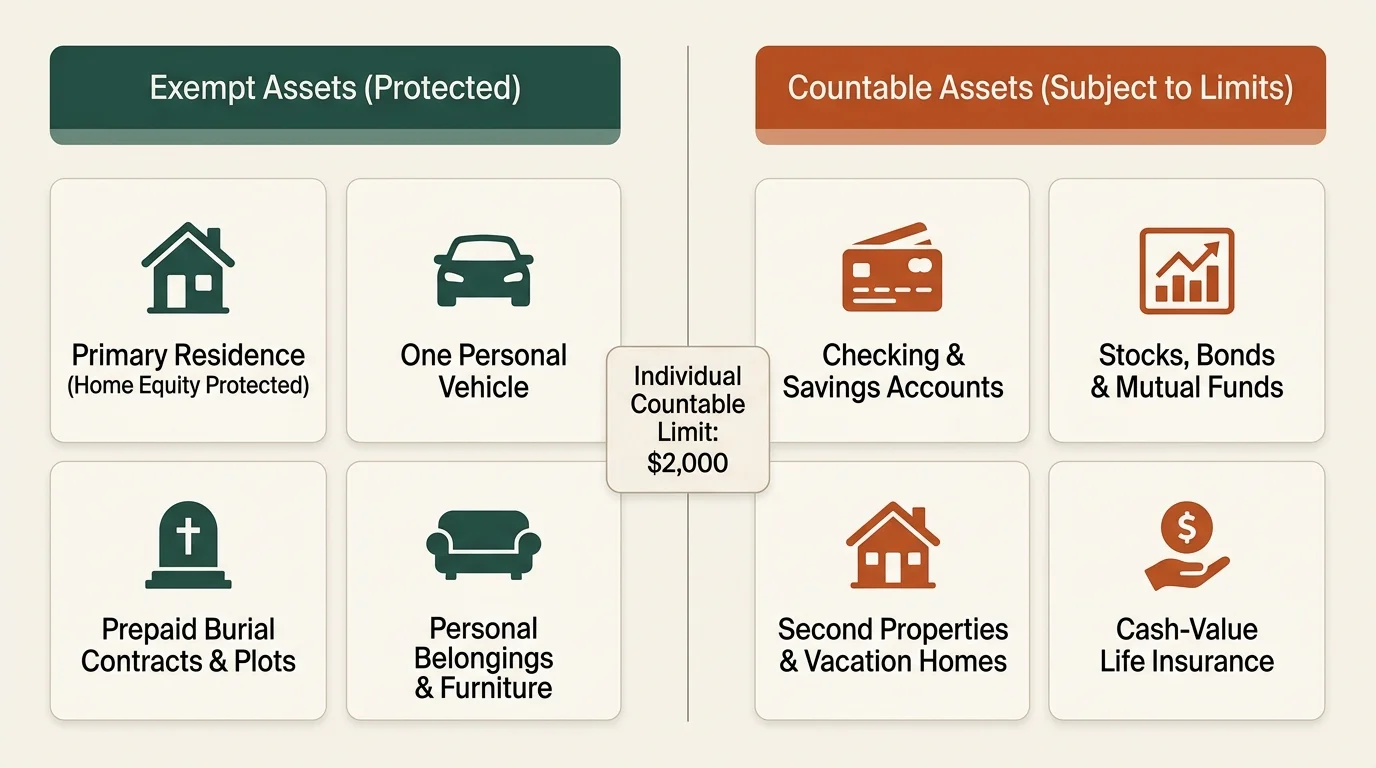
Countable vs. Exempt Assets: What You Can Keep
In the vast majority of states, a single individual may retain no more than $2,000 in countable assets to qualify for Institutional Medicaid. However, Medicaid categorizes your possessions into countable and exempt (non-countable) resources.
Understanding which assets are exempt ensures you do not needlessly liquidate protected property before applying.
- Exempt Assets (Not Counted):
- Primary Residence: Your home is exempt if your spouse lives there, or if you express an intent to return home, provided your home equity does not exceed state caps (ranging from $752,000 to $1,130,000).
- One Motor Vehicle: One personal automobile used for transportation is fully exempt regardless of value.
- Personal Belongings: Household furniture, clothing, heirlooms, and appliances.
- Irrevocable Burial Contracts: Prepaid funeral and burial spaces or irrevocable burial trusts up to state-specific limits.
- Term Life Insurance: Policies that carry no accumulated cash surrender value.
- Countable Assets (Counted Against the Limit):
- Checking and savings accounts.
- Certificates of deposit (CDs), stocks, bonds, and mutual funds.
- Secondary real estate, vacation cabins, or rental properties.
- Cash value life insurance policies with face values exceeding $1,500.
- Non-exempt retirement accounts (rules vary by state depending on whether the account is in payout status).

Protecting Your Spouse: Spousal Impoverishment Protections
If you require nursing home care but your spouse continues living independently in the community, federal law enforces Spousal Impoverishment Rules. These provisions prevent the healthy spouse (the “community spouse”) from losing their home and life savings to pay for your care.
The rules establish two critical financial protections:
- Community Spouse Resource Allowance (CSRA): The community spouse is permitted to keep a substantial portion of the couple’s combined countable assets. Under federal rules, the community spouse can retain up to a maximum of $157,920 (with a federal baseline floor of $31,584), depending on state guidelines.
- Minimum Monthly Maintenance Needs Allowance (MMMNA): If the community spouse has little or no personal income, they can keep a designated portion of the institutionalized spouse’s monthly income. The federal monthly standard allows the community spouse to retain between $2,555 and $4,066.50 per month to maintain their household.
Consider an example: John enters a nursing home, and his wife, Mary, remains in their home. John receives $2,400 monthly from Social Security, while Mary receives $800. Under MMMNA rules, Mary can redirect $1,800 of John’s income to herself to reach a state-approved allowance of $2,600 per month, leaving only John’s remaining $600 to go toward the nursing facility.
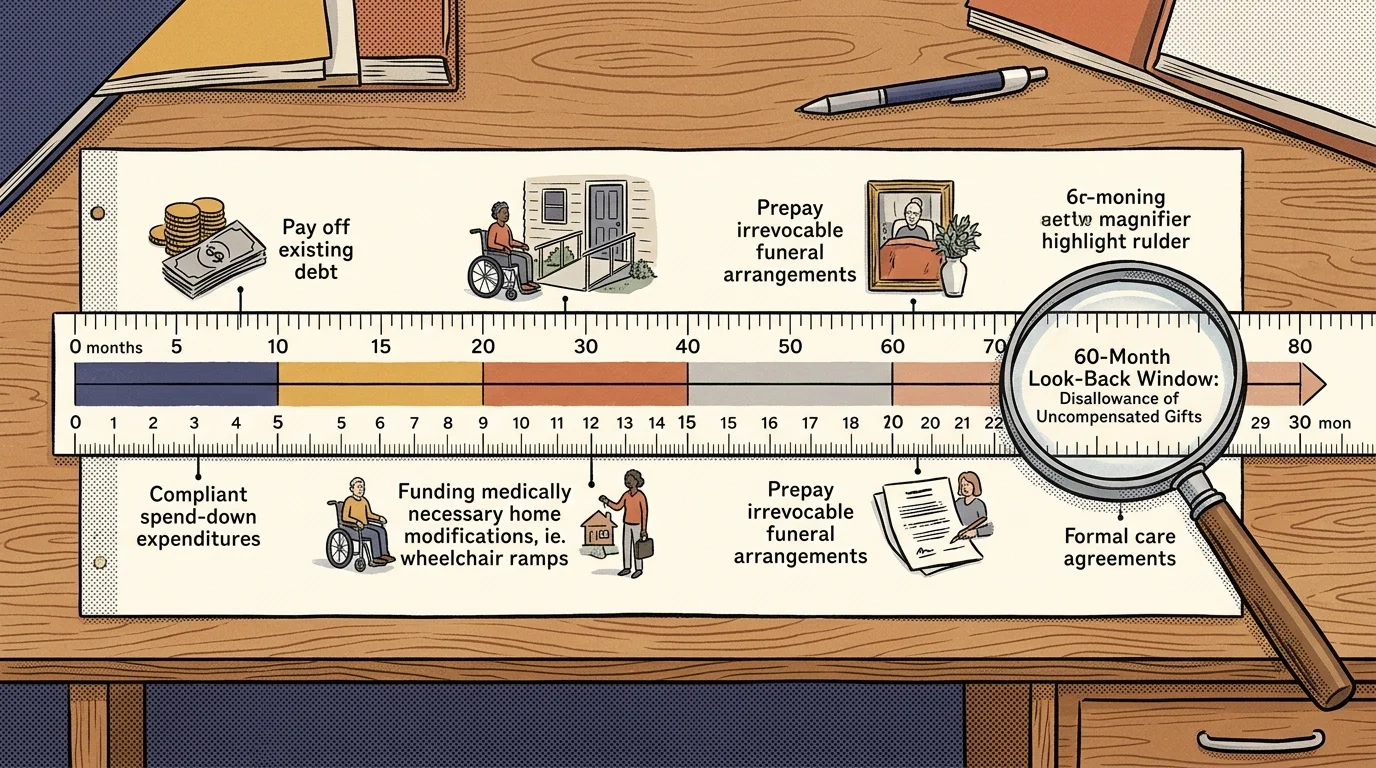
The 5-Year Look-Back Period and Spend-Down Strategies
Medicaid imposes a strict 60-month (5-year) look-back period on all asset transfers preceding your application date. State caseworkers inspect all financial statements, deeds, and asset movements over the prior five years to ensure you did not transfer money or property for less than fair market value.
If you gifted money to family members, transferred real estate to your children for $1, or donated large sums during this window, Medicaid calculates a penalty period of ineligibility. The penalty period is determined by dividing the gifted amount by the state’s average monthly private-pay nursing home rate.
For example, if you gifted $100,000 to your children and your state’s divisor rate is $10,000 per month, Medicaid will refuse to pay for your nursing home care for 10 months ($100,000 ÷ $10,000 = 10 months), beginning on the date you are otherwise eligible for care.
Rather than giving assets away, you can use structured spend-down methods to legally reduce countable assets to the $2,000 limit:
- Pay off existing debt, including home mortgages, auto loans, or credit cards.
- Complete necessary home repairs, modifications, or maintenance on your primary residence.
- Purchase an irrevocable, prepaid funeral and burial plan for yourself and your spouse.
- Upgrade essential medical equipment, hearing aids, dental work, or eyeglasses.
- Purchase a Medicaid-compliant annuity that converts countable cash into an irrevocable income stream for the community spouse.
Medicaid Estate Recovery Program (MERP) and Your Home
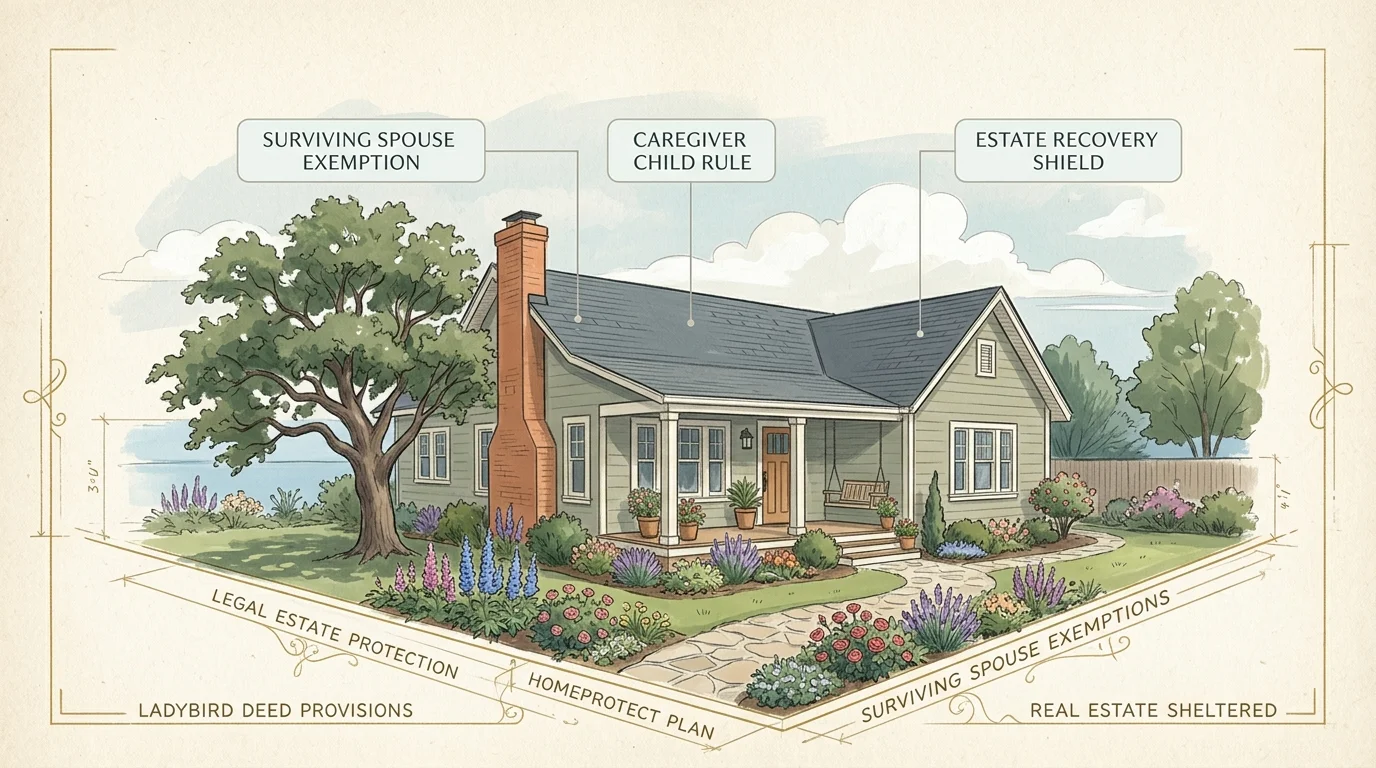
While your primary home is generally exempt during your lifetime, federal law requires every state to operate a Medicaid Estate Recovery Program (MERP). After a Medicaid beneficiary passes away, the state attempts to recover the costs paid for long-term care by placing a claim or lien against the deceased beneficiary’s probate estate—most commonly their home equity.
However, the state cannot pursue estate recovery under specific circumstances:
- While your surviving spouse is still living.
- If you have a surviving child who is under age 21, or who is blind or permanently disabled.
- If an adult child lived in the home for at least two years prior to your institutionalization and provided care that delayed your nursing home admission (the Child Caregiver Exemption).
- If a sibling holds an equity interest in the home and resided there for at least one year before your admission.
To explore local support programs, caregiver exemptions, and regional resources, contact your local Area Agency on Aging through the Eldercare Locator.
Pitfalls to Watch For
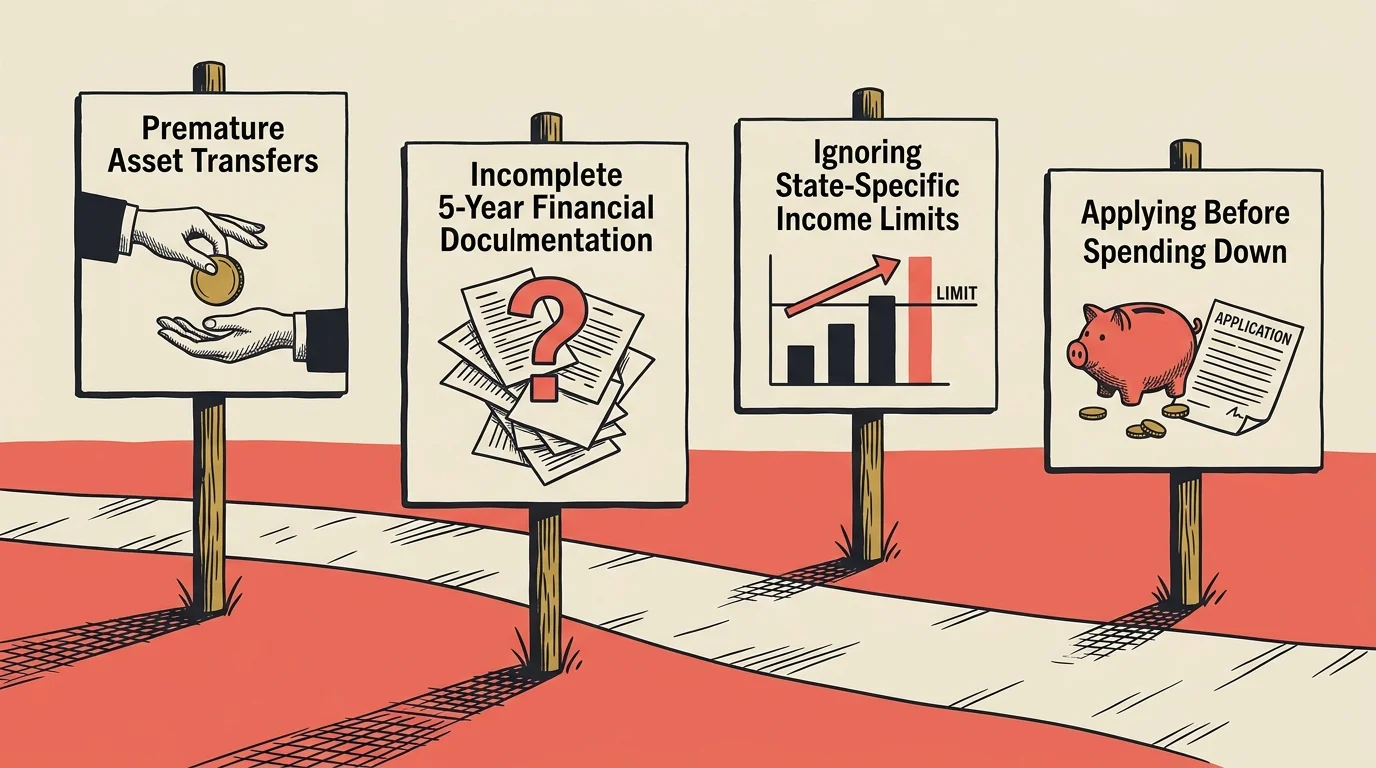
Navigating Medicaid rules requires precision; minor administrative missteps can result in delayed coverage or financial penalties. Avoid these four common mistakes:
- Gifting Money to Family Members: Transferring money, college savings gifts, or property titles to relatives within five years of applying triggers immediate penalty periods. Never transfer assets without elder law guidance.
- Waiting Until All Savings Are Gone: Many families spend down their entire life savings on private nursing home rates before investigating Medicaid. Engaging in early planning allows you to protect allowable allowances for a spouse and family.
- Ignoring State-Specific Rules: Medicaid is jointly funded by federal and state governments, but administered at the state level. Income caps, asset allowances, and trust regulations vary significantly from state to state.
- Failing to Maintain Meticulous Records: Caseworkers require complete financial records for every bank account, retirement fund, and asset held over the prior 60 months. Missing statements cause application rejections and processing delays.

Getting Expert Help
While straightforward Medicaid applications can be completed independently, complex financial or family circumstances call for specialized professional guidance. Consider consulting a certified elder law attorney (CELA) or an accredited Medicaid planner in the following situations:
- You Own Real Estate or a Business: If you own real estate beyond a primary residence, rental property, or a family business, an attorney can help restructure these holdings to avoid immediate liquidation.
- Your Income Exceeds the State Cap: If your monthly income is above $2,982, an elder law professional can properly draft and fund an irrevocable Qualified Income Trust to ensure compliance.
- You Transferred Assets Within the Past Five Years: If you made gifts or asset transfers during the 60-month window, a planner can help cure the gifts or structure partial-cure strategies to minimize the penalty period.
- One Spouse Remains in the Community: An elder law attorney can maximize the Community Spouse Resource Allowance and file for increased income allowances through administrative hearings.
Step-by-Step Medicaid Application Process
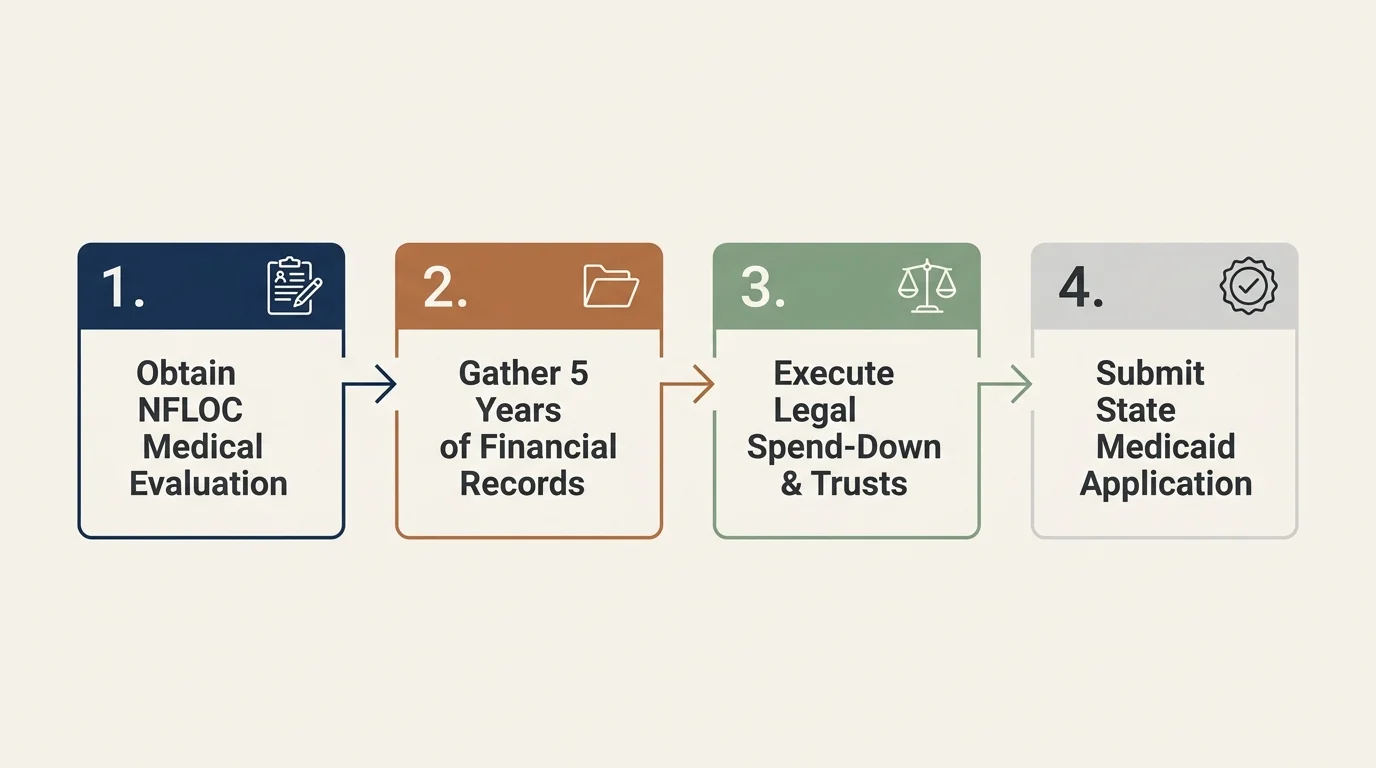
Securing Medicaid coverage requires careful coordination between your family, healthcare providers, and your state Medicaid office. Follow these steps to streamline your application:
- Obtain a Medical Assessment: Secure a physician’s statement and complete a state-administered Level of Care assessment verifying your need for daily nursing facility care.
- Gather 60 Months of Financial Records: Collect five full years of statements for all checking, savings, investment, and retirement accounts, along with tax returns, property deeds, vehicle titles, and life insurance policies. Check your current monthly benefit statements through the Social Security Administration.
- Execute Your Spend-Down Strategy: Pay off qualifying debts or purchase exempt items to bring countable assets below $2,000 (plus your spouse’s protected allowance).
- Submit the Application: File the Institutional Medicaid application through your state’s health and human services portal or county Medicaid office. Submit all requested verifications promptly to avoid procedural denials.
- Confirm Facility Medicaid Certification: Ensure your chosen nursing home has an available Medicaid-certified bed and accepts Medicaid reimbursement for your admission.
Frequently Asked Questions
Can Medicaid take my house while I am in a nursing home?
No, Medicaid will not seize your home while you are living in a nursing home, provided your home equity is under your state’s limit and you indicate an intent to return home, or your spouse resides there. However, the state may place a lien or seek estate recovery after your death unless specific surviving family exemptions apply.
How much personal income can I keep while on Medicaid in a nursing home?
Medicaid requires you to contribute most of your monthly income toward your care, but you are permitted to keep a small Personal Needs Allowance (PNA). This allowance ranges from $30 to $200 per month depending on your state, which you can use for haircuts, clothing, toiletries, and personal items.
Can I choose any nursing home if Medicaid is paying?
You can choose any nursing home that is licensed by the state, certified to accept Medicaid payments, and has an available Medicaid bed. Not every facility accepts Medicaid, and some private facilities reserve only a limited number of beds for Medicaid beneficiaries.
What happens if I give money to my grandchildren before applying?
Any gifts made to grandchildren or other family members within the 60-month look-back period are considered uncompensated asset transfers. Medicaid will assess a penalty period during which it will refuse to pay for your nursing home care, requiring you to pay privately until the penalty period expires.
Qualifying for Medicaid nursing home coverage requires proactive preparation, organized documentation, and a clear understanding of state asset and income rules. By taking advantage of legal spend-down methods, spousal protections, and trusts, you can secure high-quality long-term care while preserving your family’s financial stability.
This is educational content based on general financial principles for seniors. Individual results vary based on your situation. Always verify current benefit amounts, tax rules, and program eligibility with official government sources.
Last updated: February 2026. Benefit amounts, tax rules, and program details change annually—verify current figures with official government sources.









Leave a Reply