
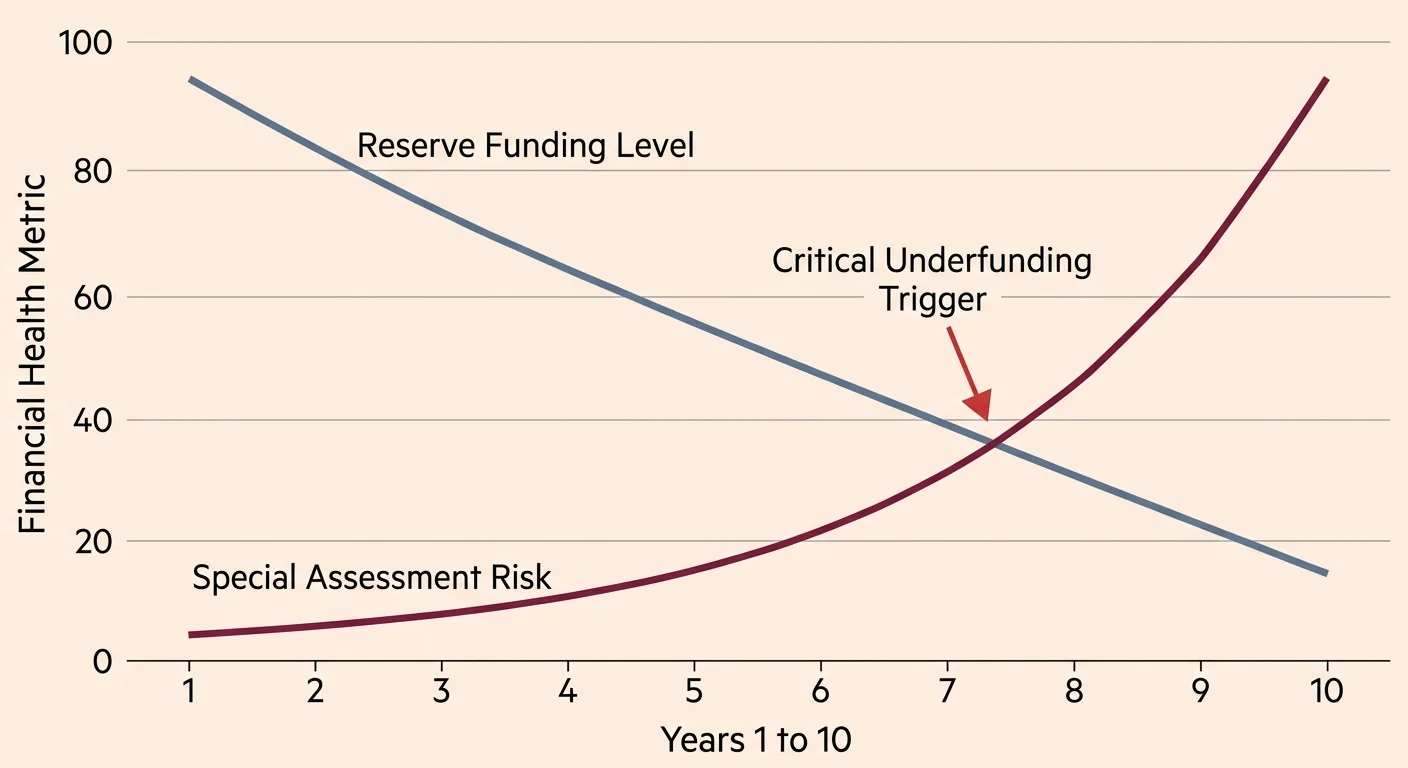
3. The HOA Financials and Reserve Studies Show Serious Red Flags
Buying into an age-restricted neighborhood ties your personal balance sheet directly to the collective financial health of the community. In addition to property taxes and insurance, you must pay monthly HOA fees. In standard 55+ developments, dues typically range from $150 to $350 per month, while luxury, resort-style communities with private golf courses, staffed gates, and expansive clubhouses routinely exceed $350 to $700 or more per month.
Before purchasing, you must examine the association’s balance sheet and latest professional Reserve Study. The reserve fund covers long-term capital replacements—such as repaving private streets, replacing clubhouse roofs, and maintaining stormwater infrastructure. According to the Community Associations Institute, a reserve funding level of 70% or higher represents a healthy association. If the reserve funding level sits below 30%, you face a severe risk of sudden, mandatory “special assessments”—lump-sum bills charging individual homeowners thousands of dollars to cover deferred maintenance.
“You must treat an HOA’s financial health just like an investment asset. If the association fails to budget for future repairs, the bill inevitably lands directly in your mailbox as an unexpected financial emergency.” — Jean Chatzky, Financial Journalist and Author
Furthermore, HOA dues do not remain static. Associations historically raise monthly dues by 3% to 5% annually to keep pace with labor, utility, and commercial property insurance increases. If your retirement income is fixed, compounding fee increases can erode your monthly cash flow over a ten- to twenty-year retirement horizon.







Way to many ads to enjoy the content.
thank you for that. i can’t stand all the click bait on seemingly things i would like to peruse.
I cant even find the actual “8 signs”! Nothing but ads
Here you go. The 8 signs:
1. Your Health or Mobility Is Declining (Or Likely to Soon)
One of the most common misconceptions about active adult neighborhoods is conflating them with supportive senior care. A 55+ active adult community provides independent, market-rate residential housing—it offers zero built-in healthcare, daily living assistance, on-site nursing, or communal dining services.
If you have a progressive medical condition or limited mobility, moving into an age-restricted active neighborhood can create an expensive double transition. When your care needs escalate, you must pay for private, third-party in-home aides or fund a secondary move into an assisted living facility. According to national long-term care data, median assisted living expenses run approximately $5,900 to $6,200 per month ($70,800 to $74,400 annually), while non-medical home health aides cost an average of $35 per hour. If you require 40 hours of weekly assistance, in-home care alone adds over $72,000 per year on top of your standard mortgage and HOA dues. If you foresee needing medical supervision or help with activities of daily living within the next five years, exploring resources through the Eldercare Locator or considering a Continuing Care Retirement Community (CCRC) provides a far safer long-term continuum of care.
2. You Rely on Frequent, Extended Visits from Children or Grandchildren
If your retirement vision involves hosting your grandchildren for the summer, babysitting multiple days a week, or providing a temporary safety net for an adult child navigating a life change, a 55+ development will likely create friction. While the federal 80/20 rule gives HOAs flexibility, most associations write highly restrictive occupancy covenants into their deeds to preserve the age-restricted environment.
Typical HOA guest policies enforce strict parameters:
Annual Guest Caps: Minor guests (under age 18 or 19) are frequently capped at 14 to 30 total overnight stays per calendar year.
Amenity Restrictions: Children often face restricted access hours at community clubhouses, fitness centers, and swimming pools, or they are barred from certain facilities entirely.
No Multi-Generational Living: Adult children under age 19 cannot establish permanent residency; adult children in their twenties or thirties can only reside with you if your specific HOA allows it under their 20% discretionary threshold.
Violating these occupancy rules can result in escalating HOA fines, legal notices, and strained relationships with neighbors who moved to the development specifically for a quiet, adult-exclusive environment.
3. The HOA Financials and Reserve Studies Show Serious Red Flags
Buying into an age-restricted neighborhood ties your personal balance sheet directly to the collective financial health of the community. In addition to property taxes and insurance, you must pay monthly HOA fees. In standard 55+ developments, dues typically range from $150 to $350 per month, while luxury, resort-style communities with private golf courses, staffed gates, and expansive clubhouses routinely exceed $350 to $700 or more per month.
Before purchasing, you must examine the association’s balance sheet and latest professional Reserve Study. The reserve fund covers long-term capital replacements—such as repaving private streets, replacing clubhouse roofs, and maintaining stormwater infrastructure. According to the Community Associations Institute, a reserve funding level of 70% or higher represents a healthy association. If the reserve funding level sits below 30%, you face a severe risk of sudden, mandatory “special assessments”—lump-sum bills charging individual homeowners thousands of dollars to cover deferred maintenance.
Furthermore, HOA dues do not remain static. Associations historically raise monthly dues by 3% to 5% annually to keep pace with labor, utility, and commercial property insurance increases. If your retirement income is fixed, compounding fee increases can erode your monthly cash flow over a ten- to twenty-year retirement horizon.
4. You Value Unrestricted Autonomy Over Your Property and Lifestyle
If you cherish personal expression, hobby work, or complete control over your home’s exterior, the rigid governance of a 55+ HOA will likely frustrate you. To preserve uniform property values and a cohesive aesthetic, age-restricted developments enforce comprehensive CC&Rs that govern daily life in granular detail.
Common restrictions include:
Exterior Modifications: Strict prohibitions against changing exterior paint colors, installing non-approved landscaping, adding solar panels without board review, or erecting fences.
Vehicle and Parking Rules: Strict bans on parking recreational vehicles (RVs), boats, trailers, or commercial work vans in driveways or on neighborhood streets for more than 24 to 48 hours.
Pet Limitations: Tight caps on the number, weight, or breeds of pets, along with designated walking zones.
Rental Restrictions: Severe limits on leasing your home, including mandatory minimum lease terms (such as 12 months) or multi-year waiting lists before an owner is permitted to rent out their property.
If you view your home as a private sanctuary where you can complete woodworking projects in an open garage, park your camper in the driveway, or landscape as you see fit, an HOA-governed community will feel confining rather than liberating.
5. You Won’t Actually Use the Expensive Amenities You’re Funding
The marketing brochures for active adult communities emphasize expansive clubhouses, championship pickleball courts, Olympic-sized swimming pools, woodworking shops, and full-time lifestyle directors. However, every resident pays for these facilities equally through monthly dues, regardless of personal usage.
Consider the math: if you pay $450 per month in HOA fees, you spend $5,400 per year purely for community upkeep and amenities. Over ten years, that represents $54,000 in non-equity housing costs—excluding regular fee inflation. If your lifestyle centers on reading, traveling, spending time with family out of town, or pursuing quiet home hobbies, you subsidize expensive recreational facilities for your neighbors without receiving proportional value.
6. You Crave Intergenerational Energy and Social Diversity
Living exclusively among individuals in your exact demographic tier offers a strong sense of shared camaraderie for some, but others find it socially isolating over time. Many retirees discover that an entirely age-segregated neighborhood lacks the dynamic energy, varied perspectives, and spontaneous rhythms of an intergenerational community.
In a standard municipal neighborhood, you interact daily with young families, working professionals, students, and long-time residents of all ages. In contrast, an active adult community concentrates a single life stage. If you thrive on mentoring younger people, hearing children playing outside, or engaging in diverse neighborhood conversations, the monoculture of an age-restricted development can feel artificial or monotonous.
7. You May Need to Sell Quickly or Want Broad Resale Liquidity
Real estate liquidity represents a critical component of retirement flexibility. When you purchase a home in a traditional neighborhood, your potential buyer pool encompasses the entire market: first-time buyers, growing families, investors, and downsizers. When you purchase an age-restricted property, you eliminate roughly 70% to 80% of all prospective buyers right out of the gate.
Because the buyer pool is legally restricted to households with at least one member aged 55+, resale velocity can slow considerably during broader real estate downturns. Furthermore, if you purchase in an expansive mega-development where the original builder continues to construct brand-new inventory, your resale home must compete directly against new, customizable models offering builder incentives. If you suddenly need to liquidate your home to relocate near family or enter a supportive care setting, an age-restricted home may take longer to market at your desired price point.
8. You Rely on a Tight, Fixed Income Sensitive to Cost Volatility
A predictable monthly budget protects retirement longevity. While buying a home in a 55+ community may seem cost-effective based on initial mortgage numbers, the uncontrollable carrying costs can destabilize a tight retirement plan. Reviewing your broad financial health using guidance from the Consumer Financial Protection Bureau (CFPB) can help you calculate your true housing debt-to-income ratio before taking on shared property liabilities.
When you live under an HOA, you lack total control over your monthly baseline expenses. A spike in the association’s master insurance policy, unexpected storm damage to common buildings, or major clubhouse renovations will drive up your monthly dues or generate unexpected assessments. If your monthly cash flow depends primarily on Social Security and a modest pension without substantial liquid cash buffers, even a $150 monthly dues increase or a $5,000 special assessment can jeopardize your day-to-day solvency.
Comparing Your Retirement Housing Options
Choosing where to live requires evaluating trade-offs across cost structures, independence, and long-term healthcare access. The table below outlines how active adult 55+ developments compare against traditional neighborhoods and Continuing Care Retirement Communities (CCRCs).
Housing Feature 55+ Active Adult Community Traditional Neighborhood Continuing Care Community (CCRC)
Age Eligibility Strictly enforced (80%+ age 55+) None (All generations welcome) Typically age 62+ or 65+
Monthly HOA / Service Fees $150 to $700+ per month $0 to $150 (Optional or minimal) $2,500 to $6,000+ per month
Healthcare & Daily Living Care None; 100% private pay/external None; 100% private pay/external Comprehensive continuum (Assisted, Skilled Nursing)
Resale Buyer Pool Restricted (~20–30% of market) Full open market (100%) None (Entrance fee refund models apply)
Lifestyle & Amenity Focus High (Golf, pickleball, social clubs) Variable (City parks, local culture) High (Wellness, dining, on-site medical care)
Maintenance Responsibility Exterior/Lawn covered by HOA; interior by owner Full owner responsibility Complete interior and exterior maintenance included
What Can Go Wrong: 4 Costly Mistakes Seniors Make
Navigating the transition into an age-restricted community requires caution. Avoid these critical mistakes when shopping for a retirement property:
Skipping the HOA Reserve Study Audit: Never purchase a 55+ home without reviewing the association’s latest Reserve Study, current operating budget, and past two years of board meeting minutes. Failing to spot an underfunded reserve (below 50% funded) exposes you to sudden special assessments for aging roofs, elevators, or roads.
Assuming “Active Adult” Accommodates Aging in Place: Many seniors move into two-story patio homes or communities without zero-threshold entryways, assuming the neighborhood will adapt as they age. When mobility declines, retrofitting an HOA-governed home or hiring expensive 24/7 private aides becomes necessary. Consulting senior living resources through the National Council on Aging (NCOA) helps clarify long-term wellness planning.
Relying on Verbal Promises from Sales Agents: On-site sales representatives work for the developer, not you. If an agent claims the HOA will permit your 22-year-old grandchild to live with you or that dues will never increase, demand to see the exact clause in the recorded CC&Rs. Written legal covenants always override verbal assurances.
Underestimating Master Insurance and Assessment Exposure: In states prone to severe weather or subject to structural integrity mandates (such as Florida’s structural inspection laws), HOA master insurance premiums have skyrocketed. Failing to budget for potential 10% to 20% annual spikes in mandatory community fees can strain an otherwise solid retirement portfolio.
When to Consult a Professional
Because buying into an age-restricted development carries binding legal and long-term financial consequences, you should consult qualified independent advisors before signing a purchase contract:
Real Estate Attorney: Hire an independent attorney who specializes in HOA law to review the community’s CC&Rs, bylaws, rental restrictions, and litigation history before closing.
Certified Financial Planner (CFP) or CPA: A financial advisor can model how escalating HOA dues, potential special assessments, and future private long-term care costs affect your safe withdrawal rates over a 20- to 30-year retirement.
Aging-in-Place Specialist or Geriatric Care Manager: If you or your spouse manage chronic health conditions, a healthcare professional can assess whether the home’s layout and the community’s geographical proximity to major hospitals will serve your physical needs over time.
Can a 55+ community legally evict an underage resident?
Yes. If an underage resident resides in the home in violation of the association’s recorded CC&Rs and guest rules, the HOA board has the legal authority to issue formal violation notices, levy daily fines against the property owner, and seek an injunction or eviction order through state court.
Under the federal Fair Housing Act and HOPA guidelines, communities must provide reasonable accommodations. In many cases, adult children with qualifying permanent disabilities who require parental care are permitted to reside in the home, but you must submit documentation and receive written board approval before moving in.
Are property taxes lower in 55+ active adult communities?
Not automatically. Property taxes are assessed by your local county or municipal taxing authority based on your home’s assessed value, not your community’s age restrictions. While some municipalities offer school tax exemptions or senior homestead discounts to qualifying homeowners aged 65+, your community type does not inherently reduce your local tax rate.
What happens if one spouse is 55+ and the other is younger?
Under federal HOPA rules, as long as at least one spouse meets the minimum age threshold (typically 55), the younger spouse may legally reside in the home. However, you must verify the specific HOA’s minimum age floor for secondary occupants (often set at age 40, 45, or 50) and review survivorship rules regarding what happens if the older spouse passes away.
Final Thoughts on Choosing Your Retirement Home
Downsizing into an age-restricted community can provide a vibrant social calendar, low exterior maintenance, and peer camaraderie; however, it requires trading away personal property autonomy and absorbing shared financial liabilities. Take the time to audit the association’s financial reserves, read every page of the CC&Rs, and honestly assess your five-to-ten-year health and family goals before purchasing.
Here you go. The 8 signs:
1. Your Health or Mobility Is Declining (Or Likely to Soon)
One of the most common misconceptions about active adult neighborhoods is conflating them with supportive senior care. A 55+ active adult community provides independent, market-rate residential housing—it offers zero built-in healthcare, daily living assistance, on-site nursing, or communal dining services.
If you have a progressive medical condition or limited mobility, moving into an age-restricted active neighborhood can create an expensive double transition. When your care needs escalate, you must pay for private, third-party in-home aides or fund a secondary move into an assisted living facility. According to national long-term care data, median assisted living expenses run approximately $5,900 to $6,200 per month ($70,800 to $74,400 annually), while non-medical home health aides cost an average of $35 per hour. If you require 40 hours of weekly assistance, in-home care alone adds over $72,000 per year on top of your standard mortgage and HOA dues. If you foresee needing medical supervision or help with activities of daily living within the next five years, exploring resources through the Eldercare Locator or considering a Continuing Care Retirement Community (CCRC) provides a far safer long-term continuum of care.
2. You Rely on Frequent, Extended Visits from Children or Grandchildren
If your retirement vision involves hosting your grandchildren for the summer, babysitting multiple days a week, or providing a temporary safety net for an adult child navigating a life change, a 55+ development will likely create friction. While the federal 80/20 rule gives HOAs flexibility, most associations write highly restrictive occupancy covenants into their deeds to preserve the age-restricted environment.
Typical HOA guest policies enforce strict parameters:
Annual Guest Caps: Minor guests (under age 18 or 19) are frequently capped at 14 to 30 total overnight stays per calendar year.
Amenity Restrictions: Children often face restricted access hours at community clubhouses, fitness centers, and swimming pools, or they are barred from certain facilities entirely.
No Multi-Generational Living: Adult children under age 19 cannot establish permanent residency; adult children in their twenties or thirties can only reside with you if your specific HOA allows it under their 20% discretionary threshold.
Violating these occupancy rules can result in escalating HOA fines, legal notices, and strained relationships with neighbors who moved to the development specifically for a quiet, adult-exclusive environment.
3. The HOA Financials and Reserve Studies Show Serious Red Flags
Buying into an age-restricted neighborhood ties your personal balance sheet directly to the collective financial health of the community. In addition to property taxes and insurance, you must pay monthly HOA fees. In standard 55+ developments, dues typically range from $150 to $350 per month, while luxury, resort-style communities with private golf courses, staffed gates, and expansive clubhouses routinely exceed $350 to $700 or more per month.
Before purchasing, you must examine the association’s balance sheet and latest professional Reserve Study. The reserve fund covers long-term capital replacements—such as repaving private streets, replacing clubhouse roofs, and maintaining stormwater infrastructure. According to the Community Associations Institute, a reserve funding level of 70% or higher represents a healthy association. If the reserve funding level sits below 30%, you face a severe risk of sudden, mandatory “special assessments”—lump-sum bills charging individual homeowners thousands of dollars to cover deferred maintenance.
Furthermore, HOA dues do not remain static. Associations historically raise monthly dues by 3% to 5% annually to keep pace with labor, utility, and commercial property insurance increases. If your retirement income is fixed, compounding fee increases can erode your monthly cash flow over a ten- to twenty-year retirement horizon.
4. You Value Unrestricted Autonomy Over Your Property and Lifestyle
If you cherish personal expression, hobby work, or complete control over your home’s exterior, the rigid governance of a 55+ HOA will likely frustrate you. To preserve uniform property values and a cohesive aesthetic, age-restricted developments enforce comprehensive CC&Rs that govern daily life in granular detail.
Common restrictions include:
Exterior Modifications: Strict prohibitions against changing exterior paint colors, installing non-approved landscaping, adding solar panels without board review, or erecting fences.
Vehicle and Parking Rules: Strict bans on parking recreational vehicles (RVs), boats, trailers, or commercial work vans in driveways or on neighborhood streets for more than 24 to 48 hours.
Pet Limitations: Tight caps on the number, weight, or breeds of pets, along with designated walking zones.
Rental Restrictions: Severe limits on leasing your home, including mandatory minimum lease terms (such as 12 months) or multi-year waiting lists before an owner is permitted to rent out their property.
If you view your home as a private sanctuary where you can complete woodworking projects in an open garage, park your camper in the driveway, or landscape as you see fit, an HOA-governed community will feel confining rather than liberating.
5. You Won’t Actually Use the Expensive Amenities You’re Funding
The marketing brochures for active adult communities emphasize expansive clubhouses, championship pickleball courts, Olympic-sized swimming pools, woodworking shops, and full-time lifestyle directors. However, every resident pays for these facilities equally through monthly dues, regardless of personal usage.
Consider the math: if you pay $450 per month in HOA fees, you spend $5,400 per year purely for community upkeep and amenities. Over ten years, that represents $54,000 in non-equity housing costs—excluding regular fee inflation. If your lifestyle centers on reading, traveling, spending time with family out of town, or pursuing quiet home hobbies, you subsidize expensive recreational facilities for your neighbors without receiving proportional value.
6. You Crave Intergenerational Energy and Social Diversity
Living exclusively among individuals in your exact demographic tier offers a strong sense of shared camaraderie for some, but others find it socially isolating over time. Many retirees discover that an entirely age-segregated neighborhood lacks the dynamic energy, varied perspectives, and spontaneous rhythms of an intergenerational community.
In a standard municipal neighborhood, you interact daily with young families, working professionals, students, and long-time residents of all ages. In contrast, an active adult community concentrates a single life stage. If you thrive on mentoring younger people, hearing children playing outside, or engaging in diverse neighborhood conversations, the monoculture of an age-restricted development can feel artificial or monotonous.
7. You May Need to Sell Quickly or Want Broad Resale Liquidity
Real estate liquidity represents a critical component of retirement flexibility. When you purchase a home in a traditional neighborhood, your potential buyer pool encompasses the entire market: first-time buyers, growing families, investors, and downsizers. When you purchase an age-restricted property, you eliminate roughly 70% to 80% of all prospective buyers right out of the gate.
Because the buyer pool is legally restricted to households with at least one member aged 55+, resale velocity can slow considerably during broader real estate downturns. Furthermore, if you purchase in an expansive mega-development where the original builder continues to construct brand-new inventory, your resale home must compete directly against new, customizable models offering builder incentives. If you suddenly need to liquidate your home to relocate near family or enter a supportive care setting, an age-restricted home may take longer to market at your desired price point.
8. You Rely on a Tight, Fixed Income Sensitive to Cost Volatility
A predictable monthly budget protects retirement longevity. While buying a home in a 55+ community may seem cost-effective based on initial mortgage numbers, the uncontrollable carrying costs can destabilize a tight retirement plan. Reviewing your broad financial health using guidance from the Consumer Financial Protection Bureau (CFPB) can help you calculate your true housing debt-to-income ratio before taking on shared property liabilities.
When you live under an HOA, you lack total control over your monthly baseline expenses. A spike in the association’s master insurance policy, unexpected storm damage to common buildings, or major clubhouse renovations will drive up your monthly dues or generate unexpected assessments. If your monthly cash flow depends primarily on Social Security and a modest pension without substantial liquid cash buffers, even a $150 monthly dues increase or a $5,000 special assessment can jeopardize your day-to-day solvency.
Comparing Your Retirement Housing Options
Choosing where to live requires evaluating trade-offs across cost structures, independence, and long-term healthcare access. The table below outlines how active adult 55+ developments compare against traditional neighborhoods and Continuing Care Retirement Communities (CCRCs).
Housing Feature 55+ Active Adult Community Traditional Neighborhood Continuing Care Community (CCRC)
Age Eligibility Strictly enforced (80%+ age 55+) None (All generations welcome) Typically age 62+ or 65+
Monthly HOA / Service Fees $150 to $700+ per month $0 to $150 (Optional or minimal) $2,500 to $6,000+ per month
Healthcare & Daily Living Care None; 100% private pay/external None; 100% private pay/external Comprehensive continuum (Assisted, Skilled Nursing)
Resale Buyer Pool Restricted (~20–30% of market) Full open market (100%) None (Entrance fee refund models apply)
Lifestyle & Amenity Focus High (Golf, pickleball, social clubs) Variable (City parks, local culture) High (Wellness, dining, on-site medical care)
Maintenance Responsibility Exterior/Lawn covered by HOA; interior by owner Full owner responsibility Complete interior and exterior maintenance included
What Can Go Wrong: 4 Costly Mistakes Seniors Make
Navigating the transition into an age-restricted community requires caution. Avoid these critical mistakes when shopping for a retirement property:
Skipping the HOA Reserve Study Audit: Never purchase a 55+ home without reviewing the association’s latest Reserve Study, current operating budget, and past two years of board meeting minutes. Failing to spot an underfunded reserve (below 50% funded) exposes you to sudden special assessments for aging roofs, elevators, or roads.
Assuming “Active Adult” Accommodates Aging in Place: Many seniors move into two-story patio homes or communities without zero-threshold entryways, assuming the neighborhood will adapt as they age. When mobility declines, retrofitting an HOA-governed home or hiring expensive 24/7 private aides becomes necessary. Consulting senior living resources through the National Council on Aging (NCOA) helps clarify long-term wellness planning.
Relying on Verbal Promises from Sales Agents: On-site sales representatives work for the developer, not you. If an agent claims the HOA will permit your 22-year-old grandchild to live with you or that dues will never increase, demand to see the exact clause in the recorded CC&Rs. Written legal covenants always override verbal assurances.
Underestimating Master Insurance and Assessment Exposure: In states prone to severe weather or subject to structural integrity mandates (such as Florida’s structural inspection laws), HOA master insurance premiums have skyrocketed. Failing to budget for potential 10% to 20% annual spikes in mandatory community fees can strain an otherwise solid retirement portfolio.
When to Consult a Professional
Because buying into an age-restricted development carries binding legal and long-term financial consequences, you should consult qualified independent advisors before signing a purchase contract:
Real Estate Attorney: Hire an independent attorney who specializes in HOA law to review the community’s CC&Rs, bylaws, rental restrictions, and litigation history before closing.
Certified Financial Planner (CFP) or CPA: A financial advisor can model how escalating HOA dues, potential special assessments, and future private long-term care costs affect your safe withdrawal rates over a 20- to 30-year retirement.
Aging-in-Place Specialist or Geriatric Care Manager: If you or your spouse manage chronic health conditions, a healthcare professional can assess whether the home’s layout and the community’s geographical proximity to major hospitals will serve your physical needs over time.
Can a 55+ community legally evict an underage resident?
Yes. If an underage resident resides in the home in violation of the association’s recorded CC&Rs and guest rules, the HOA board has the legal authority to issue formal violation notices, levy daily fines against the property owner, and seek an injunction or eviction order through state court.
Under the federal Fair Housing Act and HOPA guidelines, communities must provide reasonable accommodations. In many cases, adult children with qualifying permanent disabilities who require parental care are permitted to reside in the home, but you must submit documentation and receive written board approval before moving in.
Are property taxes lower in 55+ active adult communities?
Not automatically. Property taxes are assessed by your local county or municipal taxing authority based on your home’s assessed value, not your community’s age restrictions. While some municipalities offer school tax exemptions or senior homestead discounts to qualifying homeowners aged 65+, your community type does not inherently reduce your local tax rate.
What happens if one spouse is 55+ and the other is younger?
Under federal HOPA rules, as long as at least one spouse meets the minimum age threshold (typically 55), the younger spouse may legally reside in the home. However, you must verify the specific HOA’s minimum age floor for secondary occupants (often set at age 40, 45, or 50) and review survivorship rules regarding what happens if the older spouse passes away.
Final Thoughts on Choosing Your Retirement Home
Downsizing into an age-restricted community can provide a vibrant social calendar, low exterior maintenance, and peer camaraderie; however, it requires trading away personal property autonomy and absorbing shared financial liabilities. Take the time to audit the association’s financial reserves, read every page of the CC&Rs, and honestly assess your five-to-ten-year health and family goals before purchasing.
would like to know where there are events, groups, happenings, for Single people in Palm Beach County
you will see under a bunch of ads little boxes with numbers in them 1, 2, 3, 4, 5, etc. those are the pages you click on to read the article. i wish they would just type it out but all these flipping ads are enormously irritating
So where were the eight signs? The 55 and up communities are not the right fit. I can’t find them
1. Your Health or Mobility Is Declining (Or Likely to Soon)
One of the most common misconceptions about active adult neighborhoods is conflating them with supportive senior care. A 55+ active adult community provides independent, market-rate residential housing—it offers zero built-in healthcare, daily living assistance, on-site nursing, or communal dining services.
If you have a progressive medical condition or limited mobility, moving into an age-restricted active neighborhood can create an expensive double transition. When your care needs escalate, you must pay for private, third-party in-home aides or fund a secondary move into an assisted living facility. According to national long-term care data, median assisted living expenses run approximately $5,900 to $6,200 per month ($70,800 to $74,400 annually), while non-medical home health aides cost an average of $35 per hour. If you require 40 hours of weekly assistance, in-home care alone adds over $72,000 per year on top of your standard mortgage and HOA dues. If you foresee needing medical supervision or help with activities of daily living within the next five years, exploring resources through the Eldercare Locator or considering a Continuing Care Retirement Community (CCRC) provides a far safer long-term continuum of care.
2. You Rely on Frequent, Extended Visits from Children or Grandchildren
If your retirement vision involves hosting your grandchildren for the summer, babysitting multiple days a week, or providing a temporary safety net for an adult child navigating a life change, a 55+ development will likely create friction. While the federal 80/20 rule gives HOAs flexibility, most associations write highly restrictive occupancy covenants into their deeds to preserve the age-restricted environment.
Typical HOA guest policies enforce strict parameters:
Annual Guest Caps: Minor guests (under age 18 or 19) are frequently capped at 14 to 30 total overnight stays per calendar year.
Amenity Restrictions: Children often face restricted access hours at community clubhouses, fitness centers, and swimming pools, or they are barred from certain facilities entirely.
No Multi-Generational Living: Adult children under age 19 cannot establish permanent residency; adult children in their twenties or thirties can only reside with you if your specific HOA allows it under their 20% discretionary threshold.
Violating these occupancy rules can result in escalating HOA fines, legal notices, and strained relationships with neighbors who moved to the development specifically for a quiet, adult-exclusive environment.
3. The HOA Financials and Reserve Studies Show Serious Red Flags
Buying into an age-restricted neighborhood ties your personal balance sheet directly to the collective financial health of the community. In addition to property taxes and insurance, you must pay monthly HOA fees. In standard 55+ developments, dues typically range from $150 to $350 per month, while luxury, resort-style communities with private golf courses, staffed gates, and expansive clubhouses routinely exceed $350 to $700 or more per month.
Before purchasing, you must examine the association’s balance sheet and latest professional Reserve Study. The reserve fund covers long-term capital replacements—such as repaving private streets, replacing clubhouse roofs, and maintaining stormwater infrastructure. According to the Community Associations Institute, a reserve funding level of 70% or higher represents a healthy association. If the reserve funding level sits below 30%, you face a severe risk of sudden, mandatory “special assessments”—lump-sum bills charging individual homeowners thousands of dollars to cover deferred maintenance.
Furthermore, HOA dues do not remain static. Associations historically raise monthly dues by 3% to 5% annually to keep pace with labor, utility, and commercial property insurance increases. If your retirement income is fixed, compounding fee increases can erode your monthly cash flow over a ten- to twenty-year retirement horizon.
4. You Value Unrestricted Autonomy Over Your Property and Lifestyle
If you cherish personal expression, hobby work, or complete control over your home’s exterior, the rigid governance of a 55+ HOA will likely frustrate you. To preserve uniform property values and a cohesive aesthetic, age-restricted developments enforce comprehensive CC&Rs that govern daily life in granular detail.
Common restrictions include:
Exterior Modifications: Strict prohibitions against changing exterior paint colors, installing non-approved landscaping, adding solar panels without board review, or erecting fences.
Vehicle and Parking Rules: Strict bans on parking recreational vehicles (RVs), boats, trailers, or commercial work vans in driveways or on neighborhood streets for more than 24 to 48 hours.
Pet Limitations: Tight caps on the number, weight, or breeds of pets, along with designated walking zones.
Rental Restrictions: Severe limits on leasing your home, including mandatory minimum lease terms (such as 12 months) or multi-year waiting lists before an owner is permitted to rent out their property.
If you view your home as a private sanctuary where you can complete woodworking projects in an open garage, park your camper in the driveway, or landscape as you see fit, an HOA-governed community will feel confining rather than liberating.
5. You Won’t Actually Use the Expensive Amenities You’re Funding
The marketing brochures for active adult communities emphasize expansive clubhouses, championship pickleball courts, Olympic-sized swimming pools, woodworking shops, and full-time lifestyle directors. However, every resident pays for these facilities equally through monthly dues, regardless of personal usage.
Consider the math: if you pay $450 per month in HOA fees, you spend $5,400 per year purely for community upkeep and amenities. Over ten years, that represents $54,000 in non-equity housing costs—excluding regular fee inflation. If your lifestyle centers on reading, traveling, spending time with family out of town, or pursuing quiet home hobbies, you subsidize expensive recreational facilities for your neighbors without receiving proportional value.
6. You Crave Intergenerational Energy and Social Diversity
Living exclusively among individuals in your exact demographic tier offers a strong sense of shared camaraderie for some, but others find it socially isolating over time. Many retirees discover that an entirely age-segregated neighborhood lacks the dynamic energy, varied perspectives, and spontaneous rhythms of an intergenerational community.
In a standard municipal neighborhood, you interact daily with young families, working professionals, students, and long-time residents of all ages. In contrast, an active adult community concentrates a single life stage. If you thrive on mentoring younger people, hearing children playing outside, or engaging in diverse neighborhood conversations, the monoculture of an age-restricted development can feel artificial or monotonous.
7. You May Need to Sell Quickly or Want Broad Resale Liquidity
Real estate liquidity represents a critical component of retirement flexibility. When you purchase a home in a traditional neighborhood, your potential buyer pool encompasses the entire market: first-time buyers, growing families, investors, and downsizers. When you purchase an age-restricted property, you eliminate roughly 70% to 80% of all prospective buyers right out of the gate.
Because the buyer pool is legally restricted to households with at least one member aged 55+, resale velocity can slow considerably during broader real estate downturns. Furthermore, if you purchase in an expansive mega-development where the original builder continues to construct brand-new inventory, your resale home must compete directly against new, customizable models offering builder incentives. If you suddenly need to liquidate your home to relocate near family or enter a supportive care setting, an age-restricted home may take longer to market at your desired price point.
8. You Rely on a Tight, Fixed Income Sensitive to Cost Volatility
A predictable monthly budget protects retirement longevity. While buying a home in a 55+ community may seem cost-effective based on initial mortgage numbers, the uncontrollable carrying costs can destabilize a tight retirement plan. Reviewing your broad financial health using guidance from the Consumer Financial Protection Bureau (CFPB) can help you calculate your true housing debt-to-income ratio before taking on shared property liabilities.
When you live under an HOA, you lack total control over your monthly baseline expenses. A spike in the association’s master insurance policy, unexpected storm damage to common buildings, or major clubhouse renovations will drive up your monthly dues or generate unexpected assessments. If your monthly cash flow depends primarily on Social Security and a modest pension without substantial liquid cash buffers, even a $150 monthly dues increase or a $5,000 special assessment can jeopardize your day-to-day solvency.
Comparing Your Retirement Housing Options
Choosing where to live requires evaluating trade-offs across cost structures, independence, and long-term healthcare access. The table below outlines how active adult 55+ developments compare against traditional neighborhoods and Continuing Care Retirement Communities (CCRCs).
Housing Feature 55+ Active Adult Community Traditional Neighborhood Continuing Care Community (CCRC)
Age Eligibility Strictly enforced (80%+ age 55+) None (All generations welcome) Typically age 62+ or 65+
Monthly HOA / Service Fees $150 to $700+ per month $0 to $150 (Optional or minimal) $2,500 to $6,000+ per month
Healthcare & Daily Living Care None; 100% private pay/external None; 100% private pay/external Comprehensive continuum (Assisted, Skilled Nursing)
Resale Buyer Pool Restricted (~20–30% of market) Full open market (100%) None (Entrance fee refund models apply)
Lifestyle & Amenity Focus High (Golf, pickleball, social clubs) Variable (City parks, local culture) High (Wellness, dining, on-site medical care)
Maintenance Responsibility Exterior/Lawn covered by HOA; interior by owner Full owner responsibility Complete interior and exterior maintenance included
What Can Go Wrong: 4 Costly Mistakes Seniors Make
Navigating the transition into an age-restricted community requires caution. Avoid these critical mistakes when shopping for a retirement property:
Skipping the HOA Reserve Study Audit: Never purchase a 55+ home without reviewing the association’s latest Reserve Study, current operating budget, and past two years of board meeting minutes. Failing to spot an underfunded reserve (below 50% funded) exposes you to sudden special assessments for aging roofs, elevators, or roads.
Assuming “Active Adult” Accommodates Aging in Place: Many seniors move into two-story patio homes or communities without zero-threshold entryways, assuming the neighborhood will adapt as they age. When mobility declines, retrofitting an HOA-governed home or hiring expensive 24/7 private aides becomes necessary. Consulting senior living resources through the National Council on Aging (NCOA) helps clarify long-term wellness planning.
Relying on Verbal Promises from Sales Agents: On-site sales representatives work for the developer, not you. If an agent claims the HOA will permit your 22-year-old grandchild to live with you or that dues will never increase, demand to see the exact clause in the recorded CC&Rs. Written legal covenants always override verbal assurances.
Underestimating Master Insurance and Assessment Exposure: In states prone to severe weather or subject to structural integrity mandates (such as Florida’s structural inspection laws), HOA master insurance premiums have skyrocketed. Failing to budget for potential 10% to 20% annual spikes in mandatory community fees can strain an otherwise solid retirement portfolio.
When to Consult a Professional
Because buying into an age-restricted development carries binding legal and long-term financial consequences, you should consult qualified independent advisors before signing a purchase contract:
Real Estate Attorney: Hire an independent attorney who specializes in HOA law to review the community’s CC&Rs, bylaws, rental restrictions, and litigation history before closing.
Certified Financial Planner (CFP) or CPA: A financial advisor can model how escalating HOA dues, potential special assessments, and future private long-term care costs affect your safe withdrawal rates over a 20- to 30-year retirement.
Aging-in-Place Specialist or Geriatric Care Manager: If you or your spouse manage chronic health conditions, a healthcare professional can assess whether the home’s layout and the community’s geographical proximity to major hospitals will serve your physical needs over time.
Can a 55+ community legally evict an underage resident?
Yes. If an underage resident resides in the home in violation of the association’s recorded CC&Rs and guest rules, the HOA board has the legal authority to issue formal violation notices, levy daily fines against the property owner, and seek an injunction or eviction order through state court.
Under the federal Fair Housing Act and HOPA guidelines, communities must provide reasonable accommodations. In many cases, adult children with qualifying permanent disabilities who require parental care are permitted to reside in the home, but you must submit documentation and receive written board approval before moving in.
Are property taxes lower in 55+ active adult communities?
Not automatically. Property taxes are assessed by your local county or municipal taxing authority based on your home’s assessed value, not your community’s age restrictions. While some municipalities offer school tax exemptions or senior homestead discounts to qualifying homeowners aged 65+, your community type does not inherently reduce your local tax rate.
What happens if one spouse is 55+ and the other is younger?
Under federal HOPA rules, as long as at least one spouse meets the minimum age threshold (typically 55), the younger spouse may legally reside in the home. However, you must verify the specific HOA’s minimum age floor for secondary occupants (often set at age 40, 45, or 50) and review survivorship rules regarding what happens if the older spouse passes away.
Final Thoughts on Choosing Your Retirement Home
Downsizing into an age-restricted community can provide a vibrant social calendar, low exterior maintenance, and peer camaraderie; however, it requires trading away personal property autonomy and absorbing shared financial liabilities. Take the time to audit the association’s financial reserves, read every page of the CC&Rs, and honestly assess your five-to-ten-year health and family goals before purchasing.
55 plus community is great. Lots of really nice people. Many amenities at very cheap prices. Great security. I love Sun City in AZ and I imagine all ghe other Sun City locations are modeled the same
I just purchased in Ocala. My wife was not on the mortgage or deed. The HOA is telling us that she is restricted as a visitor!