
Retirees constantly hunt for ways to stretch their fixed incomes without sacrificing quality, yet millions overlook a massive secondary market built entirely around government surplus. Whether you want to upgrade your vehicle, buy a laptop for your home office, or even purchase investment property, federal and local agencies regularly liquidate seized or unneeded assets at steep discounts. In 2026, the Social Security Cost-of-Living Adjustment (COLA) increased benefits by 2.8 percent, adding about $56 a month to the average check. While that modest bump helps, mastering public auction sites empowers you to keep thousands of dollars in your pocket. You can bypass retail markups entirely by bidding on perfectly functional equipment, vehicles, and real estate directly from government agencies.
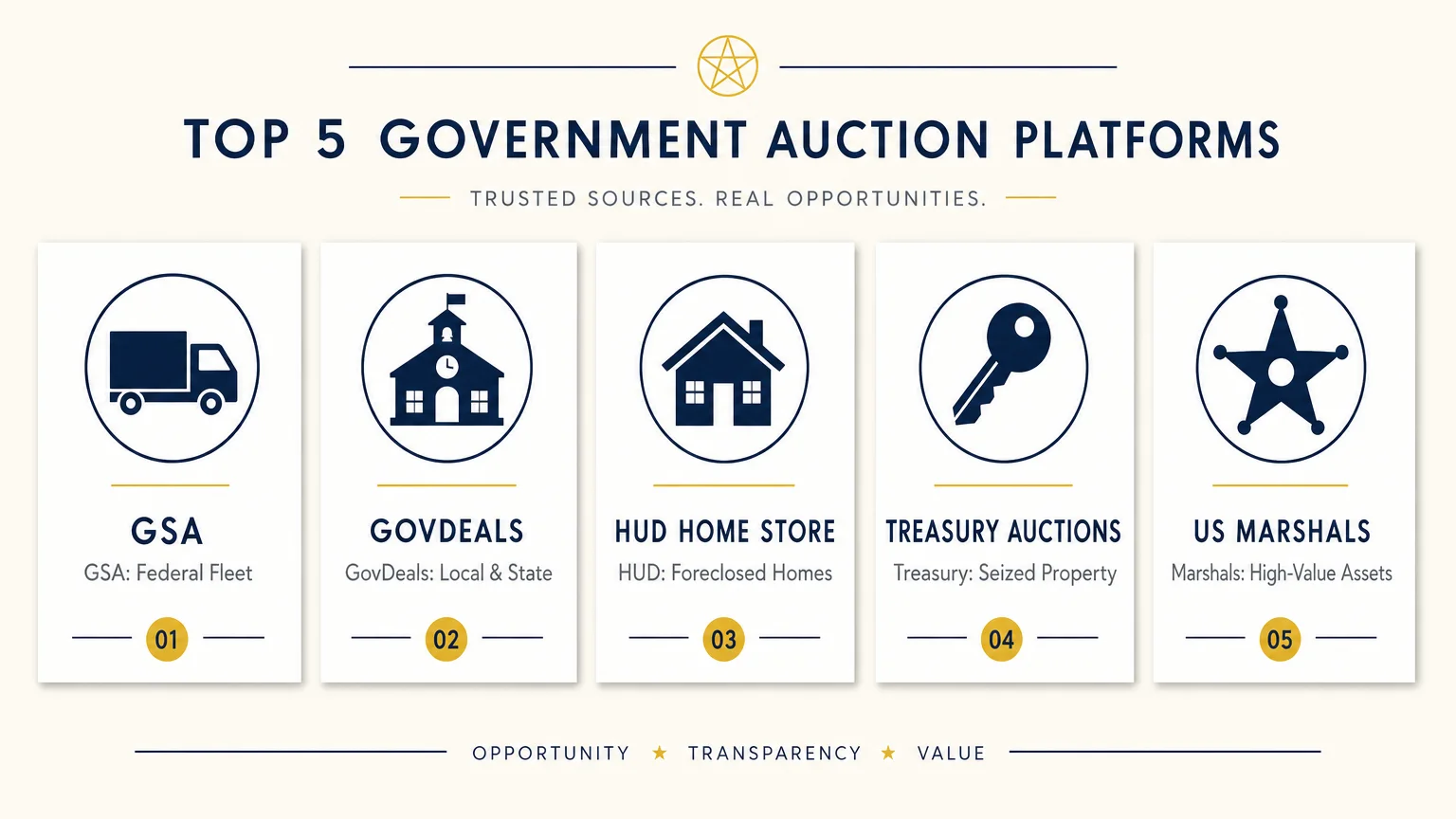
At a Glance: Top Government Bargain Platforms
Before diving into the specifics of bidding and logistics, it helps to understand the landscape of government liquidations. Federal, state, and local entities replace their assets on strict schedules. When a federal agency upgrades its fleet or an office closes down, the taxpayers’ loss becomes your gain.
- GSA Auctions: Best for federal fleet vehicles, office technology, and industrial equipment.
- GovDeals: Ideal for local and state surplus, including school district liquidations and city utility vehicles.
- HUD Home Store: The primary hub for affordable, foreclosed real estate formerly insured by the FHA.
- U.S. Treasury Auctions: The go-to source for property, jewelry, and vehicles forfeited due to tax evasion or federal violations.
- U.S. Marshals Service: Similar to Treasury auctions, focusing on high-value goods seized by the Department of Justice.
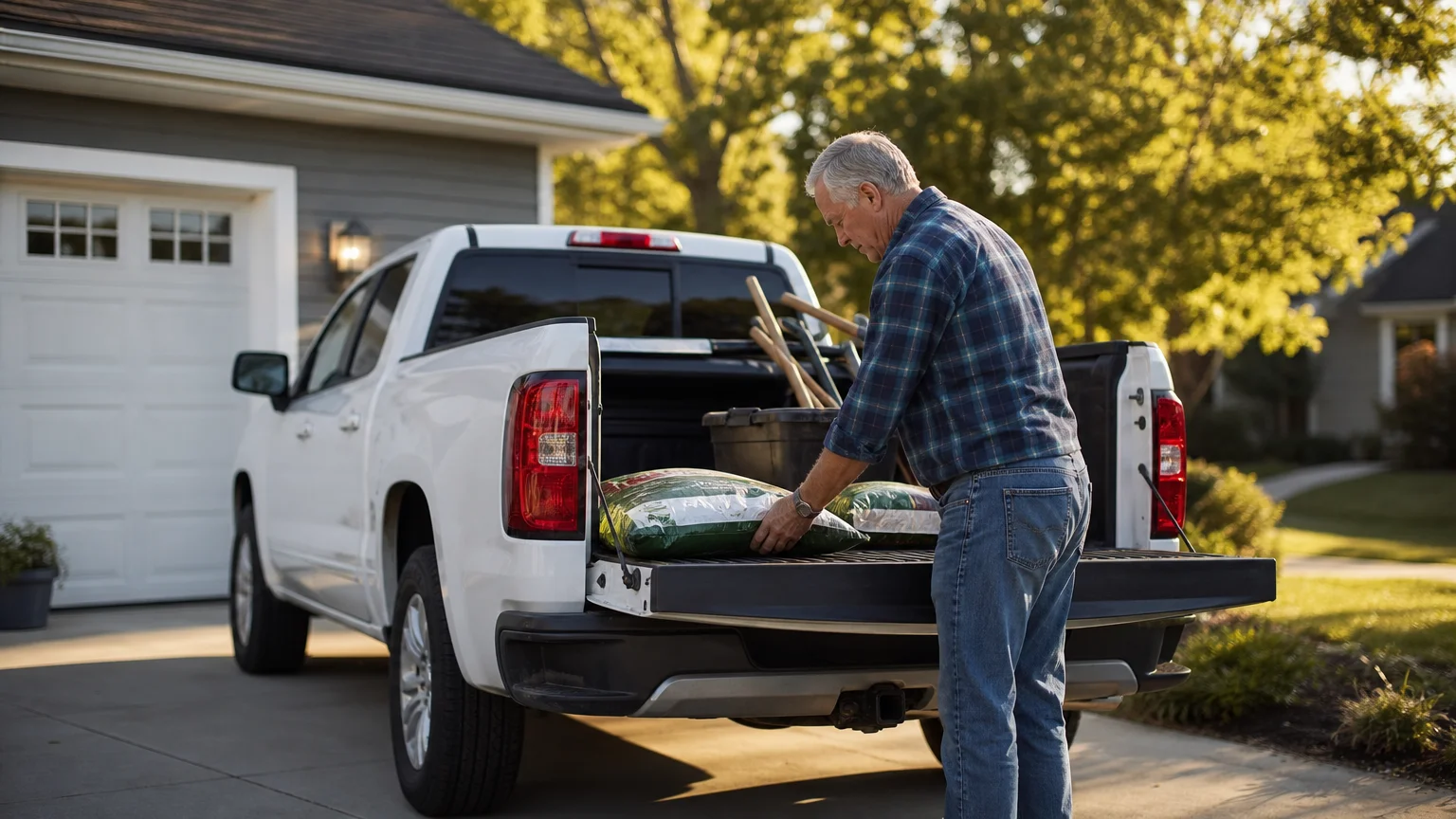
GSA Auctions: Your Source for Federal Surplus
The General Services Administration (GSA) acts as the federal government’s procurement and disposal arm. When federal agencies—such as the Department of Agriculture, the FBI, or the National Park Service—no longer need a piece of equipment, it usually ends up on GSA Auctions.
For seniors looking to purchase a reliable, gently used vehicle, this site is a goldmine. Federal fleet vehicles are typically retired after a set number of years or miles, regardless of their working condition. Because government vehicles adhere to strict preventative maintenance schedules, you can often secure a well-maintained sedan, pickup truck, or SUV for far less than blue-book value.
Beyond vehicles, GSA Auctions features high-end office furniture, laptop computers, and scientific equipment. The bidding process is straightforward. You register for a free account online, search by category or geographic location, and place your bids. However, keep in mind that GSA rarely offers shipping. If you win a pallet of computer monitors in another state, you are entirely responsible for arranging the freight or picking it up yourself.

GovDeals: Tapping Into Local and State Liquidations
While GSA handles federal property, you might prefer to shop closer to home. GovDeals is an online marketplace that partners with thousands of state, county, and municipal governments, as well as school boards and public utility companies, to sell their surplus directly to the public.
Because GovDeals sources inventory locally, it is significantly easier to find items you can inspect in person and haul away in your own vehicle. Retirees frequently use GovDeals to purchase commercial-grade landscaping equipment, heavy-duty tools for home workshops, or even surplus kitchen supplies from public schools. If your hobby involves woodworking, mechanics, or gardening, municipal surplus can provide professional-grade equipment for a fraction of retail prices.
You can search GovDeals using your ZIP code to find auctions ending near you. Always read the seller’s terms and conditions carefully; some municipalities charge a “buyer’s premium” (an additional percentage tacked onto the final sale price), while others require payment via wire transfer rather than a credit card.

HUD Home Store: Finding Affordable Real Estate
Housing represents the single largest expense for most retirees. If you are looking to downsize, relocate, or purchase a rental property to supplement your Social Security income, the HUD Home Store offers unique opportunities.
When a homeowner defaults on a mortgage insured by the Federal Housing Administration (FHA), the Department of Housing and Urban Development (HUD) takes possession of the property and lists it for sale. These homes are appraised and sold “as-is.” HUD categorizes bidders, giving priority to owner-occupants—people who actually plan to live in the home—before opening the bidding to real estate investors.
If you plan to use a HUD home as your primary residence, you gain a distinct competitive advantage over cash-rich investors during the initial exclusive bidding period. You will need to work with a HUD-registered real estate broker to place your bid. While these homes often require cosmetic updates or repairs, securing a property below market value is a powerful way to preserve your retirement nest egg.

U.S. Treasury Auctions: Bidding on Seized Assets
The U.S. Department of the Treasury regularly seizes property from individuals who evade taxes or violate federal laws. To recoup lost revenues, the Treasury holds public auctions to liquidate these assets, depositing the proceeds into the Treasury Forfeiture Fund.
Through U.S. Treasury Auctions, the public gains access to an eclectic array of high-value items. You will frequently find luxury vehicles, commercial real estate, single-family homes, fine jewelry, and collectible coins. The Treasury typically hires private auction companies (like CWS Marketing Group) to facilitate these sales, which occur both online and in person.
For a retiree with an eye for value, buying a seized asset can yield incredible savings. Because the government’s primary goal is to liquidate the asset quickly rather than hold out for top market value, opening bids are often remarkably low. Just remember that seized homes cannot be toured extensively before purchase; you must rely on open house dates and provided inspection reports.

U.S. Marshals Service Auctions: High-Value Forfeited Goods
Operating under the Department of Justice, the U.S. Marshals Service manages and disposes of properties seized during federal criminal investigations. The inventory overlaps somewhat with Treasury auctions but often features unique luxury goods, aircraft, boats, and diverse real estate portfolios.
The Marshals Service employs best practices from private industry to efficiently turn seized assets into cash to compensate victims of crime and fund law enforcement operations. They frequently partner with commercial auction houses to run their online bidding platforms. For retirees interested in recreational vehicles, boats, or vacation properties, monitoring the U.S. Marshals’ contracted auctioneers can uncover spectacular deals.
“Price is what you pay. Value is what you get.” — Warren Buffett, Investor and Philanthropist
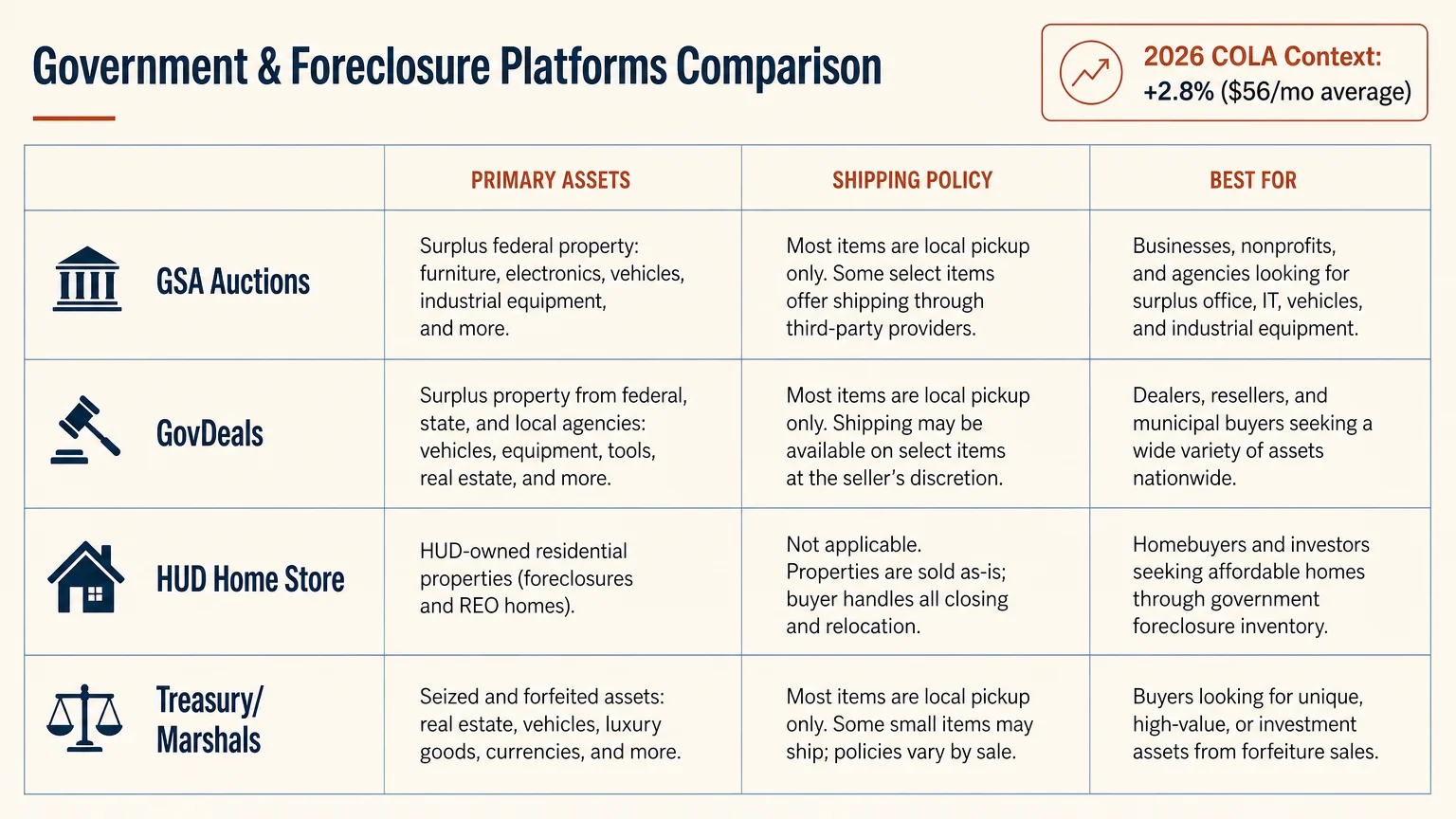
Comparing the Top Government Auction Platforms
To help you navigate your options, here is a breakdown of what makes each platform unique, so you can target your bids effectively.
| Auction Platform | Best Used For | Key Advantage | Logistics & Pickup |
|---|---|---|---|
| GSA Auctions | Federal vehicles, tech, office gear | Strict maintenance records on fleet vehicles | Buyer arranges all freight/pickup; no government shipping |
| GovDeals | Local/state surplus, school equipment | Proximity; easy to find items in your own ZIP code | Local pickup is standard; easy to inspect items in person |
| HUD Home Store | Foreclosed FHA residential properties | Owner-occupants get priority bidding over investors | Requires a HUD-registered real estate broker to bid |
| Treasury Auctions | Seized luxury goods, jewelry, real estate | High-end items sold to recover federal tax debts | Often managed by third-party auction houses |
| U.S. Marshals | Boats, aircraft, forfeited commercial assets | Proceeds support crime victims; unique inventory | Strict bidding terms; clear title conveyed via Government Deed |
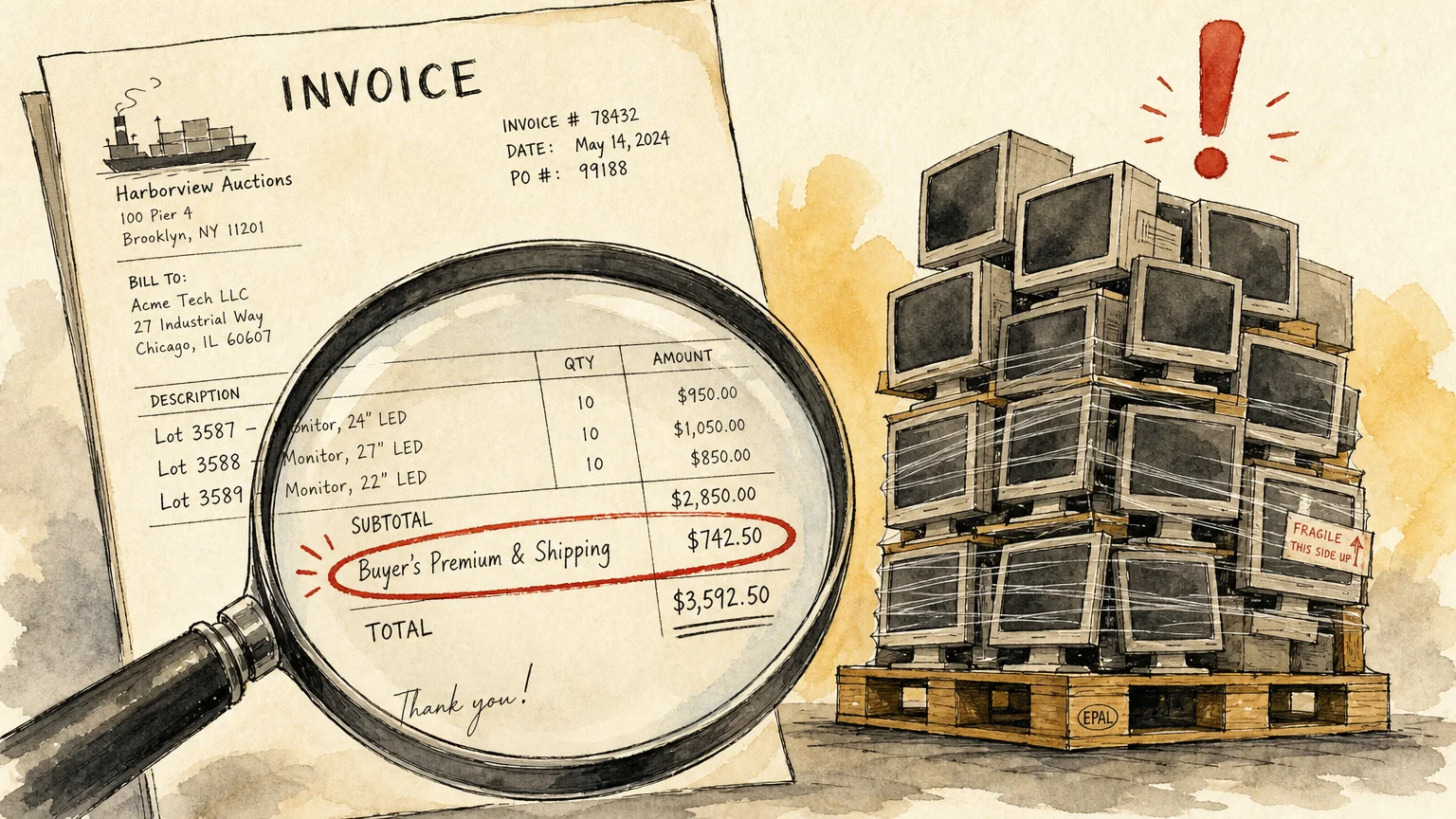
Costly Errors to Sidestep
While the discounts are real, government auctions require a sharp eye. Inexperienced buyers can easily turn a bargain into a financial burden if they ignore the fine print.
- Skipping the inspection phase: Almost all government property is sold “as-is, where-is.” There are no warranties, no guarantees, and absolutely no refunds. If an auction listing states a vehicle “ran when parked,” that does not mean it runs today. Always take advantage of the specified inspection dates to view the item in person before placing a bid.
- Ignoring the tax implications of flipping: Many retirees buy surplus goods or real estate intending to resell them for a profit. Be highly aware of how this impacts your taxes. According to the IRS, the 2026 standard deduction is $16,100 for single filers and $32,200 for married couples filing jointly (with additional amounts for those 65 and older). Piling short-term capital gains or business income on top of your Social Security and pension distributions can push you into a higher tax bracket and even cause more of your Social Security benefits to become taxable.
- Miscalculating freight and removal costs: Government agencies are not retail warehouses; they will not pack, box, or ship your winnings. If you buy a 500-pound commercial generator two states away, you must hire a freight company to palletize and ship it. Often, the cost of transportation vastly exceeds the winning bid amount.
- Succumbing to auction fever: The adrenaline of a bidding war can cloud your judgment. Determine the maximum amount you are willing to spend—factoring in buyer’s premiums, taxes, and transportation—and refuse to bid a single dollar over that limit.
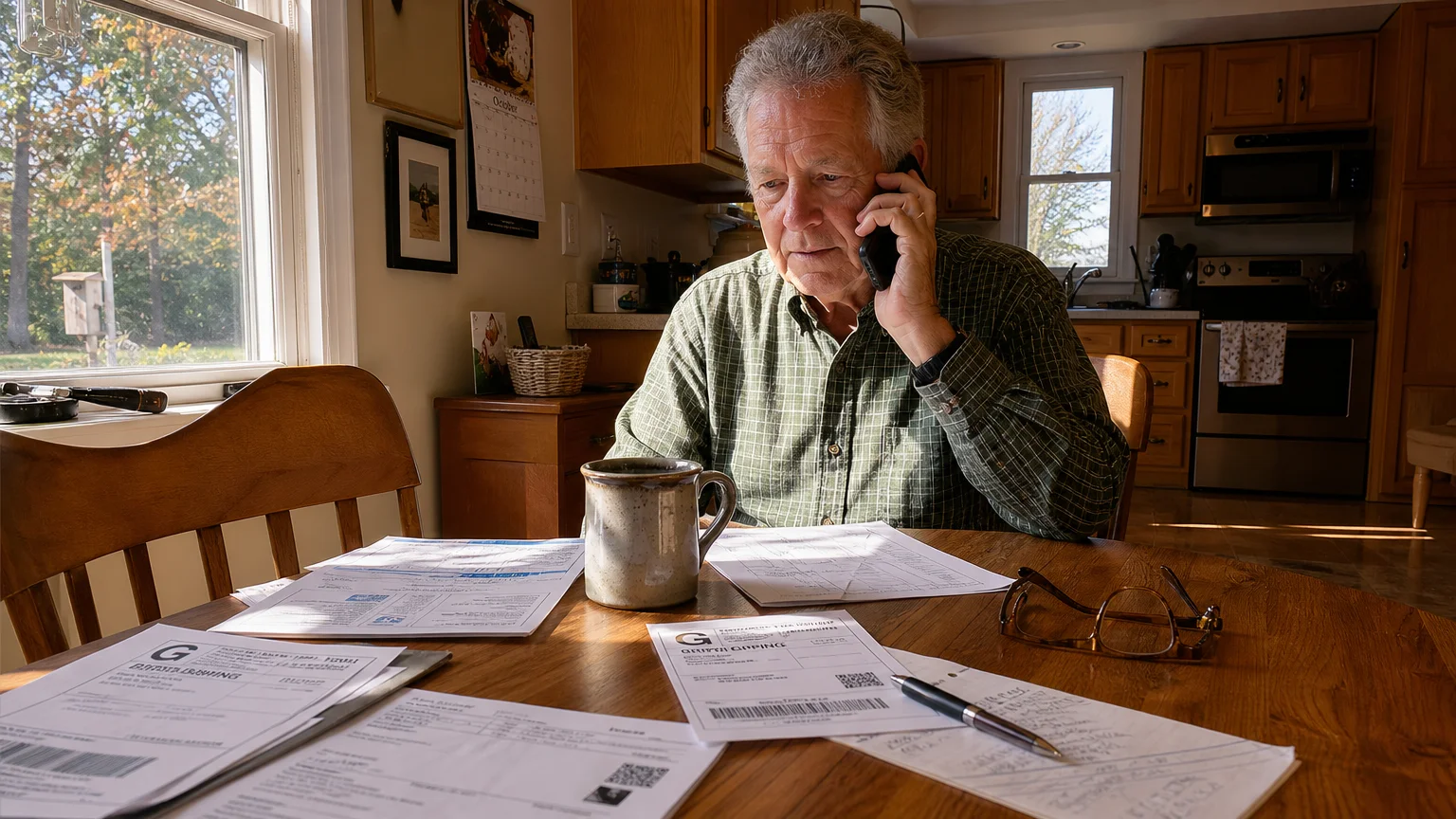
When DIY Isn’t Enough
While purchasing a surplus laptop or a set of hand tools is a straightforward do-it-yourself endeavor, certain asset classes require professional intervention to protect your retirement savings.
- Buying seized real estate: Seized homes sold by the Treasury or Marshals Service generally convey with a clear title via a Government Deed, but resolving latent property line disputes or local zoning violations falls entirely on you. You need a trusted real estate attorney to verify public records before you bid.
- Bidding on HUD Homes: You cannot place a bid on a HUD home independently; you are legally required to use a HUD-registered broker. Rely on their expertise to structure your offer correctly and handle the closing paperwork.
- Purchasing heavy machinery: If you buy a front-end loader or an retired school bus, you must comply with Department of Transportation (DOT) regulations to move it. Hiring a specialized heavy-haul logistics broker ensures the equipment is transported legally and safely to your property.
“The key to a secure retirement is finding ways to make your money work as hard as you did.” — Jean Chatzky, Financial Expert
Frequently Asked Questions
Do I have to be a business owner to bid on government auctions?
No. The vast majority of government auction sites, including GSA Auctions and GovDeals, are fully open to the general public. You simply need to register for an account, provide valid identification, and adhere to the payment terms.
Are vehicles sold at government auctions safe to drive?
Condition varies wildly. Federal fleet vehicles sold through GSA often have excellent, documented maintenance histories and are safe to drive off the lot. Conversely, vehicles seized from criminals by the U.S. Marshals or Treasury may have hidden damage. Always inspect the vehicle or hire a mobile mechanic to evaluate it during the preview period.
How long do I have to pick up an item after winning?
Government agencies operate on strict timelines. You usually have between five and ten business days to pay for your item and remove it from the premises. If you fail to pick it up, you will forfeit your payment, lose the item, and potentially be banned from future auctions.
Can I use a credit card to pay for government auction items?
It depends on the platform and the purchase amount. GSA Auctions typically accepts credit cards for smaller purchases (usually under $25,000). However, large purchases, real estate, and municipal auctions often require a wire transfer, certified check, or money order.
Making Your First Bid Count
Leveraging government auctions is a brilliant strategy for retirees who want to maximize their purchasing power. By doing your homework, inspecting items carefully, and understanding the logistics of removal, you can easily acquire high-value assets for a fraction of their retail cost. Start small—perhaps by bidding on locally sourced municipal surplus on GovDeals—to familiarize yourself with the pace and rules of public auctions.
As you gain confidence, you can explore larger investments, such as upgrading your daily driver through GSA Auctions or securing a real estate deal via the HUD Home Store. Protecting your cash flow is crucial in retirement, and buying surplus is an incredibly effective way to keep your hard-earned money right where it belongs. This is educational content based on general financial principles for seniors. Individual results vary based on your situation. Always verify current benefit amounts, tax rules, and program eligibility with official government sources like SSA.gov or IRS.gov before making major financial decisions.
Last updated: June 2026. Benefit amounts, tax rules, and program details change annually—verify current figures with official government sources.