
Understanding Safe Harbor Rules to Avoid Penalties
You can protect yourself from an IRS tax penalty notice by taking advantage of federal “safe harbor” rules. If your tax payments meet any of these legal benchmarks, the IRS cannot penalize you for underpayment—even if you end up owing tax when you file your return.
To qualify for safe harbor protection, your total tax paid through withholding and estimated payments must meet one of the following criteria:
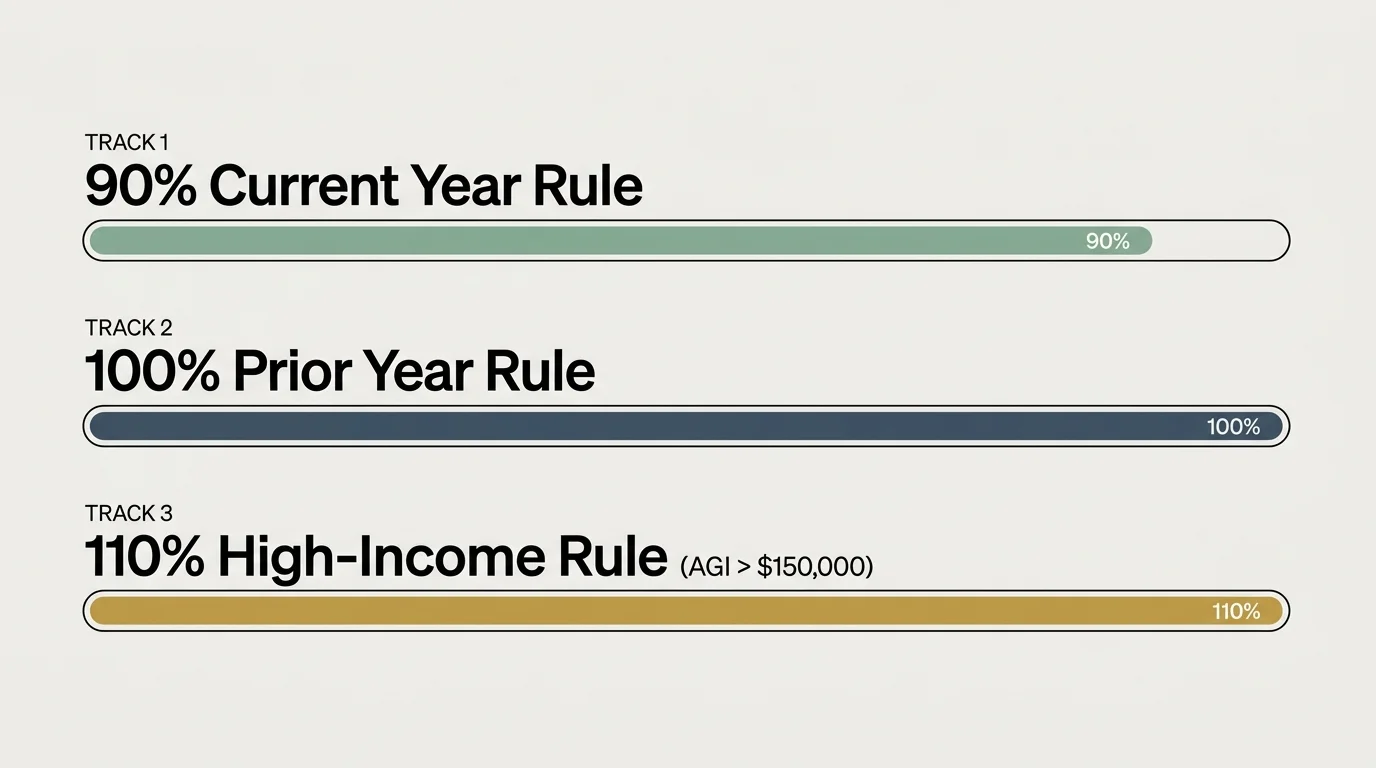
- The 90% Current Year Rule: You pay at least 90% of the total tax liability shown on your tax return for the current tax year.
- The 100% Prior Year Rule: You pay 100% of the total tax liability shown on your tax return from the previous tax year.
- The 110% High-Income Rule: If your Adjusted Gross Income (AGI) on the prior year’s return exceeded $150,000 (or $75,000 if married filing separately), you must pay 110% of your prior year’s tax liability to meet the safe harbor.
The prior-year safe harbor rule offers immense peace of mind for seniors because it relies on a known number. You simply check line 24 on your previous year’s Form 1040, divide that total liability across four equal payments or set your withholding to match it, and you completely eliminate underpayment penalties.
| Safe Harbor Option | Who It Applies To | Requirement to Avoid Penalty |
|---|---|---|
| Standard Current Year Rule | All Taxpayers | Pay at least 90% of your current tax year’s total liability. |
| Standard Prior Year Rule | Taxpayers with AGI of $150,000 or less | Pay 100% of the tax shown on your previous year’s return. |
| High-Income Prior Year Rule | Taxpayers with AGI over $150,000 ($75,000 MFS) | Pay 110% of the tax shown on your previous year’s return. |








question. I will take my first RMD ON 12 /20/2026. THE AMOUNT OF $140,000. THE ESTIMATED TAX DUE ON 1/15/27 WILL BE $30,000 ON THAT WITHDRAWAL. FEDERAL WILL I GET HIT WITH A LATE FEE THE MONEY IS TAKEN THE LAST PART OF DECEMBER.
Who do you think is the Right Person for Washington, D.C. Mayor 2026? It is a person who can evolve intellectually, socially, politically, communicatively, Judicially, Legally, & in Educating as Science and Technology. It seems unfortunately Democrats & Republicans Lawmakers both “live in the past”. This is why the Judicial & Legal Systems Cite outdated Cases in Civil, Criminal, & Bankruptcy Court. My Leadership will evoke contemporary thinking in all areas. We need adequate Teachers, Politicians, Principals, Interventionists, Judges, Prosecutors, Clergy, Journalists, & Enforcers. I will have to learn more about IRS Taxes, Property Taxes, & Zoning Laws. I think we need a Constitution and Amendments to further define human rights. Please review this information and pass it on to as many others as possible, since November 3, 26 is right around the corner.