
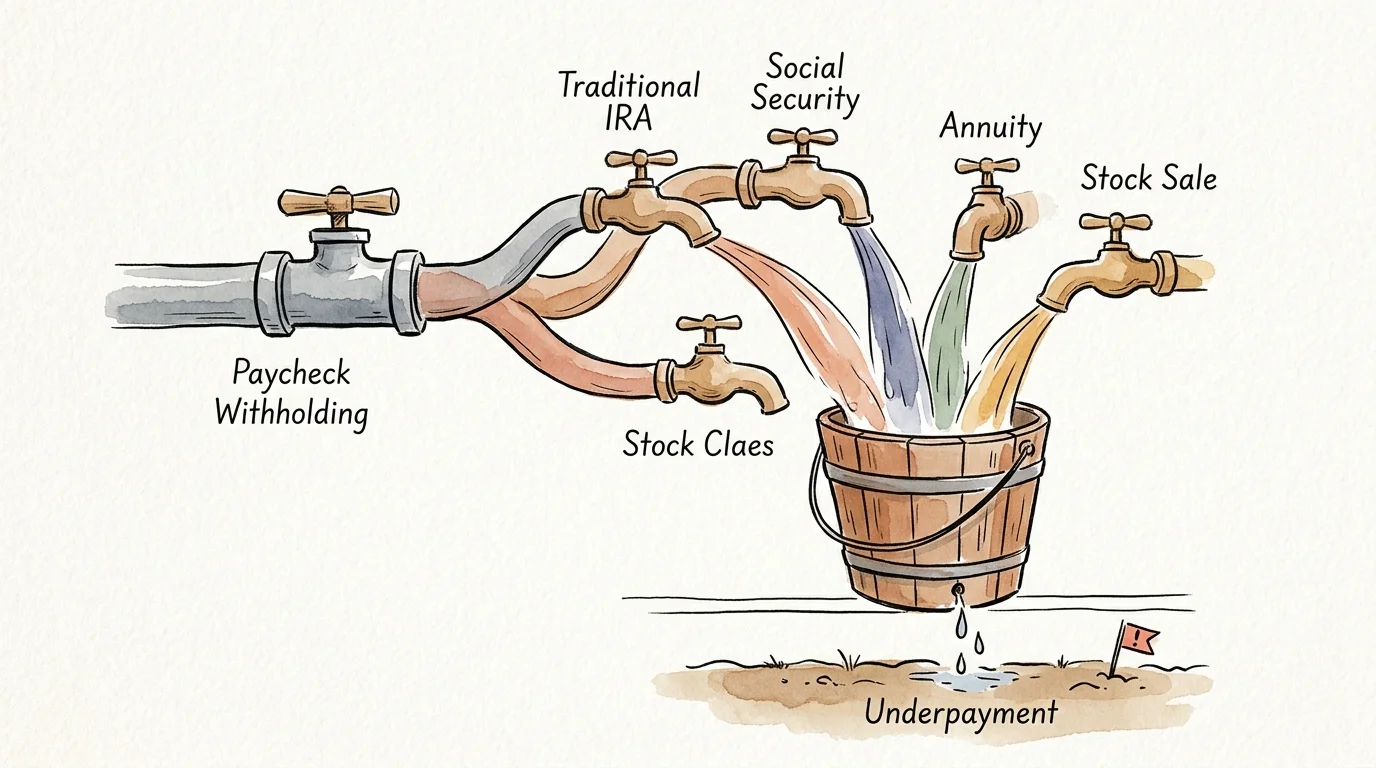
What Triggers an IRS Underpayment Penalty?
The United States operates on a “pay-as-you-go” tax system. The Internal Revenue Service expects you to pay federal income taxes as you earn or receive income throughout the tax year, rather than settling your entire bill in one lump sum on tax day.
During your working years, your employer automatically calculated and withheld income tax from every paycheck. Once you transition into retirement, that automatic safety net disappears. You suddenly receive income from diverse sources, including traditional IRAs, 401(k) plans, annuities, taxable brokerage accounts, and Social Security benefits. If these sources do not withhold enough income tax, or if you skip quarterly estimated tax payments, you might trigger an IRS underpayment penalty.
According to federal tax guidelines from the Internal Revenue Service, the government generally assesses an underpayment penalty if you owe $1,000 or more in balance due after subtracting your withholding and refundable credits. Specific triggers for retirees include:
- Starting Required Minimum Distributions (RMDs): Mandatory withdrawals from traditional IRAs or 401(k)s boost your taxable income, often placing you into a higher tax bracket without adequate tax withholding.
- Lump-Sum Investment Gains: Selling stock, real estate, or mutual fund shares creates capital gains that require timely estimated tax payments.
- Taxable Social Security Benefits: Up to 85% of your Social Security benefits become taxable if your combined income exceeds federal thresholds, yet the Social Security Administration does not withhold tax automatically.
- Stopping Paycheck Withholding: Leaving full-time employment eliminates regular paycheck withholding, requiring you to make manual quarterly estimated tax payments.






question. I will take my first RMD ON 12 /20/2026. THE AMOUNT OF $140,000. THE ESTIMATED TAX DUE ON 1/15/27 WILL BE $30,000 ON THAT WITHDRAWAL. FEDERAL WILL I GET HIT WITH A LATE FEE THE MONEY IS TAKEN THE LAST PART OF DECEMBER.
Who do you think is the Right Person for Washington, D.C. Mayor 2026? It is a person who can evolve intellectually, socially, politically, communicatively, Judicially, Legally, & in Educating as Science and Technology. It seems unfortunately Democrats & Republicans Lawmakers both “live in the past”. This is why the Judicial & Legal Systems Cite outdated Cases in Civil, Criminal, & Bankruptcy Court. My Leadership will evoke contemporary thinking in all areas. We need adequate Teachers, Politicians, Principals, Interventionists, Judges, Prosecutors, Clergy, Journalists, & Enforcers. I will have to learn more about IRS Taxes, Property Taxes, & Zoning Laws. I think we need a Constitution and Amendments to further define human rights. Please review this information and pass it on to as many others as possible, since November 3, 26 is right around the corner.