
Frequently Asked Questions
What is the minimum amount owed that triggers an IRS underpayment penalty?
The IRS generally assesses an underpayment penalty if you owe $1,000 or more in federal income tax after subtracting your tax withholdings and refundable credits, unless you meet one of the safe harbor thresholds.
Can the IRS underpayment penalty be waived for retirees?
Yes. Under federal tax law, the IRS can waive the underpayment penalty if you retired after reaching age 62 (or became disabled) during the current or preceding tax year, provided your underpayment was due to reasonable cause and not willful neglect.
How do I ask the IRS to waive an underpayment penalty?
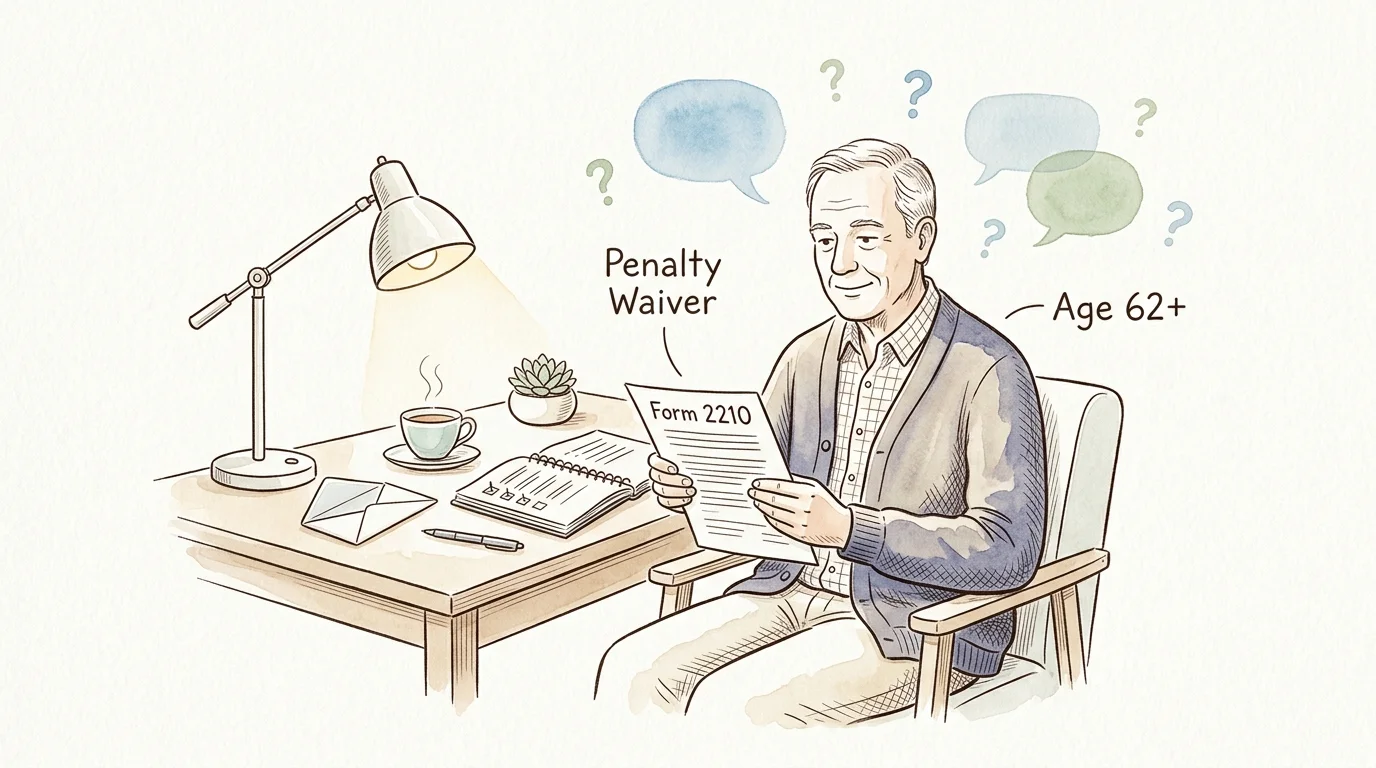
You request a penalty waiver by filing IRS Form 2210 (Underpayment of Estimated Tax by Individuals, Estates, and Trusts). You must check the waiver request box in Part I and attach a written statement explaining your age, retirement date, and reasonable cause for the underpayment.
Does tax withholding from IRA withdrawals count toward quarterly payments?
Yes! Federal tax withheld from IRA distributions or RMDs is treated as if it were paid equally across all four tax quarters, regardless of when during the calendar year the withholding occurred.
Handling an IRS underpayment penalty letter requires prompt action, but it does not need to disrupt your retirement peace of mind. By checking your safe harbor eligibility, submitting Form 2210 for a retiree waiver, and adjusting your ongoing withholding forms, you can resolve current IRS notices and ensure seamless tax compliance for years to come.
The information in this guide is meant for educational purposes. Your specific circumstances—including income, benefits, tax situation, and health needs—may require different approaches. When in doubt, consult a licensed financial advisor or tax professional.
Last updated: February 2026. Benefit amounts, tax rules, and program details change annually—verify current figures with official government sources.









question. I will take my first RMD ON 12 /20/2026. THE AMOUNT OF $140,000. THE ESTIMATED TAX DUE ON 1/15/27 WILL BE $30,000 ON THAT WITHDRAWAL. FEDERAL WILL I GET HIT WITH A LATE FEE THE MONEY IS TAKEN THE LAST PART OF DECEMBER.
Who do you think is the Right Person for Washington, D.C. Mayor 2026? It is a person who can evolve intellectually, socially, politically, communicatively, Judicially, Legally, & in Educating as Science and Technology. It seems unfortunately Democrats & Republicans Lawmakers both “live in the past”. This is why the Judicial & Legal Systems Cite outdated Cases in Civil, Criminal, & Bankruptcy Court. My Leadership will evoke contemporary thinking in all areas. We need adequate Teachers, Politicians, Principals, Interventionists, Judges, Prosecutors, Clergy, Journalists, & Enforcers. I will have to learn more about IRS Taxes, Property Taxes, & Zoning Laws. I think we need a Constitution and Amendments to further define human rights. Please review this information and pass it on to as many others as possible, since November 3, 26 is right around the corner.