

Choosing where to spend your post-military years involves far more than warm weather and memories of past duty stations. Your military pension, healthcare access, and overall cost of living change drastically across state borders.
In some areas, local income taxes quietly consume thousands of dollars from your monthly retirement checks. Other states protect your benefits entirely while keeping housing and daily expenses affordable.
We analyze where veterans should retire based on real tax policies, quality of life, and medical access. Here is your complete guide to the best and worst destinations nationwide.
Evaluating Military Retirement States: The Core Factors
Relocating after military service requires a balanced assessment of your household finances and daily lifestyle. A state with zero income tax might seem ideal until high property tax bills arrive in your mailbox.
You must evaluate how each potential home balances state taxation, living costs, and access to earned veteran benefits. Weighing these factors together prevents expensive surprises after you move.
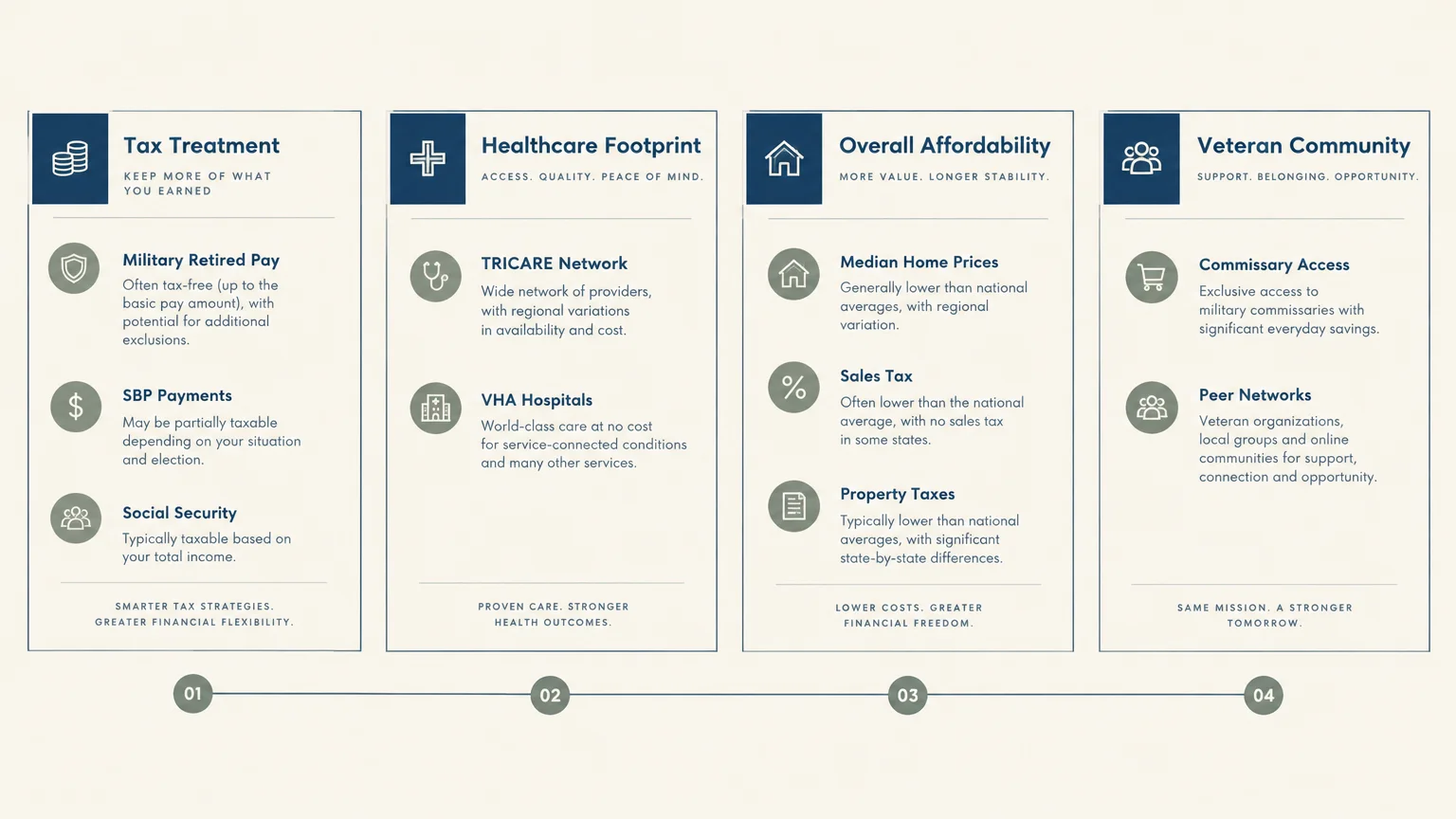
When comparing different military retirement states, focus your evaluation on four fundamental pillars:
- Tax Treatment: How the state taxes military retired pay, Survivor Benefit Plan (SBP) payments, Social Security, and second-career income.
- Healthcare Footprint: Proximity to major military treatment facilities, TRICARE network providers, and Veterans Health Administration hospitals.
- Overall Affordability: Median home prices, sales tax rates, property taxes, and grocery costs relative to your retirement budget.
- Veteran Community: Access to base commissary privileges, military discounts, veteran service organizations, and local peer support networks.
Balancing these elements ensures your military pension maintains its purchasing power throughout your retirement years. Your physical well-being also depends directly on having top-tier medical facilities within a reasonable driving distance.
How Military Retiree Taxes Impact Your Take-Home Pay
State income taxes take an immediate bite out of your disposable retirement income. Settling in a tax-friendly jurisdiction can save you hundreds of dollars every month.
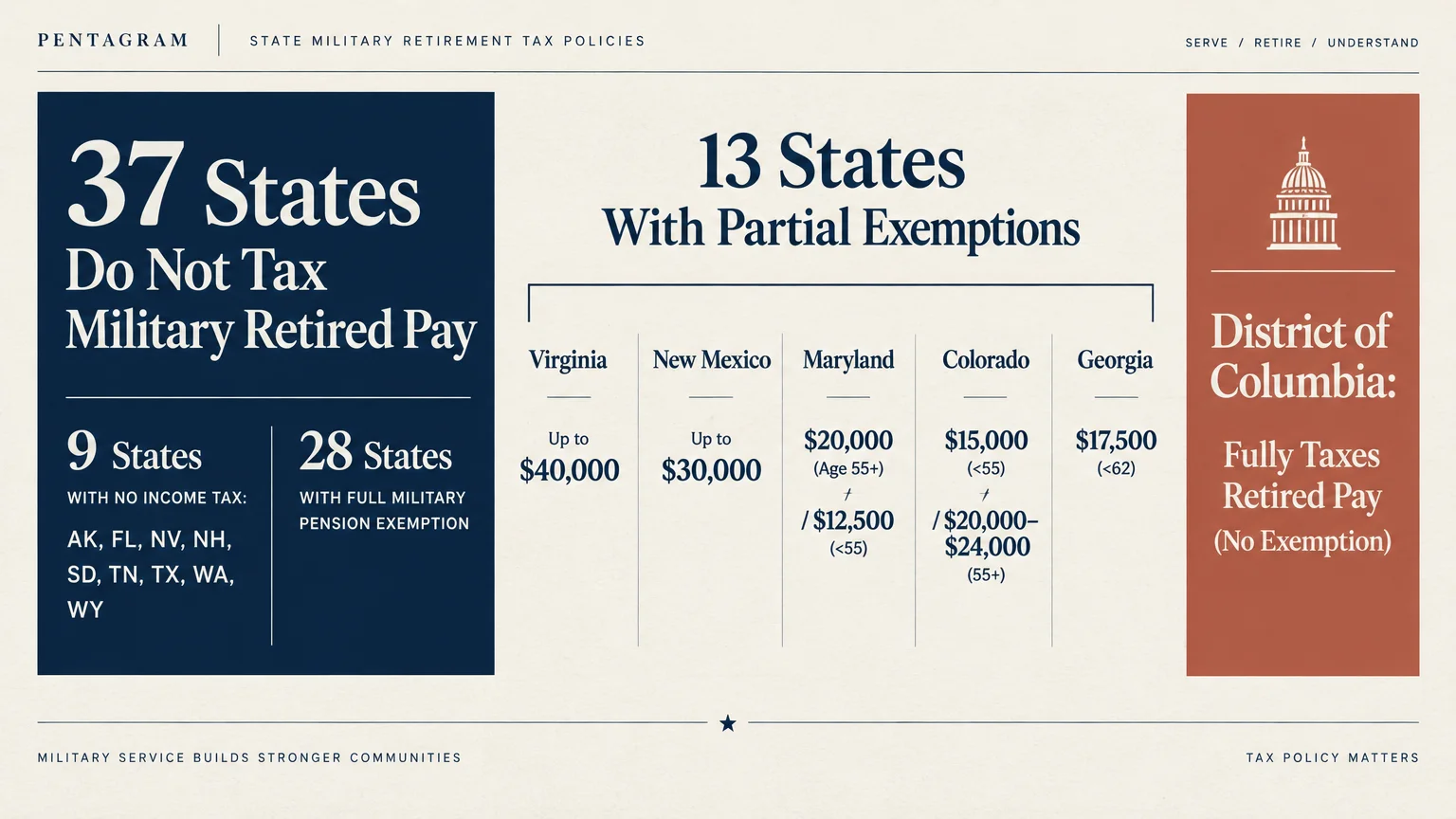
Across the country, nine states levy no broad personal income tax on any income. These states are Alaska, Florida, Nevada, New Hampshire, South Dakota, Tennessee, Texas, Washington, and Wyoming.
In those nine states, your military pension, personal investments, and private retirement accounts remain completely free from state-level income taxation. You only need to plan for federal taxes on your retirement pay.
Beyond the states without an income tax, 28 states that impose income taxes have chosen to fully exempt military retired pay. In total, 37 states do not touch your military pension at all.
Another 13 states offer partial tax exemptions on military retired pay, often depending on your age or income level. These exemptions provide partial relief, but you must monitor specific statutory caps.
For example, Virginia allows a subtraction of up to $40,000 per person on military retirement pay. New Mexico offers an exemption of up to $30,000 for qualifying military retirees.
Maryland exempts up to $20,000 for retirees age 55 and older, but limits the deduction to $12,500 for retirees under 55. Colorado exempts $15,000 for retirees under 55, increasing to between $20,000 and $24,000 once you reach 55.
Georgia exempts up to $17,500 for military retirees under age 62. The state provides an additional $17,500 exemption if you earn at least $17,500 in second-career wages.
Meanwhile, the District of Columbia stands out as the only domestic U.S. jurisdiction that fully taxes military retired pay without any military-specific exemption. Every dollar of your military pension faces local income taxes in the nation’s capital.
You can verify current federal tax rules and withholding requirements directly through the Internal Revenue Service (IRS) before finalizing your relocation budget.
“The most important investment you can make is in yourself and your financial peace of mind.” — Warren Buffett, Chairman and CEO of Berkshire Hathaway

Recent State Tax Law Changes for Military Retirees
Several states have recently overhauled their tax policies to attract and retain military retirees. Understanding these changes helps you avoid outdated advice when choosing where to settle down.
California historically taxed military retired pay in full, driving many veterans away from its high cost-of-living metro areas. However, California enacted a temporary partial exemption running from tax years 2025 through 2029.
Under this temporary rule, military retirees and SBP annuitants in California can exclude up to $20,000 of military retirement pay. To qualify, your federal Adjusted Gross Income (AGI) must stay at or below $125,000 for single filers or $250,000 for joint filers.
If your federal AGI exceeds those thresholds, California taxes your entire military pension at regular state income tax rates. Because California’s income tax rates reach as high as 13.3%, higher-earning military retirees face substantial state tax liabilities.
Vermont also revamped its military pension rules under Act 71, enacted in June 2025. This legislation eliminated the full state taxation of military pensions for most middle-income households.
Military retirement and SBP income are now 100% exempt from Vermont state income tax for filers with a federal AGI of $125,000 or less. A partial exemption phases out between $125,000 and $175,000, disappearing completely above that range.
Retirees in Vermont must note that you cannot double-dip state exclusions. If you receive both Social Security and military retirement, state law forces you to choose only one exclusion.
These shifting rules demonstrate why keeping track of military retiree taxes is critical before committing to an interstate move. A minor change in state law can significantly improve or erode your retirement cash flow.

The 5 Best Places for Military Retirees
Independent research from WalletHub evaluates all 50 states and the District of Columbia across 28 metrics covering economic environment, quality of life, and healthcare access. Several states consistently emerge as premier destinations.
These top-performing military retirement states deliver an appealing combination of full tax exemptions, robust healthcare infrastructure, and veteran-welcoming communities.
1. South Carolina
South Carolina ranks as the number one best state for military retirees for the third consecutive year. It is the only state to place in the top ten across all three study categories: economy, healthcare, and quality of life.
The state completely exempts military retired pay and SBP payments from state income taxes. South Carolina also offers low property tax rates and special property tax exemptions for veterans with service-connected disabilities.
Veterans enjoy access to major military installations, including Joint Base Charleston and Fort Jackson. These bases offer well-stocked commissaries, exchanges, and modern outpatient medical clinics.
2. North Dakota
North Dakota ranks second overall nationwide, offering an exceptionally stable economy and outstanding job opportunities for retirees seeking second careers. The state exempts military retired pay from personal income taxes entirely.
Housing remains far more affordable across North Dakota than the national average. Low crime rates and high civic engagement make it an appealing option if you appreciate distinct seasons and quiet living.
Veterans benefit from access to Minot Air Force Base and Grand Forks Air Force Base. Strong regional healthcare systems collaborate closely with the Veterans Health Administration to serve rural retirees.
3. Wyoming
Wyoming holds the third spot overall, driven by its absence of any personal state income tax. Your military pension, investments, and Social Security payments remain completely untouched by the state.
The state also boasts some of the lowest effective property and sales tax burdens in the country. This fiscal discipline allows your retirement savings to stretch considerably further.
Retirees who love outdoor recreation find world-class fishing, hiking, and hunting across the state. F.E. Warren Air Force Base in Cheyenne provides base support and community infrastructure.
4. Florida
Florida remains one of the most popular places where veterans should retire, ranking seventh overall. The state levies no personal income tax and fully protects military pensions and retirement withdrawals.
The Sunshine State features an extensive military footprint, including major installations like MacDill, Eglin, and Pensacola. This large base presence gives retirees convenient access to TRICARE network specialists and commissary benefits.
Property insurance costs and rapid home value appreciation require careful budgeting in coastal regions. However, strong veteran homestead exemptions help soften the blow for disabled veterans.
5. Maryland
Maryland ranks fifth overall nationwide, standing out for its excellent quality of life and premier healthcare resources. While Maryland does not exempt all pensions, its proximity to elite medical networks offers massive value.
The state exempts up to $20,000 of military pension pay for retirees age 55 and older. It is also home to Walter Reed National Military Medical Center and the Fort Meade medical complex.
For retirees prioritizing advanced medical care and robust federal employment options, Maryland presents a compelling location. The higher cost of living is offset by exceptional public services and cultural amenities.

The Worst States for Military Retirees
Some states create substantial financial friction for military retirees through burdensome taxes, steep living costs, or limited healthcare access. Understanding these drawbacks helps you avoid costly relocation missteps.
1. Oregon
Oregon ranks dead last among all 50 states for the fourth straight year. The state combines a high cost of living with limited military base infrastructure.
While Oregon does not tax military retired pay earned from service prior to October 1991, newer retirees face regular state income taxes. Oregon’s progressive income tax brackets climb rapidly to 9.9%.
Housing affordability in Oregon remains significantly strained across major metropolitan regions. Retirees also face fewer military installations, meaning longer travel times to access military exchanges and base medical centers.
2. Vermont
Vermont ranks 50th overall, weighed down by ranking last nationwide in economic environment. High general living expenses, elevated property taxes, and harsh winters create significant financial pressure on fixed pensions.
Although Vermont recently passed Act 71 to exempt military pensions for filers earning under $125,000, high everyday costs remain. Heating, transportation, and state sales taxes continue to erode household budgets.
The state also lacks large active-duty military installations. This leaves retirees heavily dependent on regional civilian healthcare networks rather than on-base services.
3. District of Columbia
The District of Columbia ranks 49th overall and represents the least tax-friendly jurisdiction for military retirees. D.C. fully taxes your military pension as regular income with no special exclusions.
The cost of living in the District ranks among the highest in the entire country. Sky-high housing costs, elevated parking fees, and local sales taxes quickly deplete monthly retirement benefits.
Despite possessing world-class medical facilities nearby, the extreme economic costs outweigh the healthcare advantages. Most military retirees choose to reside in neighboring Virginia or Maryland instead.
4. California
California ranks 35th overall, but ranks dead last nationwide in housing affordability. Even with the new $20,000 temporary pension exemption, high income taxes and real estate prices burden retirees.
State income tax rates top out at 13.3%, which applies to any pension income exceeding the temporary $20,000 limit. Gas taxes, sales taxes, and utility rates in California remain among the nation’s steepest.
Retirees who remain in California generally do so for family ties or mild weather. From a strictly financial standpoint, neighboring Western states preserve far more of your pension.
Comparing Key Military Retirement States
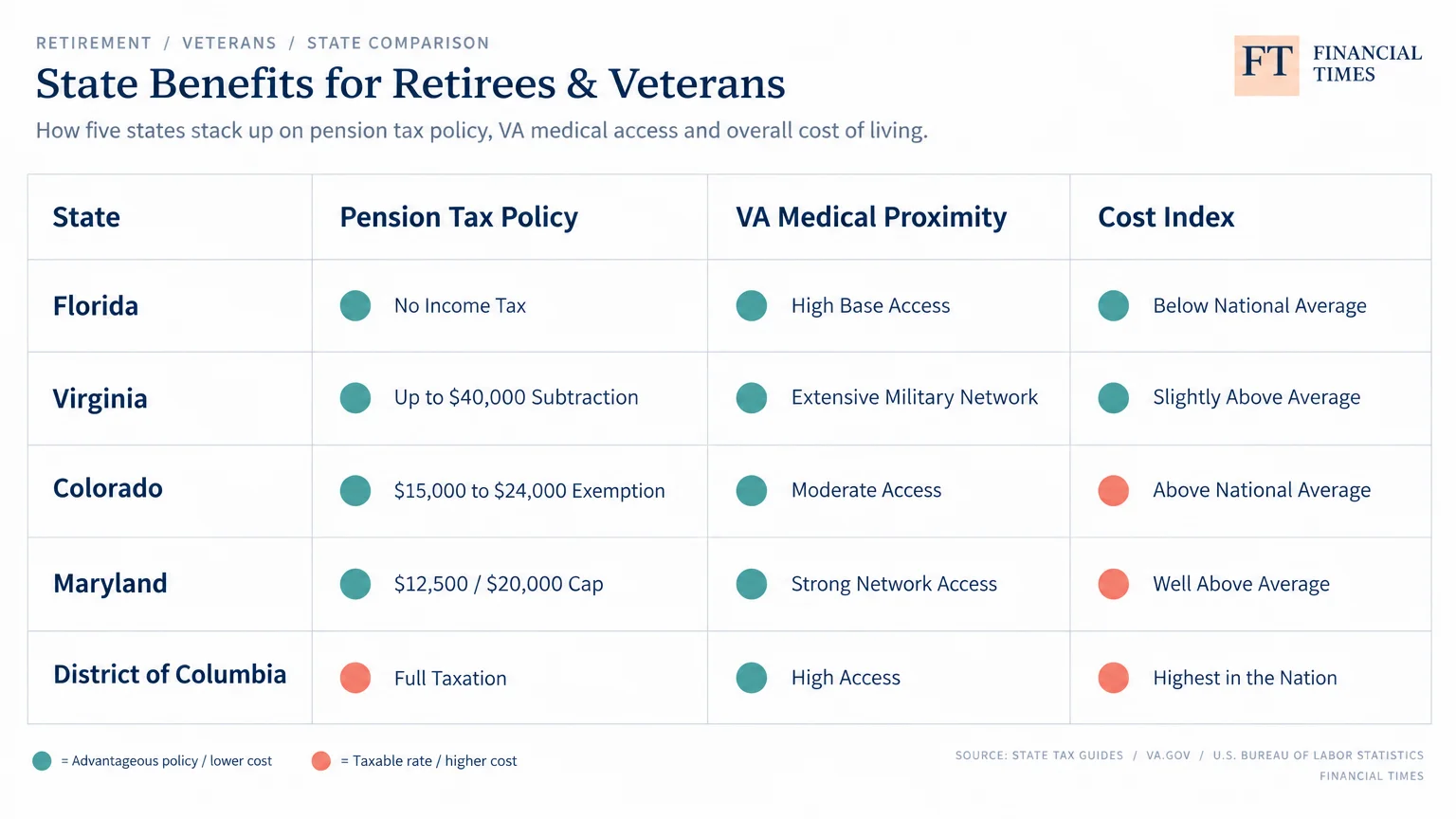
Comparing your prospective relocation options side by side clarifies how tax policies, living costs, and quality metrics interact. This side-by-side analysis highlights the sharp contrasts between regional choices.
The table below summarizes key data for popular retirement destinations, highlighting overall rankings, pension tax status, and primary advantages or disadvantages.
| State | Military Pension Taxation | WalletHub Rank | Primary Advantage / Drawback |
|---|---|---|---|
| South Carolina | 100% Exempt | 1 | Low property taxes and strong base infrastructure. |
| North Dakota | 100% Exempt | 2 | Strong job market and low housing costs; harsh winters. |
| Wyoming | No Income Tax | 3 | Zero state income tax and low sales tax burden. |
| Maryland | Exempt up to $20,000 (age 55+) | 5 | Premier medical centers; higher cost of living. |
| Florida | No Income Tax | 7 | Warm climate and abundant bases; high home insurance. |
| Massachusetts | 100% Exempt | 8 | Ranked #1 in healthcare quality; elevated housing costs. |
| Virginia | Exempt up to $40,000 | 11 | Vast veteran network and bases; high Northern VA costs. |
| Texas | No Income Tax | 20 | Zero income tax and massive VA presence; high property taxes. |
| California | Exempt up to $20,000 (AGI-capped) | 35 | Ranked last in housing affordability; top tax rates hit 13.3%. |
| District of Columbia | Fully Taxed | 49 | Zero pension exemption and exceptionally high living costs. |
| Vermont | Exempt under $125k AGI | 50 | Ranked last in economic environment; high overall expenses. |
| Oregon | Mostly Taxed (post-1991 service) | 51 | Ranked dead last overall; high income tax rates up to 9.9%. |
Notice how high-population states like Texas and Virginia rank in the middle tiers despite their popularity. High property taxes in Texas and high living costs in Virginia temper their overall economic scores.
Look beyond marketing headlines when reviewing state features. A holistic view helps you pinpoint the best places for military retirees that match your financial comfort zone.

Accessing VA Healthcare and Base Privileges
Healthcare access often becomes your top priority as you age. Moving to a rural community with cheap real estate makes little sense if your nearest medical specialist is three hours away.
The Veterans Health Administration operates 1,298 healthcare facilities across the nation. This expansive footprint includes 171 VA Medical Centers and 1,113 outpatient clinics serving roughly 9 million enrolled veterans annually.
Before buying a retirement home, review your local VA network options directly through the U.S. Department of Veterans Affairs (VA). Confirm drive times to both primary care clinics and full-service VA hospitals.
Military retirees also utilize TRICARE Prime or TRICARE Select coverage alongside VA benefits. Living near an active military installation allows you to fill prescriptions at base pharmacies without paying retail copays.
Living within 30 minutes of a major installation provides free commissary shopping, gym access, and discounted equipment rentals through Morale, Welfare, and Recreation (MWR) programs. Over a decade of retirement, those grocery and lifestyle discounts add up to thousands in savings.
Your service-connected disability compensation also plays a critical role in your retirement security. VA disability benefits are 100% exempt from both federal and state income taxes nationwide.
For 2026, the Cost-of-Living Adjustment (COLA) for military retirement pay and VA disability compensation is 2.8%. Under 2026 rates, a veteran with a 100% disability rating and no dependents receives $3,938.57 per month, or $4,158.16 with a spouse.
On October 14, 2026, the Social Security Administration (SSA) announced a 2027 COLA increase of 3.6%. This 3.6% boost applies directly to military retirement pensions and VA disability checks starting in December 2026.
“A big part of financial freedom is having your heart and mind free from what-ifs of life.” — Suze Orman, Personal Finance Author and Host

Pitfalls to Watch For
Relocating during retirement involves irreversible moving costs. Avoiding common financial traps ensures your hard-earned benefits remain secure.
Pay close attention to these four common pitfalls before choosing your new hometown:
- The No-Income-Tax Mirage: States without personal income taxes must fund public services through other revenue streams. Texas and New Hampshire, for example, charge some of the nation’s highest local property tax rates.
- Strict Exemption Caps: States like Colorado, Maryland, and Virginia offer partial pension subtractions rather than complete exemptions. Earning additional income from a second career can push your pension into taxable brackets.
- Sparse TRICARE Networks: Relocating to a remote scenic town may leave you without local in-network TRICARE physicians. Always verify that local community doctors accept TRICARE Select before moving.
- Overlooking SBP State Taxes: Some states exempt military retired pay but fully tax Survivor Benefit Plan payments received by surviving spouses. Review your state’s survivor tax laws to protect your spouse’s future income.
Taking time to model your full tax return under a new state’s rules prevents nasty surprises. A quick consultation with a local tax accountant can clarify how specific exemptions apply to your household.

Getting Expert Help
Navigating the interaction between federal pensions, disability compensation, and state tax codes can feel overwhelming. Professional guidance simplifies these decisions.
Consider seeking advice under these common scenarios:
- Filing Complex VA Claims: Work with an accredited Veterans Service Officer (VSO) from organizations like the VFW, DAV, or American Legion. VSOs never charge fees to help you file or increase disability claims.
- Coordinating Dual Retirements: If you or your spouse receive private pensions or federal civil service annuities, meet with a fee-only CERTIFIED FINANCIAL PLANNER™ professional.
- Protecting Your Family Estate: Consult a local elder law attorney licensed in your destination state. They will update your wills, trusts, and healthcare directives to comply with state probate statutes.
You can also research consumer protections and military financial literacy guides through the Consumer Financial Protection Bureau (CFPB). Their educational tools help service members avoid lending traps and retirement scams.
Frequently Asked Questions
Which states do not tax military retirement pay at all?
Nine states have no broad income tax: Alaska, Florida, Nevada, New Hampshire, South Dakota, Tennessee, Texas, Washington, and Wyoming. An additional 28 states with income taxes completely exempt military retired pay.
Does moving to a different state reduce my VA disability compensation?
No, your VA disability compensation is a federal benefit paid directly by the VA. It remains entirely tax-free at both federal and state levels, regardless of where you reside.
Why did California change its military pension tax rules?
California enacted a temporary partial exemption for tax years 2025 through 2029 to keep veteran talent in the state. Retirees earning under set income caps can exempt up to $20,000 in military retirement pay.
Is living close to a military base essential for military retirees?
While not mandatory, living near a military base provides major financial perks. You gain access to tax-free commissary shopping, military exchanges, free base pharmacy services, and discounted recreational facilities.
Strategic Next Steps for Your Retirement
Choosing where veterans should retire requires balancing financial practicalities with personal happiness. Build a detailed budget that accounts for state income taxes, local property taxes, and regional healthcare access.
Visit your shortlisted communities during different seasons before buying a home. Spending a few weeks in your prospective state gives you a genuine preview of daily life, traffic patterns, and community culture.
This is educational content based on general financial principles for seniors. Individual results vary based on your situation. Always verify current benefit amounts, tax rules, and program eligibility with official government sources.
Last updated: October 2026. Benefit amounts, tax rules, and program details change annually—verify current figures with official government sources.









Leave a Reply